From a Golden Ballroom to a Monument of Ego: Trump’s Latest Vision Tests Washington’s Patience
WASHINGTON — It was introduced as a flourish of legacy, a visual exclamation point to a presidency that thrives on spectacle. Instead, President Donald Trump’s latest proposal — a triumphal arch bearing his name, positioned near Arlington Bridge and within sight of the Lincoln Memorial — has ignited a familiar Washington debate: where, exactly, does commemoration end and self-glorification begin?
The announcement came not at a policy briefing or a congressional hearing, but in the East Room, before a carefully selected audience of donors and allies. Aides unveiled glossy renderings, some reportedly produced on 3D printers, depicting a towering arch inspired by Paris’s Arc de Triomphe — only, as Mr. Trump promised, “bigger” and “better.” The president framed the project as a long-overdue addition to the capital’s monumental landscape, a city he claimed had waited centuries for such a structure.
Yet the reaction was swift and unforgiving. Clips of the event circulated online within minutes, drawing a wave of incredulous commentary. Late-night hosts mocked it. Critics derided it as tone-deaf. Even some supporters seemed unsure how to defend a proposal that, when Mr. Trump was asked whom the arch was for, he answered with characteristic bluntness: “Me.”
The timing only sharpened the criticism. As Americans contend with stubborn inflation, rising housing costs and renewed economic anxiety, the optics of a president promoting a self-referential monument struck many as jarring. On social media, the phrase “Arch of Trump” began trending, often paired with comparisons to historical leaders whose monuments were built less out of public consensus than personal ambition.
What made the episode resonate was not merely the proposal itself, but what it suggested about Mr. Trump’s governing instincts. Since returning to office, he has often oscillated between policy pronouncements and symbolic gestures, with the latter frequently dominating the news cycle. The arch, critics argued, fit neatly into that pattern: grand, visually arresting and emotionally charged, yet disconnected from the day-to-day concerns of voters.

Behind the scenes, according to people familiar with the discussions, the idea had been circulating for months. The same architect involved in plans for a lavish White House ballroom — another project that has yet to move beyond the conceptual stage — was tasked with translating Mr. Trump’s vision into something concrete. One adviser, speaking on condition of anonymity, described the process as “less about feasibility and more about feeling,” a way for the president to imagine his place in history.
That focus has unsettled some Republicans. Rick Wilson, a former Republican strategist turned vocal critic of Mr. Trump, dismissed the proposal as a distraction masquerading as legacy. In televised remarks that quickly went viral, Mr. Wilson contrasted the imagined monument with the very real pressures facing working- and middle-class families. “It’s not the arch that people are asking for,” he said. “It’s relief.”
The White House, for its part, has downplayed the controversy, emphasizing that the proposal is exploratory and that no formal approvals have been sought. Officials noted that Washington is already a city of monuments, each reflecting the values and aspirations of its era. Whether a monument to a sitting president would fit that tradition, they said, is a question for historians and planners.
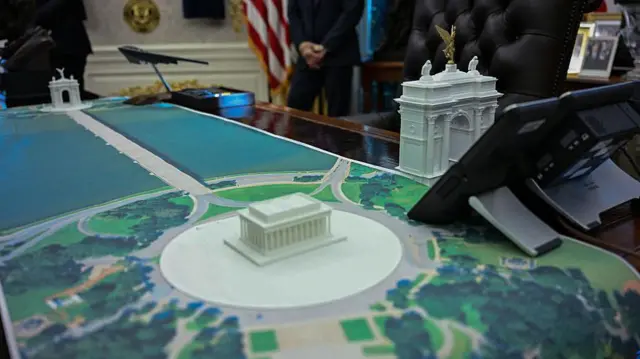
Historians, however, were quick to weigh in. Several noted that most American monuments achieve their resonance over time, shaped by collective memory rather than individual will. “The power of places like the Lincoln Memorial comes from what they came to represent, not from how loudly they were announced,” said one scholar of American civic architecture.
Still, for Mr. Trump, the spectacle may be the point. Allies say the president remains energized by projects that merge politics with branding, echoing the aesthetic of the luxury developments that once defined his public persona. In that sense, the arch is less an anomaly than a continuation — a translation of the Trump brand into marble and steel.
Whether it ever rises from the Potomac’s edge is another matter. Funding, approvals and public resistance pose formidable obstacles. But even as a concept, the proposal has already accomplished something tangible: it has dominated headlines, provoked debate and reinforced the image of a president who governs as much through symbols as through statutes.
For now, the arch exists only in renderings and rhetoric. Yet the conversation it has sparked — about ego, legacy and the boundaries of presidential self-expression — is very real. And as the clips continue to circulate and the commentary grows sharper, one thing is clear: in Washington, monuments may be built of stone, but controversies are built of attention.