Mark Carney’s Explosive Speech Signals a Political Earthquake as Canada’s Opposition Begins to Fracture
Mark Carney has delivered what many insiders are already calling the most decisive speech of his leadership, a high-energy address that instantly reshaped Canada’s political terrain. Opening with humor and confidence, Carney quickly dropped a political bombshell: another Conservative Member of Parliament has officially crossed the floor to join the Liberal Party. This dramatic moment was not symbolic theatre—it was a clear signal that momentum in Ottawa is shifting fast and decisively.
When an opposition begins losing members not to retirement or scandal, but directly to the governing party, it marks a turning point no opinion polls can fully capture. Carney is no longer simply managing government affairs; he is actively dismantling the opposition’s internal cohesion. The announcement triggered celebration in the room and sent an unmistakable message across Parliament Hill: the Conservative Party is losing its grip on unity.
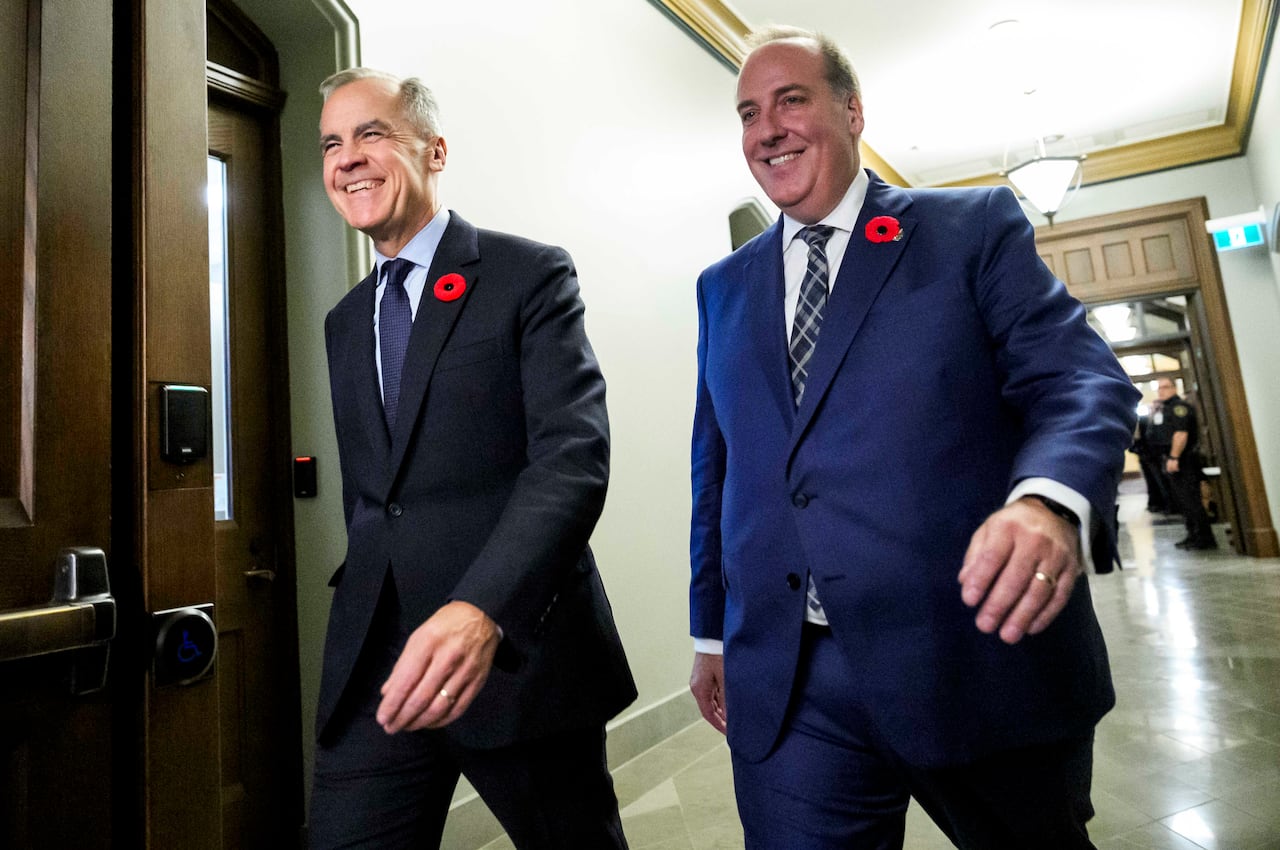
The introduction of the newest Liberal MP, former Conservative Michael Ma of Markham–Unionville, became the emotional and strategic centerpiece of the evening. Ma’s decision to align himself with Carney at a time of rising confidence in the Liberal government highlighted the prime minister’s growing gravitational pull. If Conservative MPs are now defecting publicly, the fractures inside the opposition are deeper than they appear on the surface.
Carney used the moment to frame the Liberal Party not merely as a political organization, but as a national movement—diverse, multi-generational, and powered by grassroots energy. He credited volunteers and organizers for building a coalition strong enough to expand beyond traditional partisan lines, stressing that this was not just an election win, but the creation of a durable governing force.
Shifting from celebration to realism, Carney addressed the geopolitical pressures reshaping Canada’s future. He spoke plainly about the transformation of Canada–U.S. relations, warning that American tariffs now function as deliberate economic pressure aimed at Canadian jobs, industries, and sovereignty. The era of automatic reliance on the United States, he argued, is over.
Carney then elevated the speech by presenting his upcoming budget as a national strategy rather than a routine fiscal plan. He outlined three objectives: protecting Canada from U.S. economic aggression, accelerating domestic growth to historic levels, and achieving a level of economic independence the country has never known. This trillion-dollar strategy, he said, is already producing measurable results.
Beyond economics, the prime minister emphasized inclusive nation-building. He highlighted partnerships with First Nations, Inuit, and Métis communities, support for unionized workers, and a commitment to sustainable, Canadian-led development. He also pointed to swift action on border security, gun trafficking, and fentanyl, alongside tax cuts benefiting more than 22 million Canadians.
In his closing moments, Carney spoke not as an economist or a politician, but as a Canadian deeply invested in the country’s future. He framed the current moment as a historic hinge point, calling for unity, compassion, and ambition. With another Conservative MP crossing the floor and a bold national agenda taking shape, the message was unmistakable: Canada’s political center of gravity is shifting—and this is only the beginning.