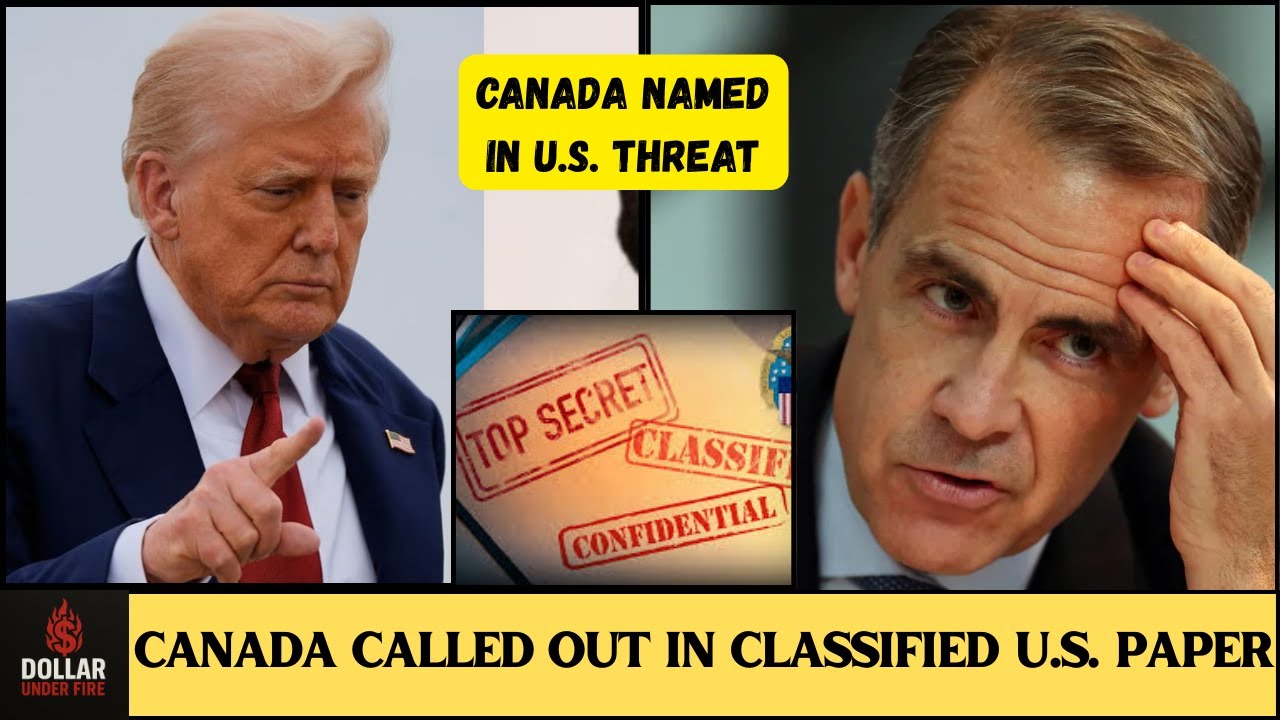
WASHINGTON — A quiet Friday in the capital turned unexpectedly turbulent after the leak of a draft U.S. national security document that, for the first time in recent memory, referenced Canada within a framework typically reserved for countries seen as presenting strategic vulnerabilities to Washington. The phrasing — described by current and former officials as “highly unusual” — sparked immediate debate in both capitals about the health of the bilateral relationship and the evolving expectations of North American coordination in an era of intensifying geopolitical competition.
The passage, which circulated widely online after being posted anonymously on a policy forum, situates Canada not as an adversary but as a “potential alignment risk” in scenarios involving China and other major powers. While the document does not list Canada as a threat in the traditional sense, its placement in a section discussing strategic reliability caught analysts’ attention and prompted a wave of speculation about whether the United States is preparing to exert stronger pressure on Ottawa across trade, technology, and security policy.
In Ottawa, officials responded with a mixture of surprise and pragmatism. According to individuals familiar with internal discussions, senior advisers to Prime Minister Mark Carney had anticipated a shift in Washington’s tone as the United States expands its efforts to consolidate alliances against China’s growing economic and military reach. One official, who requested anonymity because they were not authorized to comment publicly, said the prime minister “has understood for months that Washington’s strategic patience is narrowing” and had already taken steps to prepare for more direct U.S. expectations on defense spending, critical minerals, and Arctic governance.
Still, the inclusion of Canada in language resembling a cautionary designation unsettled many policymakers. The two nations share one of the world’s closest security partnerships, spanning intelligence, trade, cross-border defense, and energy systems. To see Canada mentioned in any context adjacent to national security vulnerabilities struck several observers as a significant symbolic departure.
“This is not how allies usually refer to each other, even behind closed doors,” said a former U.S. national security adviser who reviewed the leaked text. “It suggests a recalibration — not necessarily a rupture, but certainly a moment of reassessment.”
The draft document appears to reflect broader U.S. concerns that Canada has been slower than other allies to align with Washington on restrictions involving Chinese telecommunications firms, export controls on sensitive technologies, and the urgent modernization of the North American Aerospace Defense Command (NORAD). American officials have repeatedly signaled frustration with delays in defense procurement and Arctic infrastructure projects seen as critical to countering Russia’s and China’s growing presence in the region.

In Ottawa, the reaction was more measured. Government sources emphasized that cooperation with the United States remains “foundational” to Canadian security policy and noted that Canada has, in recent months, taken steps to increase defense spending and tighten scrutiny of foreign investment in strategic sectors. Still, the leak prompted immediate internal reviews, with several departments scrambling to determine how far the U.S. concerns extend and whether additional policy shifts may be required to reassure Washington.
Diplomats on both sides acknowledged that the leak comes at a sensitive moment. The United States is pursuing an increasingly aggressive global strategy aimed at consolidating allies into what one official called a “unified framework of reliability” in preparation for prolonged competition with China. Canada, meanwhile, has sought to diversify its economic ties and strengthen relationships in Europe and the Indo-Pacific, moves that are broadly aligned with U.S. objectives but occasionally diverge in tone and emphasis.
Experts say this moment may represent a turning point in how Washington views the obligations of its closest partners. “The U.S. is redefining what it means to be an ally,” said Dr. Elena Forrester, a professor of international strategy at Georgetown University. “It is shifting from cooperation to expectation — from persuasion to pressure. That will have major implications for countries like Canada that have historically balanced autonomy with alignment.”
The leaked passage also raised questions about sovereignty and the degree to which Canada is prepared to resist, accommodate, or negotiate Washington’s rising demands. Already, political commentators in Ottawa have framed the moment as a potential test of Canadian independence, particularly as debates intensify over whether Canada should further restrict Chinese investment, accelerate military modernization, or expand its role in the Indo-Pacific maritime strategy.

By evening, neither government had formally confirmed the authenticity of the leak, though officials in both capitals acknowledged that its language was consistent with ongoing internal discussions about alliance coordination. Whether the wording will appear in the final published strategy remains uncertain.
What is clear, however, is that a single leaked paragraph has opened a new chapter in North American diplomacy, one shaped not by past assumptions of seamless cooperation but by emerging questions about reliability, expectations, and the strategic pressures of a changing global landscape.
For Canada, the moment may prove to be the beginning of its most consequential sovereignty debate in decades — one that will test the balance between partnership and independence at a time when global tensions are rising and the United States is signaling that neutrality in high-stakes competition is no longer an option.