Behind the Music: What a Lip Reader Suggests Trump Told Mark Carney at the FIFA Ceremony
WASHINGTON — What began as a festive, carefully choreographed evening for the FIFA World Cup 2026 draw in Washington quietly evolved into one of the most intriguing diplomatic moments of the year. While global audiences focused on the performances, the lighting, and the spectacle of the event, attention in political circles quickly shifted to two men seated side by side in the front row: President Donald Trump and Mark Carney.

The curiosity surrounding their exchange did not emerge out of nowhere. Earlier that same day, Trump and Carney held a 50-minute closed-door meeting — unusual not only for its length, but for the complete absence of aides, advisers or staff. In diplomatic terms, fifty minutes is not courtesy. It is not symbolic. It is substantive. And in a period marked by rising tension over North American trade, this private conversation immediately raised questions about what kind of recalibration may be underway.
But what came next captured even more interest. When Trump and Carney appeared together publicly at the ceremony, their interactions were recorded but not immediately understood. Only after a professional lip reader analyzed the footage did new details surface about what the president said to Carney during the musical performances.
According to that analysis, Trump leaned toward Carney during the Village People’s performance of “YMCA” and said, “I love this.” Moments later, he added, “Come on, they make me happy.” He then appeared to gesture toward his wife, encouraging her to “join in,” while still directing his remarks toward Carney.
On the surface, these words may seem insignificant — a moment of levity during a public event. But for observers in Washington, they revealed something more telling: a rare instance in which Trump, who typically exerts authority in public spaces, seemed interested in drawing someone else into his personal sphere.
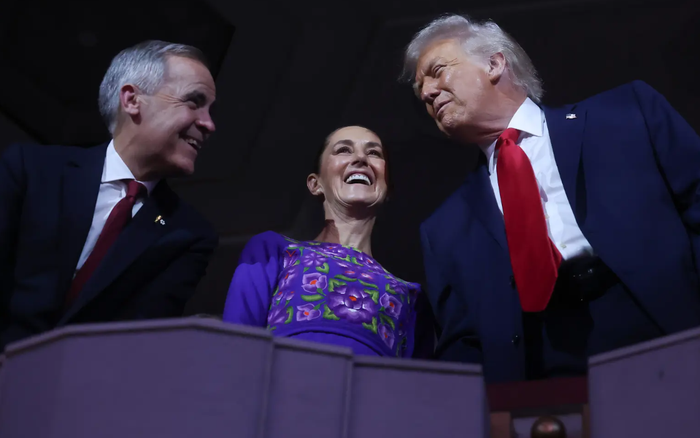
Carney’s response — calm, steady, unflustered — only heightened the contrast. He neither attempted to mirror Trump’s enthusiasm nor withdrew from the interaction. Instead, he maintained the same composed presence he is known for on the global stage. It was this balance — engagement without deference — that caught the attention of seasoned diplomats and analysts who have observed how Trump interacts with other leaders.
For much of the past decade, Trump’s presence at international gatherings has been defined by pressure, unpredictability and strategic use of dominance. Carney, however, represents a different style of leadership: measured, consistent, and quietly authoritative. In this setting, Trump appeared almost eager to bridge the gap, while Carney remained firmly grounded.
The broader political context made the moment even more notable. Recent shifts in North American trade discussions have generated unease across Canadian manufacturing and steel sectors. Reports that the administration is considering a more unilateral approach to regional trade have increased friction between Washington and Ottawa. Against this backdrop, Carney’s ability to project confidence — and Trump’s willingness to direct attention toward him — offered a glimpse into a relationship that is more complex than outward tensions suggest.
Observers also noted how cameras lingered on Carney throughout the night. In a room filled with political figures, celebrities and international delegates, Carney repeatedly drew visual attention. Clips featuring him circulated online within hours, trending across multiple platforms. The public’s fascination reflected a broader dynamic: in uncertain political moments, audiences often gravitate toward figures who appear steady and competent.
Yet perhaps the most significant element of the evening was what remained unknown. The 50-minute private meeting between Trump and Carney was never publicly briefed. No readout was issued. No official comments were made. In the absence of formal information, analysts are left to interpret the public interaction as a window into the private one. The relaxed posture Trump displayed, the visible effort to engage Carney, and the confidence Carney exhibited all suggested a negotiation where neither man attempted to dominate the other.

As foreign leaders and reporters revisit the footage, the moment has become an unexpected focal point — not because of the words spoken, but because of the dynamic they revealed. In an era when diplomacy is often overshadowed by spectacle and performative confrontation, the quiet yet deliberate exchange between Trump and Carney offered a different kind of signal: one rooted in subtlety, posture and the unguarded human moments that can shape geopolitical relationships.
In Washington, the question now is not what song was playing that night, but what conversations began earlier that day — and how the relationship between Trump and Carney may influence the next stage of North American diplomacy.