OTTAWA — A pointed warning from Alberta’s premier over the future of Canadian oil exports has intensified debate in Washington about the stability of North America’s energy relationship and raised questions about whether the United States may be losing long-held leverage in continental energy markets.
Speaking at a press availability in Calgary this week, the premier suggested Alberta could consider redirecting as much as two million barrels per day of crude — a significant share of U.S. refinery intake — if Washington proceeds with new rounds of tariffs and cross-border restrictions. The comments, though not accompanied by formal policy, signaled a shift in tone at a moment when cross-border relations are undergoing rapid change.
Senior U.S. officials privately conceded that the remarks landed harder than expected. Several midwestern refineries remain structurally dependent on Canadian crude, and analysts warn that even the threat of redirection introduces new uncertainty into a market already strained by global supply shifts.
“This was a message delivered with unusual clarity,” said one former U.S. energy diplomat. “The United States has long assumed Canadian supply was fixed and guaranteed. That assumption now appears less certain.”
A Broader Energy Realignment
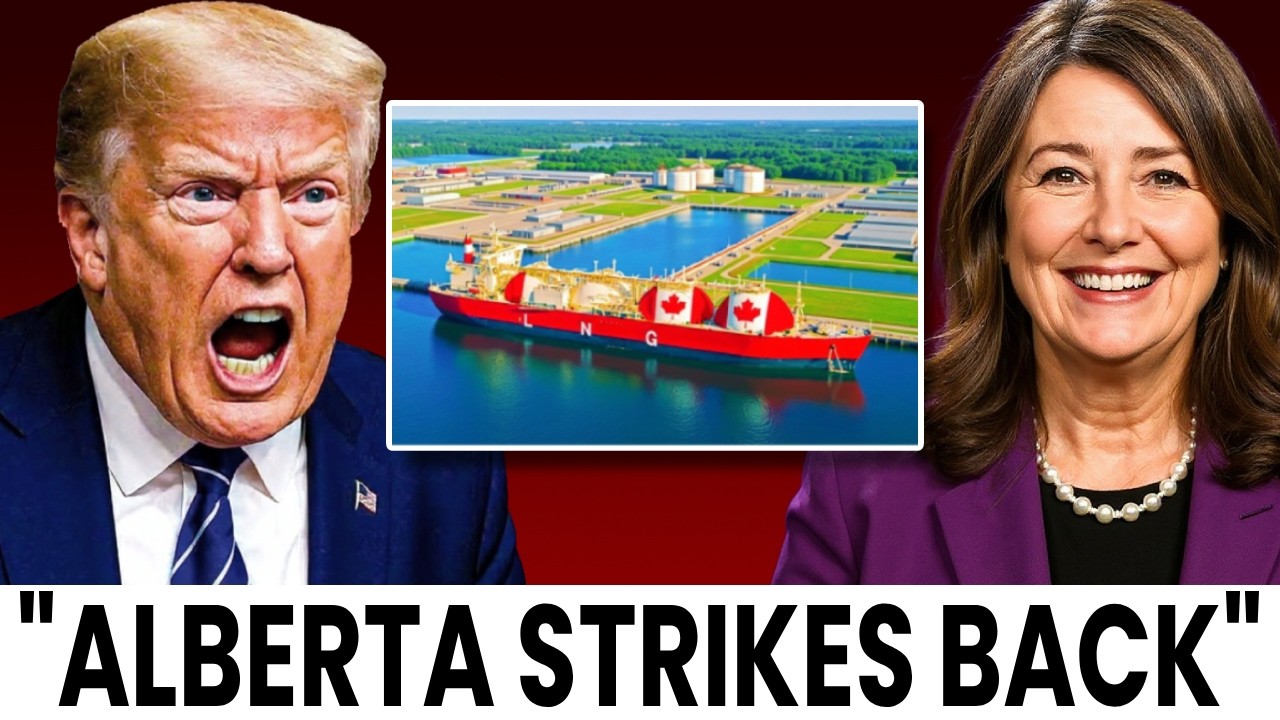
Alberta’s remarks come as Canada accelerates a sweeping transformation of its energy export strategy — one that increasingly looks east and west rather than exclusively south. Most notable is the surge in liquefied natural gas (LNG) development along the Pacific Coast, where major export terminals are advancing after years of regulatory delay and shifting market sentiment.
Once considered unlikely to compete with the United States — now one of the world’s largest LNG exporters — Canada’s LNG sector is gaining momentum as Asian utilities seek long-term contracts insulated from geopolitical frictions in the Middle East and volatility in Russian supply.
Mark Carney, the former Bank of Canada governor and a senior figure in the country’s emerging climate and industrial strategy, recently described LNG development as “a generational opportunity to anchor Canada in the Indo-Pacific economy.” His remarks, together with Alberta’s warning, have amplified the perception that Canada is reassessing the fundamentals of its energy relationship with Washington.
Market Reaction and Policy Questions
In Washington, the premier’s comments triggered immediate calls among congressional energy committees and White House advisers. Although no immediate policy decisions are expected, staffers acknowledged privately that the U.S. has fewer tools than in previous decades to exert pressure on Canadian producers.
The U.S. refining sector’s reliance on heavy Canadian crude — especially in states such as Illinois, Ohio, and Michigan — has deepened as domestic shale production trends toward lighter grades. This mismatch means any significant reduction in Canadian flows would force refineries to seek heavier crude from higher-priced or geopolitically sensitive suppliers.
“Even the credible suggestion of a diversion has consequences,” said an analyst with Wood Mackenzie. “Pricing models shift, futures markets react, and refiners begin contingency planning.”
Market volatility remained modest, but several energy desks reported heightened interest in Canadian shipping data and forward contracts for Pacific Basin buyers — a sign that traders are considering the possibility, however remote, of a redirected supply map.

Ottawa’s Quiet Strategy
Federal officials in Ottawa offered no public endorsement of Alberta’s remarks but did not distance themselves from the underlying message. Instead, senior aides emphasized Canada’s evolving energy posture, which includes LNG partnerships in Japan, South Korea, and Singapore, as well as emerging hydrogen and critical minerals investments aimed at diversifying export destinations.
Privately, those familiar with the discussions say the federal government sees the moment as an opportunity to underscore Canada’s value to Indo-Pacific markets while reminding Washington that energy cooperation requires long-term predictability — something recent U.S. tariff proposals have complicated.
One senior official described the shift as “a recalibration, not a rupture,” but acknowledged that the United States may need to adjust to a world in which Canada exercises more agency over its energy flows.
Reactions in Asia
In Tokyo and Seoul, the developments were followed closely. Asian utilities have expressed interest in diversifying LNG portfolios amid uncertainty over Chinese demand, Russian long-term supply, and global emissions policies. Canada’s perceived reliability — both political and environmental — positions it as an increasingly attractive source of long-term contracts.
“The key question for Asian buyers is not just price,” said an energy economist in Seoul. “It is stability. Canada is signaling that it intends to be a serious, long-term participant.”

A Shifting Map, Not a Sudden Break
Most experts caution against interpreting Alberta’s remarks as evidence of an imminent break with the United States. Trade, geography, and infrastructure still bind the two economies, and neither government has signaled a desire to unravel decades of cooperation.
But the symbolic impact is clear. For the first time in years, Canada is demonstrating it possesses meaningful leverage — and is willing to articulate it publicly when political tensions rise.
“This is less about what happens tomorrow,” said a former U.S. official. “It is about what North American energy looks like ten years from now.”
As debates intensify in Washington and Ottawa, the region finds itself navigating a new era — one in which Canada’s expanding global ambitions may reshape the balance of energy power across the continent.