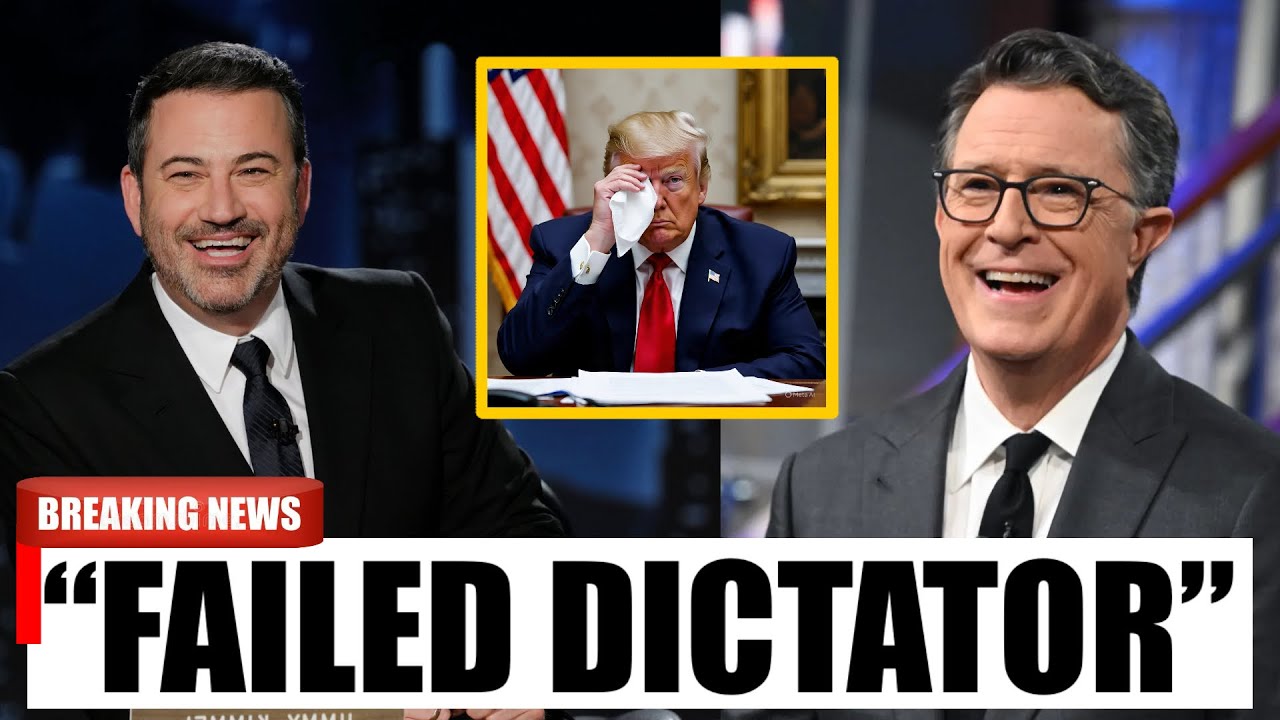
What began as a routine monologue on ABC’s Jimmy Kimmel Live! quickly escalated into one of the most unusual intersections of entertainment and politics in recent months. In a moment that captured widespread online attention, Jimmy Kimmel addressed reports that former president Donald Trump had privately urged allies — including sympathetic FCC voices — to pressure networks over Kimmel’s content. What followed was a segment that blended satire, political confrontation, and a surprising degree of institutional tension, culminating in a rare show of solidarity across late-night television.
Kimmel opened the monologue with a tone that appeared more restrained than his usual comedic delivery. But within minutes, his remarks sharpened into a pointed critique of what he described as “an attempted cancellation from someone who can’t take a punchline.” Clips of the moment circulated widely overnight, generating hundreds of thousands of views as audiences responded to both the comedic framing and the underlying seriousness of the allegation.
The situation intensified when Stephen Colbert, host of CBS’s The Late Show, devoted a portion of his own program to the controversy later the same evening. Colbert’s segment, while comedic, offered a more structural critique of political pressure on media institutions, focusing on Trump’s reported frustrations with late-night comedy and his attempts to reshape public narratives around satire and criticism. “You can’t cancel comedy,” Colbert said, before proceeding with a detailed, humor-laced breakdown of Trump’s reaction.
According to individuals familiar with the network discussions — who spoke on condition of anonymity because they were not authorized to comment publicly — ABC executives were not aware of the extent of the alleged pressure until the reports reached the press earlier in the week. One executive described the situation as “an unexpected collision between entertainment programming and political machinery,” adding that Kimmel’s decision to address it on air was not coordinated with network leadership in advance.
Within Trump’s orbit, the reaction was reportedly swift and frustrated. Advisers familiar with the former president’s response said he viewed the segments from both Kimmel and Colbert as part of a longstanding grievance he holds toward late-night comedians, whom he has often accused of partisanship. According to one aide, the former president “felt the networks were ganging up on him,” and the monologues only reinforced his belief that the entertainment industry is aligned against him.
Political analysts say the episode reflects a persistent tension that has grown over the past decade — the increasingly porous boundary between comedic commentary and political discourse. Late-night shows, once largely confined to celebrity interviews and light humor, have become highly influential sources of political framing for millions of viewers. That influence has drawn criticism from political figures across the spectrum, but the friction has been particularly acute with Trump, whose presidency generated unprecedented levels of satirical scrutiny.
The online reaction illustrates the speed at which such moments now dominate public conversation. Hashtags related to the monologues trended across platforms, and clips circulated not only among fans of the shows but also within political communities and media criticism circles. The rapid spread raised questions about how conflicts between political figures and entertainers may increasingly shape public debates about free expression, media pressure, and the role of satire in democratic culture.

Some media scholars argued that the episode may have unintended consequences for all parties involved. For Kimmel and Colbert, the heightened exposure reinforces their cultural influence, but it also places them at the center of political narratives they do not always seek to drive. For Trump, the optics of attempting to suppress a comedian’s content — whether through formal channels or informal pressure — risk reinforcing longstanding critiques about his approach to dissent and criticism.
While the story’s long-term implications remain uncertain, the immediate outcome is clear: Kimmel remains on air, Colbert’s commentary drew significant attention, and the debate over late-night political satire has only intensified. What began as another monologue has evolved into a national conversation about political power, media independence, and the fragile relationship between public figures and those who critique them.
As the clip continues to circulate and reactions spread, the incident has become one of the most widely discussed cultural moments of the week — a reminder that in today’s media environment, the lines between politics and entertainment are not just blurred; they are increasingly indistinguishable.