Late-Night Comedy Takes Aim Again as Jimmy Kimmel and Bill Burr Unpack Trump’s “Dark Secret”
In an era when late-night television has increasingly blurred the line between entertainment and political commentary, Jimmy Kimmel and Bill Burr delivered a segment this week that quickly became a cultural flashpoint. Their joint appearance — a blend of satire, confrontation, and tightly scripted humor — centered on what they described as one of Donald Trump’s “darkest secrets,” a phrase that, by design, left more questions than answers. Yet the impact of the moment had less to do with any revelation and more to do with the unfiltered way the comedians approached their subject.
The segment began ordinarily enough. Kimmel, who has spent years weaving political observations into his nightly monologues, stepped onto the stage with a tone that felt both familiar and unusually pointed. He opened with a comment suggesting that Trump’s real vulnerabilities were not the ones publicly debated — legal investigations, political missteps, or policy failures — but those rooted in personality, ego, and insecurity. It was a framing that set the stage not for scandal, but for a psychological excavation.
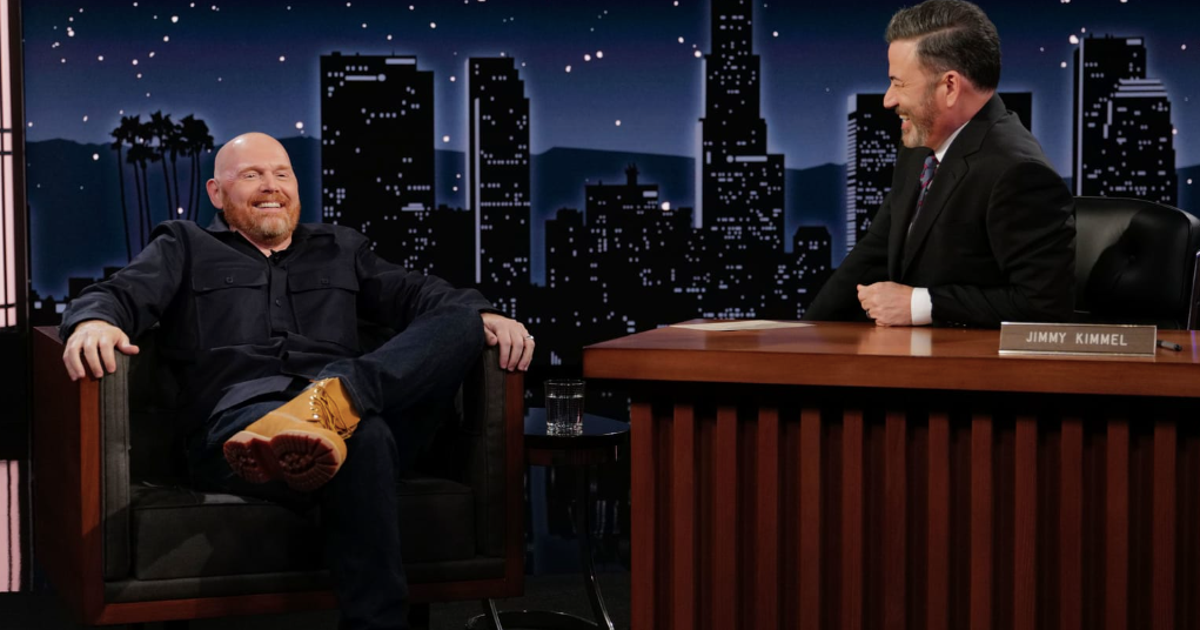
Within moments, Bill Burr stormed in to join him, drawing immediate cheers from an audience well aware of Burr’s reputation for sharp-edged commentary. Burr launched into what he called a “verbal excavation,” mocking the idea that Trump has secrets at all. “He doesn’t hide things,” Burr said. “He just refuses to admit them even when the whole world has already seen it.”
What followed was not a conventional expose, but something closer to a comedic autopsy of Trump’s public persona. The two men volleyed observations at a rapid pace, highlighting the former president’s tendency to deflect blame, inflate achievements, and present himself as perpetually aggrieved. Their approach was less about revealing new information and more about reframing widely known patterns of behavior through satire.
The chemistry between Kimmel and Burr, though rooted in humor, carried an undercurrent of commentary that made the segment feel unusually resonant. They portrayed Trump not as a political figure commanding the national stage, but as a character trapped within his own narrative loops — one who, despite his power, seems perpetually unsettled by late-night ridicule. In this sense, the “dark secret” hinted at during the broadcast was not a hidden scandal but the fragility that the comedians argue defines Trump’s relationship with public criticism.

According to several individuals familiar with the situation, Trump did indeed watch the broadcast in real time. Two sources at Mar-a-Lago, speaking on the condition of anonymity, described his reaction as “volcanic.” They detailed a period of pacing and raised voices, with Trump objecting not just to the jokes themselves but to the idea that late-night comedians would dare present him as emotionally vulnerable. One source called it “a meltdown,” while another suggested that this was hardly the first time a comedy monologue had elicited such a response.
This dynamic — comedians making pointed observations, Trump reacting strongly, and the cycle becoming news — has become a defining feature of the current media climate. Late-night comedy, once largely separated from political influence, now functions as both commentary and provocation. Segments like the one delivered by Kimmel and Burr do more than entertain; they shape narratives, influence digital conversations, and occupy space in the broader political discourse.
The clip spread rapidly online, gathering millions of views across platforms. Supporters of the comedians praised the moment as a bold confrontation of what they see as Trump’s unwillingness to engage with criticism. Trump’s defenders, meanwhile, dismissed the segment as partisan entertainment masquerading as social insight. The debate mirrored the polarized climate of American politics, where even comedy becomes a battleground.
Yet beyond its immediate virality, the Kimmel-Burr collaboration underscores a deeper shift. Political satire has always existed, but rarely has it held this much cultural weight. In recent years, comedians have become — willingly or not — participants in political accountability, their commentary dissected with the seriousness once reserved for editorial writers.
By the time the segment ended, nothing truly secret had been revealed about Trump. But perhaps that was the point. What Kimmel and Burr exposed was not a hidden scandal but an observable truth: that the former president’s public persona continues to be defined as much by his reactions as by his actions. The laughter that filled the studio served not merely as entertainment, but as a reminder of how fragile and combustible the intersection of power and ego can be.
In this sense, the late-night moment was less a takedown than a reflection — a mirror held up to a political figure who has spent years trying to control the narrative surrounding him, only to find that comedians remain among his most persistent and disarming critics.