Kimmel’s Sharp Takedown of JD Vance Highlights a Growing Rift Between Political Performance and Public Reality
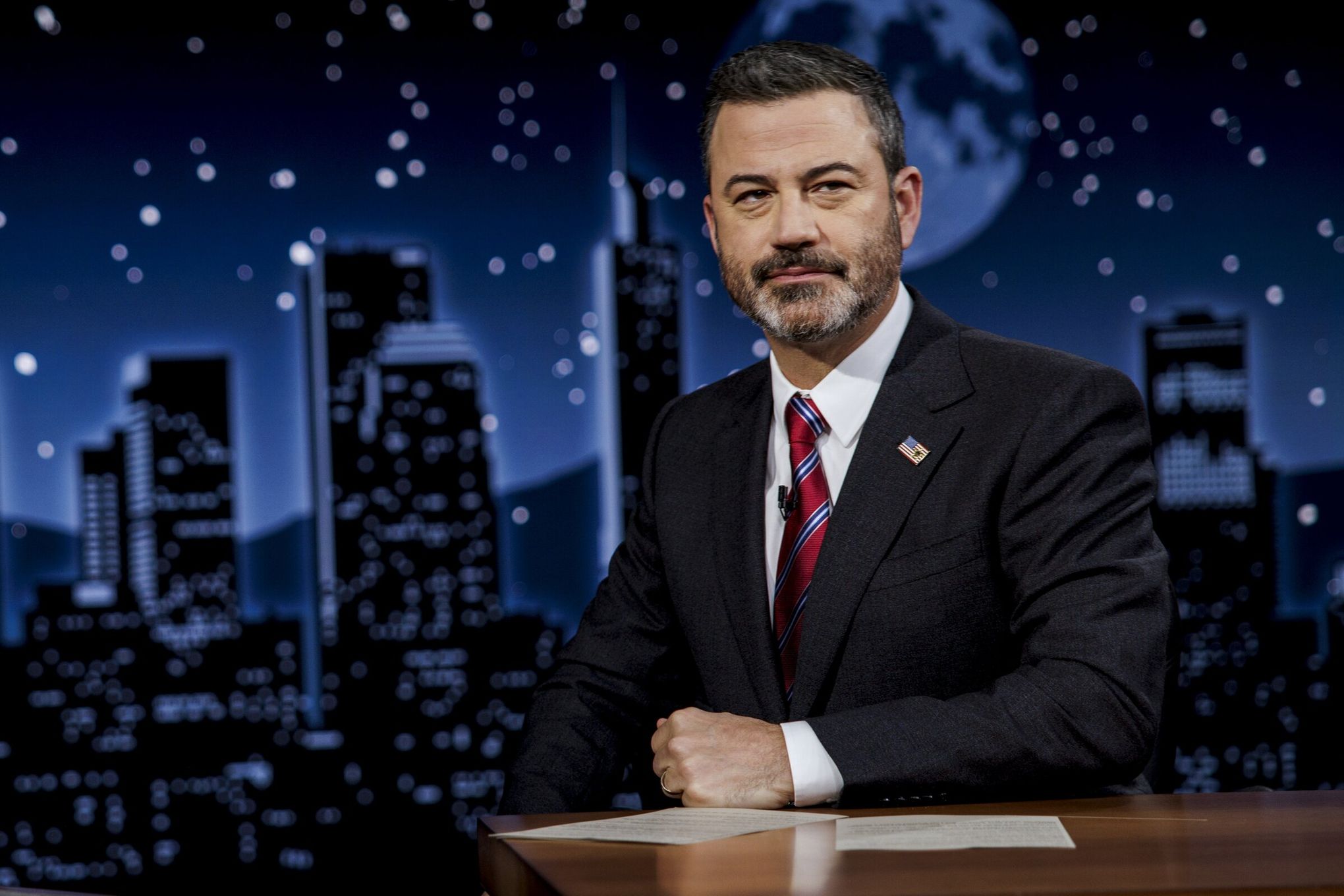
In an era when political messaging increasingly resembles entertainment more than governance, late-night television has again shown its unexpected power to shape public perception. This week, Jimmy Kimmel delivered a blistering on-air critique of Senator JD Vance — a segment that spiraled across social media within hours, igniting debate over political loyalty, authenticity, and the increasingly surreal nature of campaign communication.
The moment unfolded with the ease of a seasoned performer who has spent nearly a decade navigating the turbulent seas of political absurdity. Kimmel, who has long incorporated political commentary into his monologues, directed his attention toward Vance’s evolving relationship with former President Donald Trump. What began as a set of jokes soon morphed into something sharper: a pointed dissection of how a once-vocal critic had transformed into one of Trump’s most enthusiastic defenders.
Kimmel’s critique centered on what he called Vance’s “political metamorphosis,” a shift so dramatic that commentators on both sides have struggled to categorize it. Vance, whose memoir-turned-Hollywood-film once positioned him as a chronicler of working-class despair, now appears onstage as a loyal surrogate, nodding dutifully as Trump veers through long, meandering speeches involving steam power, oxen, magnets, and whatever else arrives in the moment. Kimmel replayed these scenes with the pacing of a journalist and the timing of a comedian, highlighting the widening gap between political theater and substantive policy.
The segment’s viral spread reflects a tension growing within the Republican Party — and, more broadly, within American politics. Vance’s swift elevation from author to senator to Trump confidant has raised questions not only about ideological coherence but also about the personal calculus required to survive in modern political ecosystems. For critics, his new posture signals an abdication of conviction. For supporters, it represents adaptive loyalty in an era dominated by charismatic political personalities.
Kimmel seized on this contradiction, characterizing Vance as someone who “traded spine for spotlight.” The line resonated in part because it captured a broader phenomenon: the increasingly common transformation of political figures into supporting characters orbiting celebrity-style power. Where previous generations of politicians emphasized independence, insistence, or ideological lineage, today’s incentives reward proximity, performance, and the ability to amplify a leader’s message without deviation.
:max_bytes(150000):strip_icc():focal(749x0:751x2)/Erika-Kirk-JD-Vance-Turning-Point-USA-event-Ole-Miss-fa348bba950748c08c95369127340891.jpg)
One of the most widely shared moments in the segment came when Kimmel contrasted Vance’s early criticisms of Trump — critiques that once framed him as a voice of reason within conservative intellectual circles — with his current full-throated endorsements. Viewers were reminded of statements Vance made before entering the political arena, when he warned of the dangers of populist manipulation and the fragility of democratic institutions. The split-screen juxtaposition between past and present was intentionally jarring.
But beyond the comedy, Kimmel’s takedown pointed to a deeper challenge: the erosion of clarity in political communication. As campaigns increasingly favor theatricality over depth, serious policy discussions risk being eclipsed by spectacle. Kimmel’s monologue illustrated this trend through examples of Trump’s recent public remarks — rambling tangents about steam energy, oxen, and magnets — while showing Vance beside him, nodding in unwavering affirmation. The visual itself became a political critique.
The reaction inside conservative circles has been mixed. Some advisers reportedly dismissed the segment as yet another example of “Hollywood meddling,” an argument that has become increasingly common whenever entertainment commentators critique Republican candidates. Yet several longtime strategists privately acknowledged that the monologue struck a nerve precisely because it captured a truth they themselves have struggled to articulate: that Vance’s public identity is still evolving, and not always convincingly.

Meanwhile, the segment’s virality underscores how late-night television continues to shape conversations beyond its comedic intent. While few voters rely on such shows for political guidance, they remain culturally influential, especially among younger audiences who consume politics through clips, reactions, and online discourse rather than through traditional news sources.
What Kimmel achieved — intentionally or not — was to reframe Vance’s political persona through the lens of contradiction. And in an election cycle defined by rapid narratives and fragmented attention, such reframing can have real consequences.
Though Vance dismissed the monologue as partisan mockery, the underlying critique remains: the growing dissonance between his prior warnings about political extremism and his current alliance with its loudest champion. As campaign pressures intensify, that dissonance may become harder to reconcile publicly.
Ultimately, Kimmel’s takedown served less as a comedic skit and more as a cultural snapshot — a reflection of the current moment, when the lines between political loyalty and political performance have never been more blurred. In a season where attention is currency, the question is no longer whether such moments matter, but how deeply they shape the stories voters come to believe.