Politics & Media
Obama’s Sharp Critique of Trump on Live Television Sparks National Discussion and Renewed Debate Over Presidential Qualifications

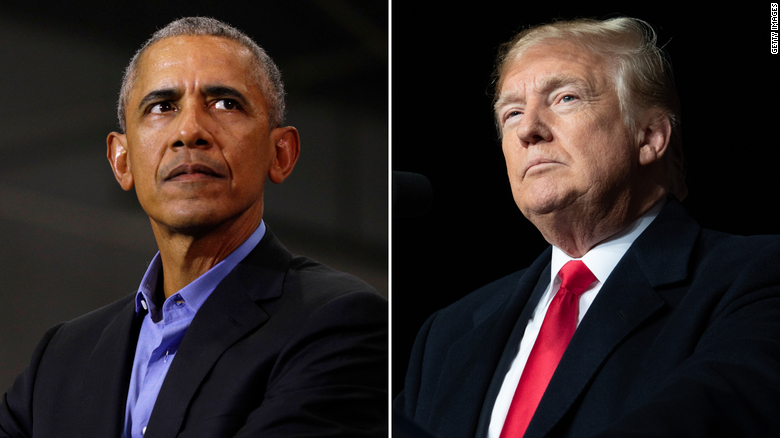
Former President Barack Obama delivered one of his most pointed public critiques of former President Donald J. Trump during a live television interview on Monday night, describing Trump as “the least qualified president ever to hold the office,” a remark that immediately reverberated across political, media and online circles.
The exchange, which unfolded during a wide-ranging interview intended to focus on Obama’s post-presidential initiatives, quickly shifted into a broader conversation about democratic norms, governing experience and the role of leadership in a polarized political climate. The host, acknowledging the unpredictability of live television, appeared momentarily taken aback as the studio fell into a brief, stunned silence.
Within minutes, clips began circulating across major social platforms, drawing millions of views and sparking intense debate about both the substance and tone of Obama’s assessment. Supporters said Obama had articulated concerns long voiced by critics of the Trump administration, while detractors accused him of inflaming partisan tensions.
A Remark Years in the Making
According to several people familiar with Obama’s thinking, the former president has grown increasingly vocal in private about what he views as “erosions of institutional stability” in the years since Trump first entered office. Yet Obama has largely avoided blunt, unscripted characterizations of Trump in public appearances.
Monday’s interview marked a shift in that pattern.
The host had asked Obama to reflect on the evolving expectations of presidential leadership. Obama paused for several seconds before giving an unusually candid reply.
“When we talk about qualifications,” he said, “we’re not just talking about résumé lines. We’re talking about temperament, respect for facts, an appreciation for the institutions you steward. And by those measures, I believe Donald Trump was the least qualified president ever to hold the office.”
The reaction inside the studio was immediate—some gasps, some applause, and a visible freeze among audience members who appeared caught between surprise and anticipation of what might follow.
Trump Allies Mobilize a Rapid Response

Trump’s team responded swiftly. A campaign spokesperson issued a late-night statement calling Obama’s remarks “false, partisan and disrespectful,” and accused the former president of attempting to “rewrite history for political gain.” The statement also praised Trump’s economic, border and foreign-policy record, though it did not directly address the specific concerns Obama raised about qualifications.
Several prominent Trump allies appeared on conservative cable networks within hours of the interview, characterizing the comments as “inappropriate” and “divisive.” One senior adviser claimed, without evidence, that Obama had coordinated the critique with Democratic strategists.
Obama’s office declined to elaborate beyond the remarks made on air.
A Historic First? Scholars Weigh In
Presidential historians and political scientists were quick to contextualize the exchange. While former presidents have occasionally offered pointed assessments of their successors, the directness of Obama’s statement drew particular attention.
“This is not unprecedented, but it is unusual,” said Dr. Laura Mendelson, a historian at Princeton University. “Former presidents typically tread carefully when discussing those who came after them, particularly on questions of competence. Obama’s decision to be explicit indicates a growing concern about democratic norms.”
Others noted that the polarized media landscape magnified the moment in ways unimaginable decades ago.
“What might once have been a passing critique in a print interview now becomes a viral, real-time confrontation that shapes national conversation,” said Dr. Samuel O’Connor, a political communications expert at Stanford.
Reaction Across the Public Sphere
Commentators across the political spectrum debated whether Obama’s remarks were an overdue acknowledgment or an unnecessary escalation.
Among Democrats, many praised the former president for articulating frustrations they felt had long gone unspoken by mainstream leaders. Progressive activists referenced the moment as a “clarifying line” in national discourse.
Conservative commentators argued that Obama was undermining political stability by criticizing a former president so sharply. They also noted that such remarks could deepen existing divides.
Online, reactions were even more intense. The clip quickly rose to the top of trending lists across platforms. Some users shared the segment with approval, calling it “historic.” Others condemned it, insisting that Obama’s comments were inappropriate for a former president. The polarized reaction reflected the fractured nature of American political culture.
Inside the Studio: A Tense but Controlled Moment
Individuals present for the taping described the moment as both tense and oddly subdued. The host attempted to pivot back to scheduled topics but acknowledged later that “the atmosphere changed instantly.”
“It felt like everyone in the room realized they had just witnessed something that would dominate national discussion,” said one audience member.
The network issued a brief statement confirming the interview’s authenticity and noting that no edits would be made to later broadcasts.
A Larger Conversation Ahead
Political analysts say the incident may become a defining moment in the evolving relationship between former presidents and the modern media ecosystem. It also raises fresh questions about how political leaders—past and present—should navigate public disagreements in an era of near-instant amplification.
“Obama’s remarks didn’t occur in a vacuum,” Mendelson said. “They unfolded at a moment when Americans are intensely attuned to issues of democratic legitimacy, executive power and political truthfulness. That’s why the reaction was so swift and so widespread.”
As of late Tuesday, neither Obama nor Trump had issued further statements. But the national conversation ignited by the exchange showed no signs of fading—a reminder that live television continues to serve as a catalyst for some of the country’s most consequential political debates.