Trump’s Online Outburst After a Jimmy Kimmel Segment Reveals a Familiar Pattern.
In the rapidly shifting intersection of entertainment and politics, few moments this week captured the public’s attention as sharply as President Donald J. Trump’s late-night online eruption — a response triggered not by a court ruling, a policy debate, or a campaign development, but by a single, pointed segment from comedian Jimmy Kimmel. The moment, which aired to millions, quickly migrated across social platforms, igniting the kind of cultural flashpoint that has increasingly come to define the Trump era.
What began as a routine monologue on Jimmy Kimmel Live! escalated into a national conversation when Kimmel offered an unusually direct critique of Trump’s behavior surrounding newly released Epstein-related documents. The segment itself was measured, even understated — a quiet dissection of Trump’s online tone in recent days, delivered with the cadence of a storyteller rather than an attack dog. Yet it was precisely that restraint, viewers later said, that gave the commentary its force.
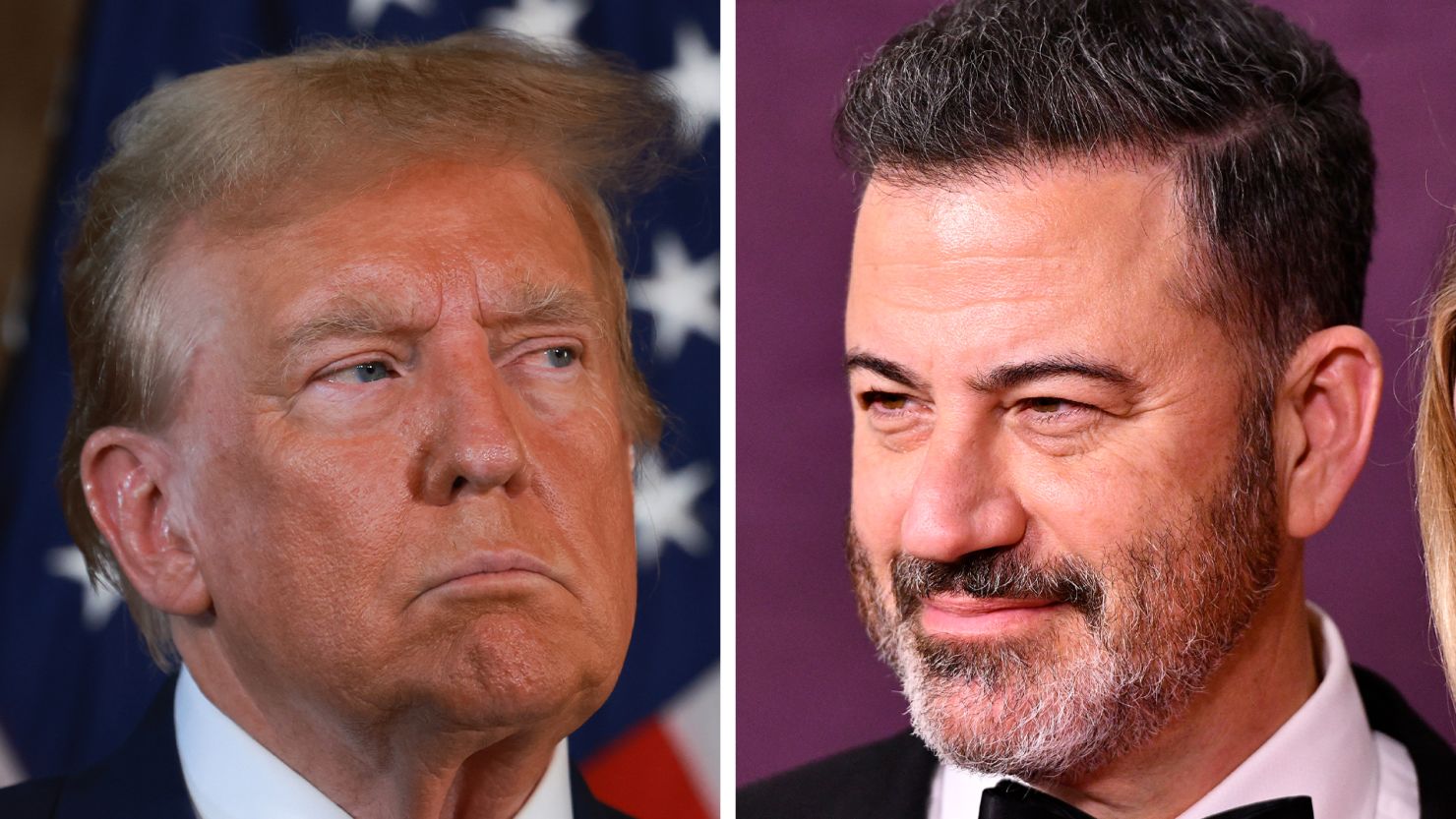
Within hours of broadcast, the reaction from Trump was unmistakable. A cascade of posts appeared on his social platform, unfocused in direction but unmistakable in emotional register. The former president ricocheted between grievances, political commentary, and personal accusations, often returning to the topic of late-night television with a level of fixation that surprised even longtime observers. By early morning, the episode had evolved into one of the most discussed political-media collisions of the week.
The core of Kimmel’s segment touched on a familiar tension in Trump’s public persona: the distinction between his online bravado and his in-person interactions. Kimmel walked viewers through several past examples in which Trump, after days of blistering public criticism directed at political rivals or local officials, adopted a noticeably softer posture when meeting the same figures face-to-face. The monologue presented these contrasts not as political failings but as behavioral patterns, detectable over time and understood by anyone who paid close attention.

For Trump, according to aides familiar with the events of the evening, the commentary struck a nerve. While the former president has long dismissed late-night comedians as partisan adversaries, his reactions have often suggested a deeper sensitivity to media portrayals. This week’s response — lengthy, urgent, and at times contradictory — offered another window into that tension.
The timing, as several strategists noted, was also notable. The country is wrestling with rising economic unease, evolving foreign policy challenges, and intensifying political polarization as another election cycle approaches. Yet for several hours, Trump’s attention appeared fixed almost entirely on the late-night segment, a contrast that fueled widespread commentary among both supporters and critics.
Reactions within Trump’s political orbit were mixed. Some allies echoed his frustration, arguing that media figures have long subjected the former president to uneven scrutiny. Others, however, expressed quiet concern that the intensity of his response risked overshadowing broader political priorities at a moment when his campaign is attempting to project discipline. “It’s the kind of distraction that can take on a life of its own,” one adviser said, requesting anonymity to discuss internal conversations.
In the broader media landscape, the exchange reignited debates about the role of late-night television as a form of political commentary. Over the past decade, hosts like Kimmel have blurred the lines between comedy, cultural critique, and civic discourse — a shift accelerated during the Trump presidency and sustained afterward. Their influence often emerges less from the punchlines themselves and more from the narratives they construct: slow, deliberate examinations of public figures that reach audiences who might otherwise avoid traditional political news.
In this instance, Kimmel’s segment circulated far beyond the show’s typical reach. Clips were shared across platforms, generating discussion not only about Trump’s reaction but also about the nature of presidential communication in the digital age. Scholars who study political discourse noted that Trump’s response underscored an ongoing challenge for public figures navigating modern media: the difficulty of controlling narratives in an environment where commentary, satire, and reporting blend into a single loop of immediate public judgment.
For now, Kimmel has not escalated the confrontation. In the opening minutes of his following broadcast, he referenced the online uproar only in passing, opting instead for a more subtle acknowledgment of the moment. The audience’s reaction — loud, sustained, almost defiant — suggested that, for many viewers, the dynamic has become emblematic of something larger than a single televised critique.
The episode, brief as it was, offered a revealing snapshot of how quickly political and entertainment worlds can collide, and how profoundly those collisions can shape public conversation. In that sense, the events of this week were less a departure than a continuation of a long-running story: a former president who remains deeply attuned to televised portrayals, a media landscape increasingly intertwined with political life, and a public still captivated — for better or worse — by the friction between them.
As the clip continues to circulate and political tensions mount, one thing is certain: this is unlikely to be the last time a late-night monologue reshapes a day’s political narrative.