Political Fiction / Analysis
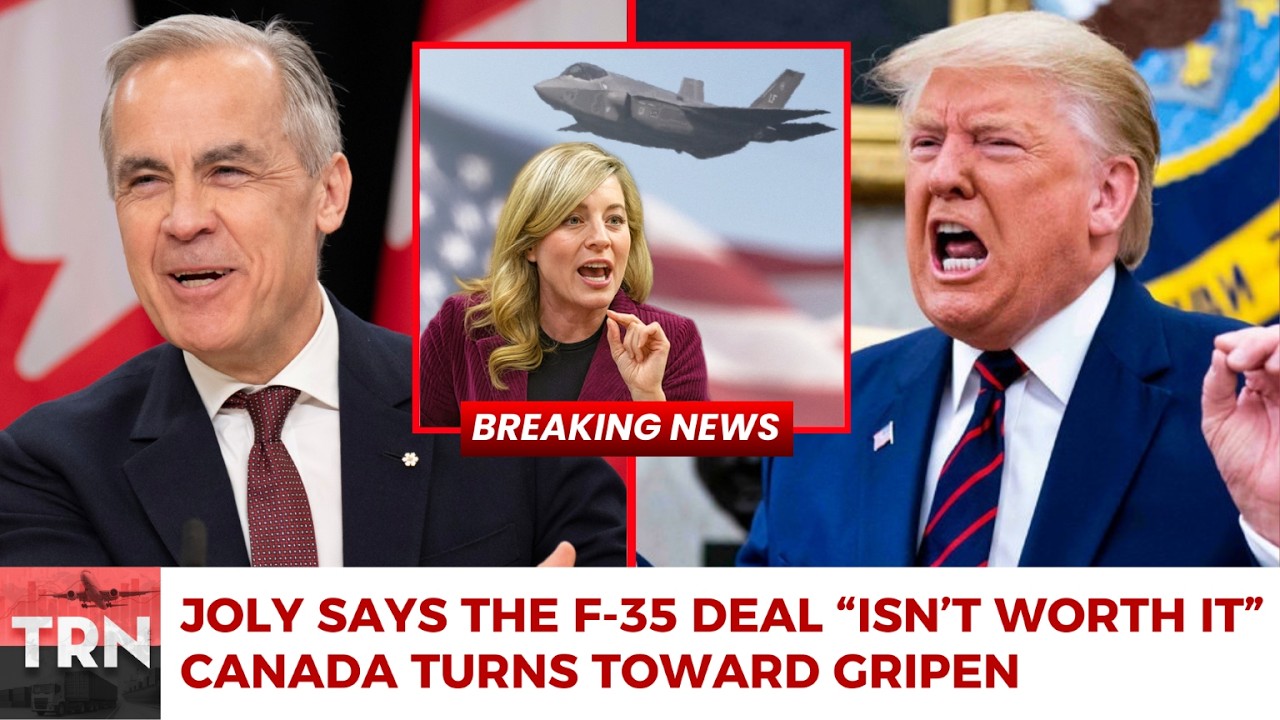
Canada’s Reassessment of F-35 Procurement Signals a Shift in Industrial Strategy and Defense Diplomacy
OTTAWA — In a move that surprised defense observers across North America, Foreign Minister Mélanie Joly has initiated a sweeping review of Canada’s long-standing commitment to the U.S.-built F-35 fighter jet, setting off a wave of political and industrial speculation. Although no decision has been finalized, the government’s willingness to reassess its largest defense purchase in decades abruptly introduced uncertainty into what had appeared to be a settled procurement process.
The renewed scrutiny comes as cabinet ministers and senior defense officials weigh the possibility of expanding partnerships with European manufacturers — particularly Sweden’s Saab, whose Gripen E platform has been promoted by Canadian aerospace unions as a vehicle for securing as many as 10,000 domestic jobs. While the figure remains unverified, the claim has amplified public debate over whether defense procurement should primarily reinforce national industry or prioritize interoperability with NATO standards.
Officials familiar with the discussions, who spoke on the condition of anonymity because deliberations remain ongoing, said the move does not represent a rejection of the F-35 program but rather a broader re-evaluation of Canada’s long-term industrial strategy. “The question is not whether the F-35 is capable,” one official said. “The question is what mix of capabilities and industrial benefits makes sense for the next thirty years.”
Washington Seeks Clarity Amid Policy Shift
The policy shift reportedly startled U.S. officials, who had viewed Canada’s participation in the F-35 program as both strategically valuable and politically secure. Senior American defense representatives have privately expressed concern that any deviation could complicate North American Aerospace Defense Command (NORAD) modernization, an initiative that has been jointly championed by Washington and Ottawa.
“Interoperability is at the heart of regional security,” said a former Pentagon official who worked closely with Canadian counterparts. “The United States wants certainty, and sudden procurement ambiguity always generates the opposite.”
Still, the White House has refrained from public criticism. Two U.S. diplomats emphasized that defense procurement remains a sovereign decision and that the bilateral relationship is strong enough to withstand periodic policy divergences. But congressional aides acknowledged that a reduced Canadian role in the F-35 program could invite renewed scrutiny of industrial offsets and supply-chain contributions that Canadian firms currently provide.
An Industrial Debate Decades in the Making
Canada’s aerospace sector — once a dominant force in North America — has spent years urging the government to diversify procurement partnerships to strengthen domestic production capacity. Saab’s Gripen proposal, which places heavy emphasis on industrial participation and technology transfer, has been cited by labor groups as a rare opportunity to rebuild a manufacturing base hollowed out by years of consolidation.
Economists note that while job-creation projections are often optimistic, they reflect long-standing frustration with procurement models that rely heavily on foreign-built equipment. “In every major defense acquisition, there is a tension between cost, capability, and domestic benefit,” said Anika Varga, an economist at the University of Toronto who studies industrial defense policy. “This time, the political appetite for emphasizing the third category appears unusually strong.”
The Swedish government, for its part, has welcomed Canada’s new review, but Saab officials avoided public statements beyond acknowledging that their aircraft remains “competitively positioned” for any future tender. European diplomats in Ottawa described the moment as an opening to strengthen Canada–EU defense cooperation at a time when Washington is increasingly preoccupied with its own global commitments.
Defense Experts Warn of Strategic Trade-offs

Military analysts caution that shifting away from the F-35 program — even partially — could introduce operational challenges. Canada has invested heavily in pilot training, maintenance integration, and long-term support structures aligned with the American system.
“To unwind from that ecosystem would be costly and complicated,” said Lt. Gen. Mark Whittaker, a retired Royal Canadian Air Force commander. “The Gripen is a sophisticated platform, but its adoption would require rethinking everything from supply chains to data integration.”
Still, some former officials argue that overreliance on U.S. systems carries risks of its own. They point to export controls, software restrictions, and long-term contractual obligations that provide little flexibility for domestic innovation. “Every procurement choice has a sovereignty price tag,” said one former procurement officer. “The question is where Canada wants to pay it.”
Political Calculus Ahead of a National Debate
Prime Minister Justin Trudeau faces competing pressures: a Canadian public increasingly focused on domestic industry, a defense establishment advocating continuity, and allies watching for signals of Canada’s long-term strategic orientation. Members of Parliament from aerospace-heavy constituencies have already welcomed Joly’s review, while opposition critics accuse the government of creating uncertainty in national security planning.
Polls show Canadians evenly divided — with support for the F-35 rooted in perceptions of reliability and alliance cohesion, while backing for alternatives reflects concerns about economic self-sufficiency.
A Decision With Continental Implications
Whether Canada ultimately reaffirms its F-35 commitment or advances toward a mixed or alternative fleet, the review process underscores shifting geopolitical realities: allies are recalculating industrial priorities, global supply chains are stressed, and middle powers are asserting more autonomy.
For now, officials insist the process is routine. But the political, economic, and diplomatic consequences of any major adjustment would ripple far beyond Ottawa — and Washington is paying close attention.