“The House on Willow Lane”
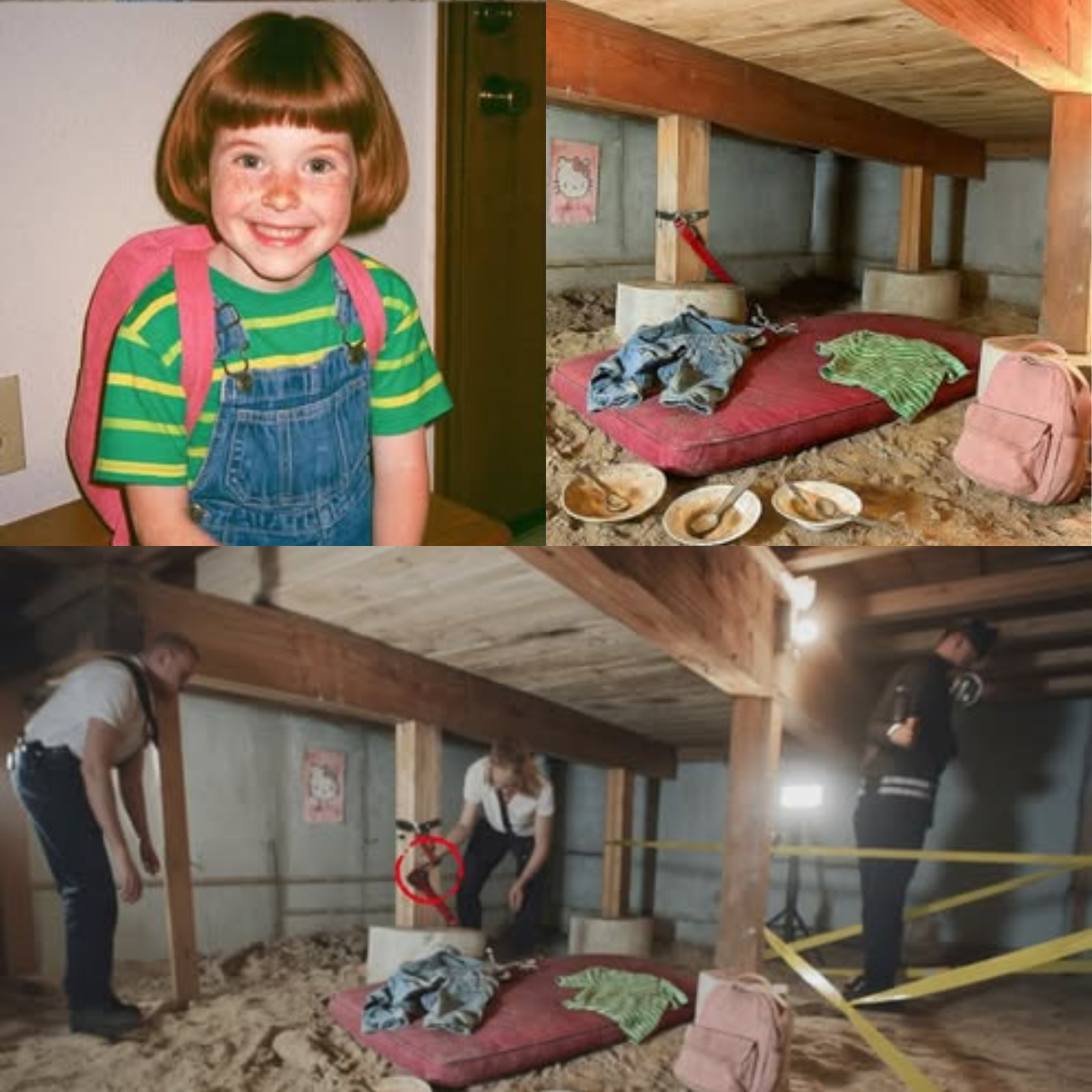
In a quiet town that had seen little change, the disappearance of an eight-year-old girl many years ago remained an open wound.
She had vanished on her way to school, just three blocks from her home.
Hundreds of volunteers, police officers, and sniffer dogs scoured every corner, every attic, every drain — but the trail had gone cold.
Her name was Maggie Crowley, and though her picture once hung in every window, over time it had yellowed, curled, and quietly disappeared.
The town moved on. Or at least, it pretended to.
Until one gloomy afternoon, nearly twenty-five years later, when a team of electricians was called to check the old wiring of an abandoned house on Willow Lane.
1. The House
The Crowley place had been empty for decades.
Locals said it was cursed — that you could still hear a child humming through the walls on stormy nights.
Most dismissed it as folklore, but no one volunteered to work there alone.
That day, Eli Turner, a senior electrician nearing retirement, led the team. The house had recently been purchased by a developer hoping to restore it into luxury rentals.
The front door groaned when Eli pushed it open.
The air smelled of damp wood and forgotten time.
“Check the basement wiring first,” he told his apprentice, Noah. “The fuse box should be down there. Be careful with the floor — it’s half-rotted.”
Noah nodded, flashlight trembling slightly as he descended the stairs.

2. The Basement
It was colder below. The air was thick with mildew.
Noah’s beam cut through the dark, catching cobwebs and rusted pipes.
Then the light flickered across something strange — a section of wall that didn’t match the rest.
Most of the basement was brick, but this part had wooden boards hastily nailed over it.
The edges were uneven, as though someone had sealed it in a hurry.
“No way that’s original,” Noah muttered. He tapped one board with his pliers. It echoed hollowly.
“Eli!” he called up the stairs. “You need to see this!”
Eli arrived moments later, frowning. “What is it?”
“Look. This wall was added later. Someone hid something behind it.”
Eli sighed. “Developers probably don’t want surprises. Let’s open it — carefully.”
They pried the boards loose, one by one. The final nail squealed as it came free.
The smell hit first.
Rot and dust — but beneath it, something metallic, sour.
Noah gagged. “Oh, God.”
Inside the cavity was a small wooden chair… and on it, a faded pink backpack, coated in gray dust.
3. The Discovery
Eli froze. The air in the basement seemed to vanish.
He reached for the backpack, brushing off the grime. The zipper had rusted shut, but the fabric bore a faint embroidered name — letters half worn but still visible:
M. Crowley.
Noah’s flashlight trembled in his hand. “That’s her, isn’t it? The girl…”
Eli swallowed hard. “Call the sheriff. Now.”
4. The Sheriff Arrives
Within an hour, the old house was surrounded by police cars and yellow tape.
The town hadn’t seen this many flashing lights since the original search for Maggie.
Sheriff Lydia Reeves, who had been a rookie officer when Maggie disappeared, stood at the basement entrance, her jaw tight.
She stared at the small chair, the bag, and the wall that had hidden them.
“For twenty-five years,” she whispered, “this was here.”
Forensics moved carefully, cataloguing every inch.
Inside the backpack they found a child’s notebook, a broken crayon, and a photograph — a little girl smiling in front of a yellow bicycle.
The bike, Sheriff Reeves remembered, had never been found.
5. The Mark on the Floor
As the forensics team worked, Noah pointed to something near the base of the hidden cavity.
There was a faint scrape mark on the floor, like something heavy had been dragged — then another, circular, almost like a ring of rust.
“What’s that?” he asked.
One of the techs crouched down. “Could be where a metal bucket sat. Maybe something was buried underneath.”
They cleared the dirt gently, revealing an old tin container. Inside was a bundle of newspaper wrapped around something brittle and white.
Bones.
Tiny ones.
The basement went silent.
Reeves closed her eyes. “Call the coroner.”
6. The Town Reacts
By evening, every resident of Willow Lane was outside, watching the lights flicker through the rain.
For years, the house had been a symbol of fear and gossip — now it was a crime scene reborn.
Eli sat in the back of the ambulance, wrapped in a blanket. He couldn’t shake the image of the small chair.
He remembered being a teenager when Maggie vanished. Everyone had searched these streets — including her father, Daniel Crowley, who had collapsed from exhaustion on day three.
Daniel died two years later, never knowing what happened to his daughter.
Eli glanced toward the house. “Guess we all stopped looking too soon,” he murmured.
7. The Letter
Two days later, the state lab confirmed the remains were human — and likely Maggie Crowley’s.
But there was more.
Inside the tin box, folded between the newspapers, they found a piece of paper — yellowed, water-stained, and written in shaky handwriting:
“I’m sorry. I didn’t mean for it to happen. I just wanted her to stop screaming.”
The note was unsigned.
But the writing style matched an old suspect’s file from 1999 — Harold Kemp, the property’s previous owner.
Kemp had been questioned after Maggie’s disappearance but released due to lack of evidence. He’d died a decade later, alone.
Reeves stared at the note for a long time.
There would be no trial. No confession beyond those few words.
But at least — finally — there was an answer.
8. The Mother
The next morning, Sheriff Reeves visited Ellen Crowley, Maggie’s mother, who still lived in the same little blue house on Maple Street.
She opened the door slowly, gray-haired now, her face a roadmap of years waiting for closure.
Reeves held out a small evidence bag containing the pink backpack.
Ellen’s breath hitched. She took it with trembling hands, tracing the embroidered initials.
“She used to love that bag,” she whispered. “She said it made her look grown-up.”
Reeves nodded. “We found her in the old Kemp property. There was… a note. It seems he kept her there for a time. She’s gone now, Ellen. But she’s home.”
Tears slipped down the woman’s cheeks.
For the first time in twenty-five years, she allowed herself to cry without fear that it was too soon, too hopeless.
“Thank you,” she said simply.
9. The Storm
That night, thunder rolled across the town — a storm that washed the dust and the silence off Willow Lane.
The house was fenced off, marked for demolition.
But before it was torn down, Sheriff Reeves went inside one last time.
The basement was empty now, the walls bare except for the faint outline where the boards had been.
She shone her flashlight across the floor — and saw something she hadn’t noticed before.
Scratched faintly into the concrete, just beside the spot where the chair had stood, were three small words:
“I want home.”
Reeves closed her eyes.
“Now you have it, sweetheart,” she whispered.
Then she turned off the light and walked up the stairs, leaving the darkness behind.
10. Epilogue
A year later, the lot where the house had stood became Willow Park, a small playground with a plaque near the swings:
In Memory of Maggie Crowley —
Lost but never forgotten.
Every spring, children’s laughter filled the air where silence once lived.
And sometimes, when the wind blew just right, the neighbors swore they could hear it carry a faint echo — not a scream, not a cry — but a little girl’s giggle, bright and free.