The Middle Power Axis: How a $4-Billion Radar Deal Signaled Canada and Australia’s Divorce from Washington
CANBERRA / OTTAWA — For eighty years, the defense architecture of the Western world followed a predictable script: major technological breakthroughs began in the United States and flowed outward to its loyal allies. But in the spring of 2026, that script was torn up in the Arctic and the Australian Outback.

What began as a quiet series of procurement discussions has crystallized into the largest defense export in Australian history—a $4-billion deal to provide Canada with a revolutionary “Over-the-Horizon” radar system. While the technical capabilities of the radar are transformative, the strategic subtext is seismic: the Pentagon was next in line for this technology, but Australia chose to let Canada “jump the line,” cutting Washington out of the loop entirely.
The Architecture of Autonomy
The centerpiece of the deal is the Jinderlee Operational Radar Network (JORN) technology. Unlike conventional radar, which is limited by the curve of the Earth, this system bounces signals off the ionosphere to detect ships, aircraft, and hypersonic missiles up to 3,000 kilometers away.
For Canada, the deal is the cornerstone of a $420-million Arctic sovereignty push. The radar will be deployed across the North Pole, replacing the obsolete Cold War-era North Warning System. By partnering with Australia rather than the United States, Prime Minister Mark Carney has signaled that Canada no longer requires American permission—or American hardware—to monitor its own northern approaches.
The ‘Rudd Factor’ and the Death of Loyalty
Diplomatic insiders point to a specific moment in October 2025 as the catalyst for this realignment. During a bilateral meeting at the White House, President Donald Trump reportedly humiliated the Australian Ambassador, Kevin Rudd, over past social media posts. The public mocking of a senior diplomat, followed by the imposition of 50% tariffs on Australian steel and aluminum, sent a clear message to Canberra: 80 years of shared sacrifice in Korea, Vietnam, and the Gulf were no longer enough to buy an exemption from “America First” economics.
“The relationship wasn’t just strained; it was being systematically dismantled,” noted one Australian defense analyst. “When you mock the ambassador and tax the exports of your most loyal ally, you shouldn’t be surprised when they find new partners for their most sensitive technology.”
A $9.5-Billion Diversification
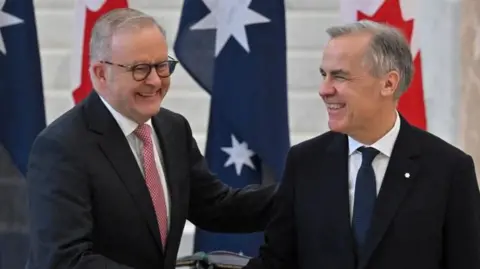
The defense deal is only one node in a rapidly expanding network. In a whirlwind 10-day tour spanning three continents, Prime Minister Carney has locked in $9.5 billion in contracts that conspicuously bypass Washington.
Before landing in Sydney to become the first Canadian leader to address the Australian Parliament in two decades, Carney stopped in India. There, he signed a $2.6-billion uranium deal, securing Saskatchewan nuclear fuel for Indian reactors through 2035. The move rehabilitates a once-frozen relationship with New Delhi and ensures that two of the world’s rising powers are economically “locked in” for the next decade.
Davos and the ‘Rupture’
The intellectual framework for this pivot was laid out by Carney at the World Economic Forum in Davos this past January. In a speech that earned a rare standing ovation from global leaders, Carney described the current state of affairs not as a transition, but as a “rupture” of the U.S.-led order.
“If we are not at the table, we are on the menu,” Carney famously declared. By the time he landed in Australia this week, the “Carney Doctrine” had moved from theory to billion-dollar reality. Australia’s decision to side with Canada—not quietly, but on the floor of its Parliament—suggests that middle-power nations are no longer waiting for a seat at Washington’s table. They are building their own.
The Irreversible Shift
While some in Washington dismiss these moves as temporary adjustments to a volatile administration, the industrial reality suggests otherwise. A $4-billion radar system takes years to build and decades to operate; a uranium contract through 2035 creates a generational energy dependency. These are not handshakes; they are structural rewiring.
As Carney’s team prepares for its next mission in Tokyo, the message to the world is clear: A country once told it “lives because of the United States” has just spent $9.5 billion proving it does not. The supply chains are rerouting, the defense alliances are hardening, and for the first time in the modern era, the most important strategic architecture in the Indo-Pacific is being built without a single dollar from Washington.