THE GREAT FRY FRENZY: How Canada’s Potato Pivot Left U.S. Fast-Food Giants Reeling
WASHINGTON – It began as a rumble in the potato fields of Prince Edward Island. It has ended as a full-blown crisis in the drive-thrus of America.
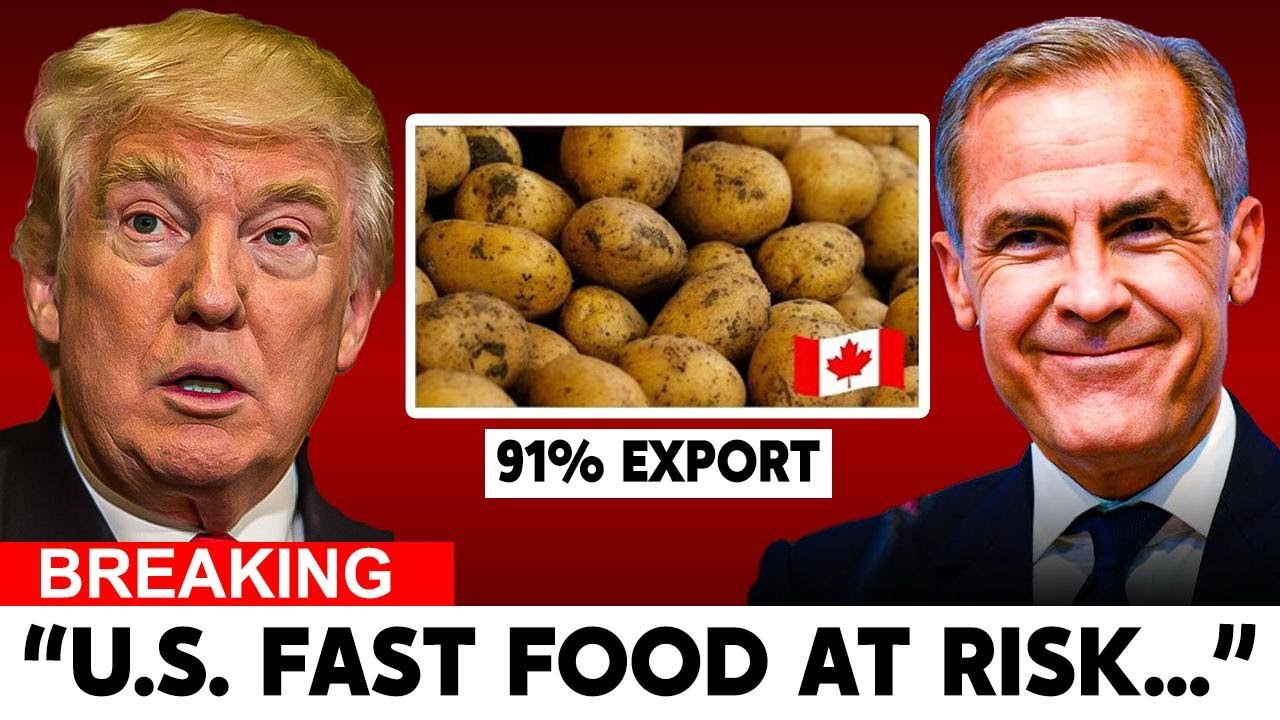
In a twist of agricultural brinkmanship that has Wall Street analysts scrambling and fast-food fans fuming, Canada has executed what trade experts are calling a “masterstroke” in the ongoing tariff war with the United States. By quietly diverting millions of pounds of frozen french fry exports away from American buyers and locking in lucrative deals elsewhere, Ottawa has triggered a supply crunch that is now emptying freezers at some of the largest fast-food chains in the world.
McDonald’s, Wendy’s, and Burger King are facing what industry insiders are describing as the most significant potato supply disruption in a generation. And the architect of this high-stakes gambit? Prime Minister Mark Carney, the former central banker who appears to have been playing a very long game.
The Secret 18-Month Plan
While Washington was focused on tariff threats and trade demands, Carney’s team was quietly working the back channels. Sources close to the Prime Minister’s Office confirm that an 18-month secret diversification plan has been in motion, designed explicitly to wean Canadian potato growers off their reliance on the U.S. market.
“It was brilliant in its simplicity,” said a senior agricultural trade strategist who spoke on condition of anonymity. “The U.S. kept demanding priority access to Canadian potatoes, treating it like a given. Meanwhile, Carney’s people were on planes to Mexico City, Tokyo, and Manila, locking in contracts at premium prices.”
The strategy gained critical mass following Carney’s September 2025 meeting with Mexican President Claudia Sheinbaum, where the two leaders heralded a “new era of elevated cooperation” . Since then, Canadian agricultural ministers have been relentless in pursuing new markets, with trade missions to Guadalajara becoming routine and negotiations advancing to harmonize phytosanitary measures with Mexico .

The Perfect Storm
The supply crunch didn’t happen in a vacuum. Multiple factors converged to create what one industry analyst called “the perfect fry storm.”
Prince Edward Island, which exports about half its total potato crop to the U.S., suffered its driest growing season on record in 2025, with production down nearly 16 percent . The combination of reduced supply and redirected exports has created a bottleneck that U.S. processors simply cannot fill.
Adding fuel to the fire, Canadian authorities recently increased the floor price on certain U.S. potato imports to avoid triggering anti-dumping penalties—a move that effectively shut the door on American potatoes trying to enter the Canadian market . The National Potato Council in the U.S. has formally requested a Section 332 investigation into Canadian trade practices, arguing the moves violate “at least the spirit” of the USMCA trade agreement .
Chaos in the Drive-Thru
For American consumers, the diplomatic maneuvering has translated into a very real problem: where are the fries?
“Walk into any fast-food joint right now and you can feel the tension,” said restaurant industry consultant Maria Santos. “Managers are watching their fry inventory like hawks. Some locations are already limiting portions. The marketing people are in panic mode because fries aren’t just a side dish—they’re the profit center.”

Lamb Weston, the heavyweight of the french fry industry and a major supplier to McDonald’s, recently closed a plant in Connell, Washington, laying off 375 workers amid softening demand—but now faces the opposite problem: supply can’t keep up with what demand remains . The company’s CEO cited “demand for frozen potato products continuing to lag behind supply,” but the equation has shifted dramatically with Canadian exports tightening .
Consumer Backlash and Meme Warfare
The internet, as always, has responded with characteristic chaos. Memes depicting empty fry baskets and sorrowful clowns have gone viral. #FryCrisis and #CarneysColdCut are trending on social media platforms, with users sharing photos of sad, fry-less meals and speculating about which chain will blink first.
“First they came for our healthcare, now they come for our fries? This is war,” read one viral tweet that has been liked over 200,000 times. Another user photoshopped Carney’s face onto a potato with the caption: “The most dangerous spud in North America.”
What Happens Next?
The diplomatic fallout is still unfolding. U.S. trade officials are reportedly furious, having been caught completely off-guard by the scale and coordination of Canada’s pivot. The National Potato Council is pushing for remedial action, arguing that stable trade relations are essential for both countries .
But on the ground in Canada, farmers are breathing easier. Tyler Heppell, a fifth-generation potato farmer from British Columbia, told BNN Bloomberg that a “buy-Canada” push has strengthened domestic demand, with consumers stepping up to support local farmers . His social media videos showcasing potato farming garnered more than 520 million views last year, tapping into a wave of nationalist food sentiment .
For Prime Minister Carney, the gamble appears to be paying off. By locking in higher-paying international deals while enforcing strict border measures, Canada has transformed its potato sector from a U.S. dependency into a diversified export powerhouse. The question now is whether American fast-food giants can adapt before their freezers run dry—and whether their customers will forgive them for the fry shortage that could define the summer of 2026.