🔥 BREAKING: Donald Trump FACES PUSHBACK IN CROSS-BORDER DISPUTE — CANADA FIRES BACK OVER BRIDGE CLAIMS 🌉🇨🇦
A late-night threat by President Donald Trump to block the opening of a nearly completed international bridge has injected fresh uncertainty into one of North America’s most critical trade corridors, transforming a long-planned infrastructure milestone into the latest flash point in U.S.-Canada relations.
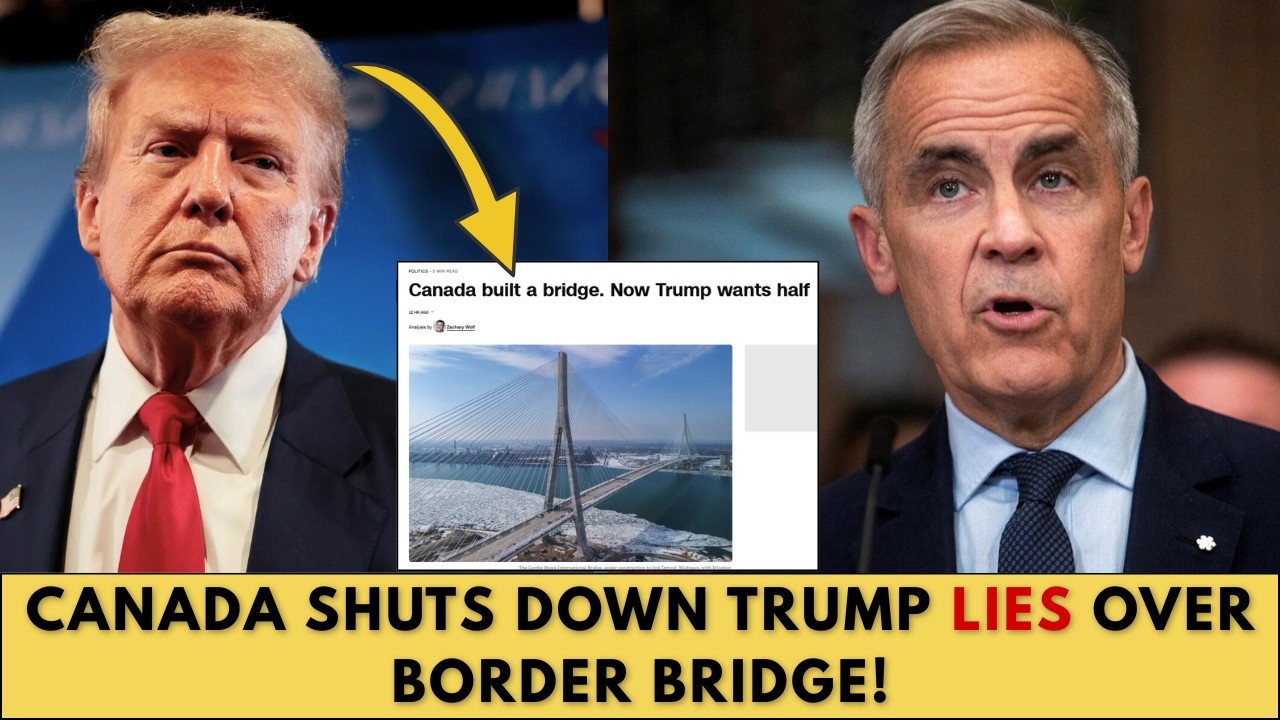
The project at the center of the dispute — the Gordie Howe International Bridge — is 98 percent complete. Stretching across the Detroit River between Windsor, Ontario, and Detroit, the $6 billion span was designed to ease congestion, fortify supply chains and symbolize the economic interdependence of two nations that share the world’s longest peaceful border.
In a social media post, Mr. Trump suggested that the United States had been treated unfairly in the financing of the bridge and asserted that the country should “own at least half” of it before allowing the crossing to open. He argued that Canada owed compensation and warned that the launch could be delayed unless American interests were fully addressed.
The reaction from officials and industry leaders on both sides of the border was swift, in part because the financing and ownership structure of the bridge has long been public and settled.
Canada financed the project in full, covering not only the bridge itself but also customs plazas and highway connections in both countries. Under a 2012 agreement with the State of Michigan, ownership of the bridge is shared between Canada and Michigan. Canada is to recoup its upfront investment through toll revenues; after those costs are recovered, net revenues will be split.
American workers have participated in the construction, and American steel was incorporated into the Michigan side of the project. During Mr. Trump’s first term, his administration endorsed the bridge as a vital economic link and approved funding related to customs facilities.
“What changed?” asked one Michigan business leader privately, noting that the corridor carries billions of dollars in goods annually. The Detroit-Windsor crossing is a linchpin of the North American auto industry, with parts often crossing the border multiple times before final assembly. Agricultural products, energy shipments and manufactured components also flow through the region in high volumes.
Blocking or delaying the new bridge would not primarily burden Canada, economists say. It would likely disrupt American supply chains, particularly in Michigan and the broader Midwest, where factories depend on predictable cross-border movement.
Gov. Gretchen Whitmer of Michigan has previously emphasized the project’s importance to job creation and regional competitiveness, and state officials have signaled that they expect the bridge to open on schedule. For Michigan, the agreement secured partial ownership of a major international asset without requiring the state to bear construction costs — a structure that was widely viewed as fiscally advantageous.
Mr. Trump’s criticism of the bridge came alongside broader grievances. He suggested that Canada had undermined American alcohol sales and hinted at concerns about Ottawa’s trade posture toward China. He even alluded, obliquely, to cultural touchstones such as hockey, broadening the scope of the dispute beyond infrastructure.
To some analysts, the bridge controversy reflects shifting economic dynamics. For decades, Canada’s heavy reliance on the American market gave Washington substantial leverage in trade negotiations. In recent years, however, Canada has pursued diversification strategies, expanding trade ties with Europe and Asia and seeking to reduce vulnerability to political volatility in the United States.
That recalibration may have altered the tone of cross-border negotiations. “When partners diversify, leverage changes,” said a trade policy expert who has advised both governments. “But threatening shared infrastructure is a risky way to respond.”
Prime Minister Mark Carney opted for a restrained approach. In public remarks, he reiterated that Canada financed the bridge, that ownership is shared and that the project benefits both economies. He characterized the crossing as a symbol of cooperation rather than exploitation and avoided escalating rhetoric.
Ontario’s premier, Doug Ford, was more direct, rejecting the notion that Canada had taken advantage of the United States and emphasizing the documented terms of the agreement. Canadian officials framed their response as fact-based and measured, underscoring that American labor and materials were integral to the project.
Infrastructure of this scale typically outlasts the political cycles that surround it. The bridge is expected to carry roughly 8,000 trucks daily once operational, reducing congestion at the privately owned Ambassador Bridge and creating a direct freeway-to-freeway connection between Ontario’s Highway 401 and Interstate 75. Over decades, the efficiency gains are projected to yield billions in savings for industries on both sides of the border.
Yet even durable projects can become vulnerable to short-term political pressures. Markets and businesses tend to react swiftly to uncertainty, particularly in corridors as economically concentrated as Detroit-Windsor. Automotive manufacturers and logistics firms closely monitor any sign of disruption.
In the end, the bridge itself — steel and concrete spanning a narrow river — remains unchanged. What has shifted is the political narrative around it. Whether Mr. Trump’s threat materializes into concrete action is unclear. Altering the ownership or financing structure would require navigating existing agreements and legal frameworks.
For now, the episode serves as a reminder that even long-negotiated, bipartisan infrastructure projects can become proxies in larger geopolitical and domestic disputes. The Gordie Howe bridge was conceived as a testament to integration and shared prosperity. Its opening, once a straightforward engineering milestone, has instead become a test of how two deeply intertwined economies manage friction in an era of sharpened rhetoric.