🔥 BREAKING: Donald Trump SIGNALS TRADE PRESSURE — Mark Carney’S RESPONSE PUTS $6.4B ROUTE IN FOCUS 🌎⚡
In early February, a late-night social media post from President Donald Trump jolted one of North America’s most vital trade corridors, casting uncertainty over the imminent opening of the Gordie Howe International Bridge between Windsor, Ontario, and Detroit.
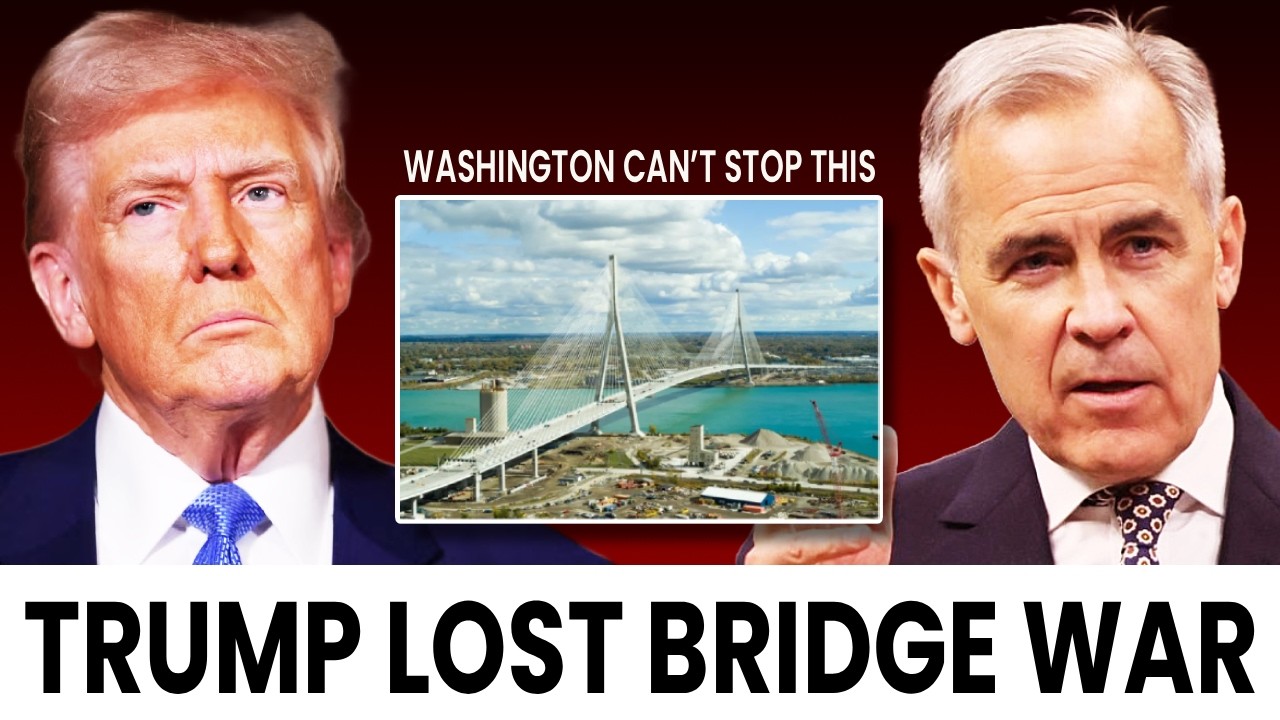
The bridge — a $6.4 billion project financed entirely by Canada — was expected to open later this year, adding long-awaited capacity to a corridor that carries roughly a quarter of all merchandise trade between Canada and the United States. But Mr. Trump declared on Truth Social that he would seek to block its opening, asserting that Canada “owns both sides” of the span and suggesting the United States should be compensated before traffic begins to flow.
The remarks landed amid broader trade tensions, including disputes over dairy protections, Ontario’s restrictions on American alcohol sales and Prime Minister Mark Carney’s recent trade outreach to China. Yet the facts of the bridge agreement, negotiated more than a decade ago, tell a more intricate story.
Under a 2012 deal between the Canadian government and the State of Michigan, Canada agreed to cover the full construction cost of the bridge, its customs plazas and highway connections on both sides of the border. In return, Michigan secured 50 percent ownership of the completed span without contributing upfront capital. Canada would recover its investment through toll revenues; only after those costs are recouped would net toll proceeds be split evenly between the two partners.
The agreement was signed by Michigan’s Republican governor at the time, Rick Snyder, and advanced with federal approval in Washington. In 2013, the State Department issued the required presidential permit. During Mr. Trump’s first term, his administration endorsed the project in a joint statement with then–Prime Minister Justin Trudeau and approved legislation that included funding for U.S. customs operations at the site.
That record prompted swift rebuttals from Michigan officials after Mr. Trump’s February post. Mr. Snyder wrote in The Detroit News that the arrangement had been structured to protect Michigan taxpayers while securing half ownership of a major international crossing. Blocking or delaying the bridge, he argued, would primarily hurt Michigan’s economy.
Gov. Gretchen Whitmer’s office emphasized that the project supports thousands of jobs and strengthens the auto industry, a sector deeply integrated across the border. Senator Elissa Slotkin warned that disrupting the opening could reverberate through regional supply chains, increasing costs for manufacturers and consumers alike.
To understand the stakes, it helps to consider the infrastructure the new bridge will complement. Since 1929, the privately owned Ambassador Bridge has served as the primary commercial link between Detroit and Windsor. Because the Detroit-Windsor Tunnel does not permit commercial trucks, heavy freight traffic has largely depended on that single span, creating what critics describe as a near-monopoly.
The new bridge aims to address both capacity and resilience. Unlike the Ambassador Bridge, whose Canadian approach funnels trucks onto city streets before connecting to highways, the Gordie Howe span will link directly to Ontario’s Highway 401 and Interstate 75, creating a seamless freeway-to-freeway connection. A study by the University of Windsor estimated that the crossing could reduce commercial transit times by up to 20 minutes per trip, generating as much as $2.3 billion in savings over 30 years.
Roughly 8,000 trucks are expected to use the bridge daily, along with thousands of commuters. The Detroit-Windsor corridor underpins the North American auto industry, where parts may cross the border multiple times before a vehicle is assembled. Even modest delays can ripple through assembly plants in Michigan and Ontario.
Mr. Trump’s suggestion that the bridge could serve as leverage in broader trade negotiations faces practical constraints. Ownership terms are fixed under the 2012 agreement. Michigan already holds a 50 percent stake, and the United States government approved the necessary permits years ago. Blocking the opening would not alter that structure; it would postpone the economic benefits for Michigan businesses while preserving reliance on the existing crossing.
Mr. Carney, for his part, sought to defuse the confrontation. He reiterated that Canada financed the project, that ownership is shared and that American and Canadian workers built the span using steel from both countries. Rather than escalate publicly, he emphasized continued dialogue and the bridge’s role as a symbol of cross-border cooperation.
The episode illustrates how quickly a decade-long infrastructure effort can become entangled in contemporary politics. In Washington, trade debates have grown more charged as lawmakers weigh tariffs, court rulings and shifting public opinion. In Michigan, where cross-border commerce supports thousands of jobs, leaders of both parties have largely focused on economic continuity.
As ribbon-cutting plans advance, the bridge stands as a physical testament to negotiated agreements that outlast electoral cycles. Political rhetoric may surge and recede, but contracts, permits and financing arrangements tend to endure. For manufacturers awaiting smoother supply chains and for workers whose livelihoods depend on a steady flow of goods, the practical math of trade may ultimately matter more than the noise surrounding it.