🔥 BREAKING: MEXICO SIDES WITH CANADA IN MAJOR TRADE SHIFT — NORTH AMERICAN DYNAMICS BEGIN TO REALIGN 🇲🇽🇨🇦🇺🇸
MEXICO CITY — When President Claudia Sheinbaum stepped to the podium for her morning news conference on Jan. 22, few expected a remark that would reverberate across North America.
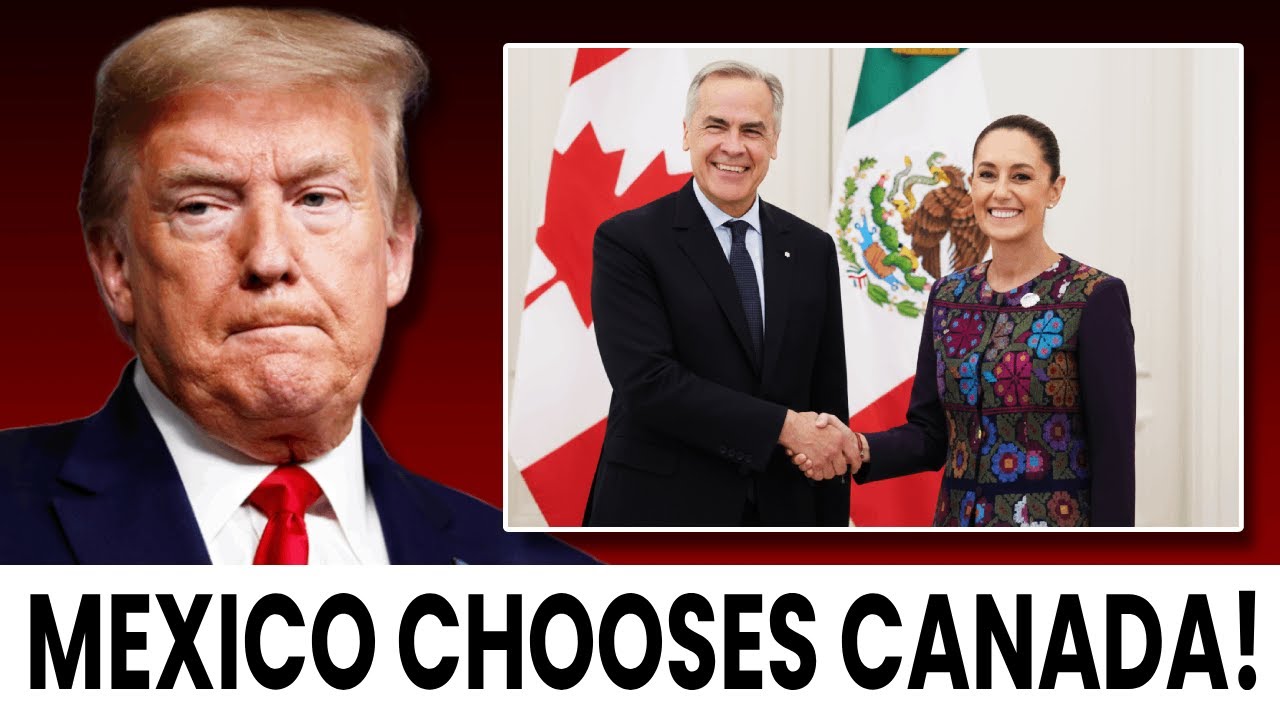
Asked about a speech delivered days earlier at the World Economic Forum in Davos by Mark Carney, Canada’s prime minister, Ms. Sheinbaum did not deflect. Instead, she offered measured but unmistakable praise, calling the address “very good” and aligned with the challenges facing the world today.
In diplomatic language, it was more than courtesy. It was a signal.
Mr. Carney’s speech in Davos had challenged a long-held assumption: that middle powers such as Canada and Mexico must compete for favor with dominant nations — above all, the United States — to secure economic stability. He argued instead for deeper cooperation among peers to reduce vulnerability to sudden policy shifts and geopolitical pressure.
The remarks drew limited attention in Washington, where analysts largely dismissed them as rhetorical positioning. But in Mexico City, they landed differently.
Ms. Sheinbaum’s endorsement, delivered less than 48 hours later on national television, suggested that Mexico sees merit in recalibrating its strategic posture — particularly as President Trump confirmed plans to impose 25 percent tariffs on goods from Mexico and Canada.
The tariffs, set to take effect after earlier delays, have reignited fears of economic disruption across the continent. Markets have responded with volatility, and business leaders warn that supply chains integrated under decades of free trade agreements could again be strained.
For Mexico, the memory of such instability is recent and vivid.
The dismantling of NAFTA during Mr. Trump’s first term and its replacement with the United States-Mexico-Canada Agreement (USMCA) introduced a six-year review mechanism that ensures recurring uncertainty. Tariffs on steel, aluminum and other goods were imposed with little warning. Negotiations often unfolded under public pressure and threats.
Against that backdrop, Mr. Carney’s proposal — that middle powers coordinate rather than compete — resonates.
“It is not about confrontation,” said a senior Mexican lawmaker, speaking on condition of anonymity to discuss diplomatic strategy. “It is about balance.”
The groundwork for closer Canada-Mexico ties has been quietly laid. In January, Canada’s governor general, Mary Simon, concluded a three-day visit to Mexico City, the first by a Canadian governor general to the Mexican capital. Meetings emphasized reconciliation, sovereignty and shared experiences navigating relationships with more powerful neighbors.
Members of Mexico’s Congress from across the political spectrum have echoed the need for deeper engagement with Canada. Some have expressed concern that the future of the USMCA could be uncertain if Washington approaches the 2026 review with ambivalence or hostility.
Economically, the logic of cooperation is tangible.
Consider canola, a commodity that illustrates the vulnerabilities of global trade. Mexico imports much of its canola from the United States. Canada, meanwhile, exports significant quantities to China, exposing itself to Beijing’s tariff policies. By expanding direct trade between Canada and Mexico, both could reduce exposure to political decisions made elsewhere.
Such substitution is not ideological; it is pragmatic. Canada’s recent negotiations with China — linking electric vehicle access to reductions in agricultural tariffs — have demonstrated a willingness to pursue strategic trade-offs without sacrificing autonomy.
For Mexico, whose economy remains deeply intertwined with that of the United States, diversification carries both opportunity and risk. Roughly 80 percent of Mexican exports go north. Yet repeated tariff threats have underscored the costs of overdependence.
Together, Canada and Mexico represent an economic bloc of more than $4 trillion in gross domestic product. Coordinated positions in advance of the 2026 USMCA review could strengthen their leverage in negotiations with Washington.
Diplomatic steps appear to be accelerating. A major Canadian trade mission to Mexico is scheduled for early next year, led by senior officials and focused on energy, agriculture and technology partnerships. Observers say tangible agreements — such as expanded agricultural trade or joint renewable energy projects — would mark a shift from symbolism to substance.
Mr. Trump’s rhetoric has also played a role. His recent comments suggesting closer U.S. control over Canada, along with renewed tariff threats, have been interpreted in both Ottawa and Mexico City as reminders of asymmetry.
“Every time there is an insult or a unilateral move, it reinforces the case for coordination,” said a former Mexican trade negotiator.
Still, neither country seeks rupture. Mexican officials have emphasized that cooperation with Canada is intended to strengthen North America, not fragment it. The aim is to ensure that the continent’s trade architecture rests on mutual respect rather than transactional pressure.
The broader question is whether this emerging alignment marks a durable shift or a tactical response to a volatile moment.
Historians may look back on this January as an inflection point: a Davos speech that might have faded into obscurity instead prompted a swift and public endorsement from Mexico’s president. What followed — legislative support, diplomatic visits and planned trade missions — suggests a recalibration in progress.
For decades, Washington has been the unquestioned axis of North American economic gravity. Now, Ottawa and Mexico City appear to be testing whether closer coordination can subtly redistribute that weight.
Whether the experiment succeeds will depend on more than speeches. It will hinge on contracts signed, supply chains rewired and political will sustained beyond the current cycle of tariffs and threats.
But for now, a quiet shift is underway — less dramatic than a trade war, perhaps, but potentially just as consequential.