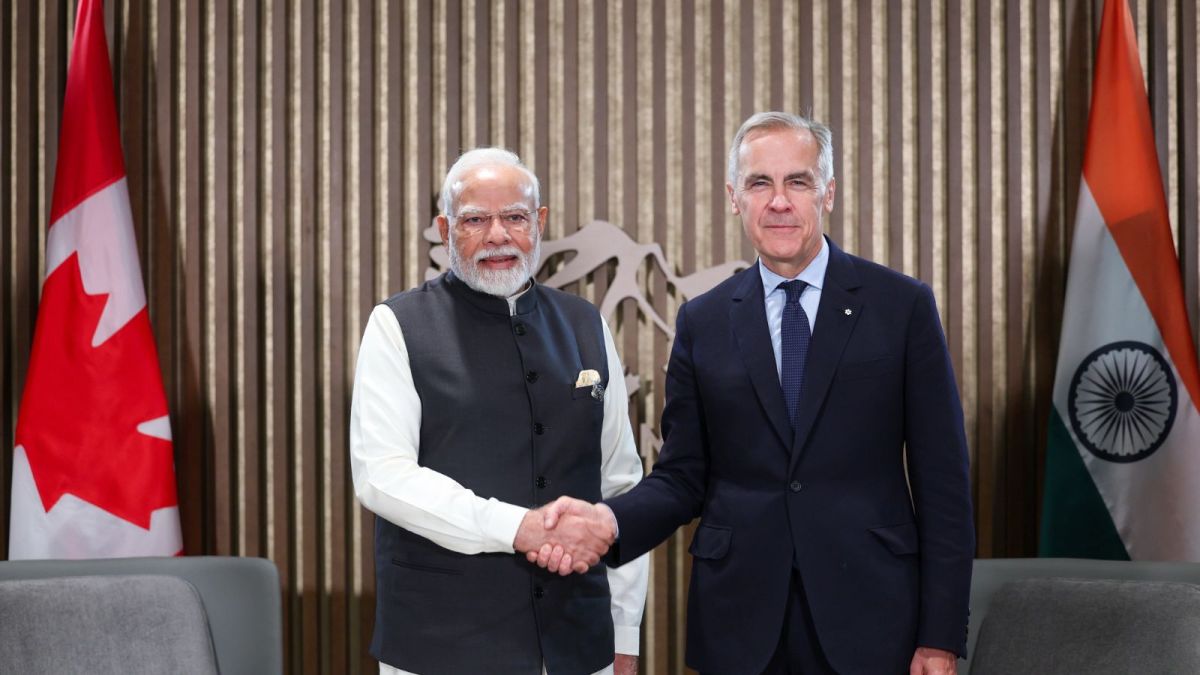
Prime Minister Mark Carney arrived in Mumbai this week to launch what his office describes as one of Canada’s most consequential trade diversification efforts in decades: a push to more than double bilateral commerce with India to $70 billion by 2030.
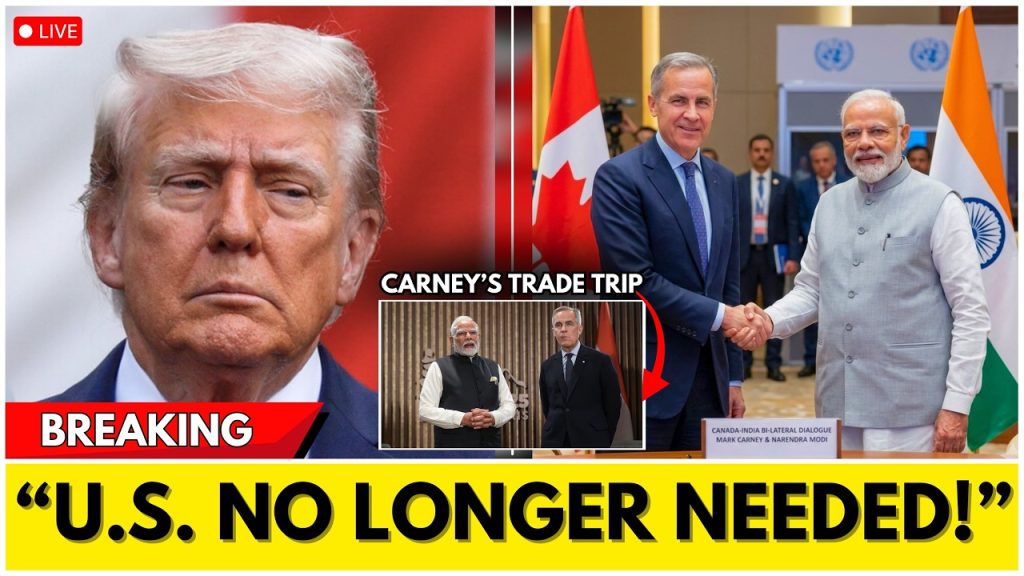
The four-day visit — spanning Mumbai and New Delhi — includes meetings with Prime Minister Narendra Modi, senior cabinet officials, pension fund executives and leaders from energy, technology and infrastructure sectors. At the center of the agenda is a proposed Comprehensive Economic Partnership Agreement (CEPA) aimed at reducing tariffs, expanding services trade and deepening investment flows.
A Diplomatic Reset Enables Economic Ambition
The visit follows a significant thaw in Canada–India relations after nearly two years of diplomatic strain. Tensions escalated in 2023 when then–Prime Minister Justin Trudeau publicly alleged links between Indian agents and the killing of Sikh activist Hardeep Singh Nijjar in British Columbia — allegations New Delhi denied.
Under Carney’s leadership, Ottawa has signaled a shift toward what officials call “pragmatic engagement.” Canadian security officials now say they see no evidence of ongoing foreign interference tied to India. Quiet security consultations between national security advisers preceded the economic outreach, laying the groundwork for resumed trade talks.
Without that reset, analysts say, a large-scale economic agreement would have been politically impossible.
The $70 Billion Target: Ambitious but Strategic
Current Canada–India bilateral trade stands at roughly $30.8 billion. The $70 billion target implies approximately $40 billion in incremental trade growth over six years.
By comparison, Canada’s annual merchandise trade with the United States exceeds $700 billion. Even if achieved, the India target would not replace U.S. market access — but it would meaningfully reduce concentration risk. Roughly 75% of Canadian exports currently flow south of the border.
Diversification, Carney’s team argues, is about leverage and resilience rather than replacement.
Sectoral Focus: Energy, Minerals, Agriculture, Tech
The proposed agreement is expected to emphasize complementary strengths:
- Energy and uranium: India imports the majority of its energy. Canadian LNG and uranium exports could expand as India scales power generation capacity.
- Critical minerals: Lithium, cobalt, nickel and rare earth elements — central to electric vehicle and battery manufacturing — align with India’s industrial ambitions.
- Agriculture: Canada is a major exporter of pulses and grains; tariff reductions could boost lentil, wheat and canola access to India’s growing middle-class market.
- Technology and services: Canada’s artificial intelligence ecosystem and India’s engineering workforce present opportunities for joint ventures and digital trade expansion.
Canadian pension funds — managing approximately $2 trillion in assets — are already active investors in Indian infrastructure and real estate. Expanded trade architecture could accelerate capital deployment.
Strategic Context: Beyond U.S. Dependence
The timing of the trip is notable. The review of the United States–Mexico–Canada Agreement (USMCA) approaches, and President Donald Trump has renewed tariff threats in recent months. While Canada remains deeply integrated with the U.S. economy, Ottawa has signaled it will not rely exclusively on that relationship.
Carney’s Indo-Pacific outreach extends beyond India, with parallel engagement in Australia and Japan. Together, those markets could account for roughly $170 billion in trade and investment relationships by 2030 if current trajectories hold.
From a negotiation standpoint, credible alternatives can alter leverage. If Canadian exporters have diversified outlets, tariff threats carry less proportional impact.
India’s Calculus
For Modi, closer ties with Canada reinforce India’s positioning as a leading global growth engine. India is now the world’s most populous country and among its fastest-growing major economies. Attracting G7 investment strengthens its international economic standing and supports supply chain diversification away from China.
The proposed CEPA would reportedly aim to eliminate tariffs on up to 99% of goods over time — an aggressive target that, if realized, would represent one of Canada’s most expansive trade agreements outside North America.
Risks and Realities
Trade negotiations of this scale typically take years. Political sensitivities around agriculture, labor mobility and intellectual property can slow progress. Domestic industries in both countries will scrutinize sector-specific concessions.
Still, political momentum appears aligned. Both governments face incentives to demonstrate economic pragmatism amid global uncertainty.
Structural Repositioning
Carney has framed the trip not as symbolic diplomacy but as “economic architecture.” The objective is to construct institutional frameworks — regulatory alignment, investment protection mechanisms, procurement channels — that outlast electoral cycles.
Whether the $70 billion target materializes on schedule remains uncertain. What is clear is the direction: Canada is methodically broadening its trade map.
The India tour does not sever North American integration. But it signals that Ottawa intends to negotiate future trade dynamics from a more diversified base — one less vulnerable to unilateral tariff escalation.
In global commerce, diversification is not defiance. It is insurance.