🔥 JUST IN: U.S. CORN FACES GLOBAL SETBACK — CANADA’S PREMIUM HARVEST GAINS THE EDGE 🌽
For decades, American corn moved across oceans with little resistance. Grain buyers from Asia to Europe regarded the United States as a dependable supplier, capable of delivering vast volumes at predictable quality through an unmatched export system anchored along the Gulf Coast and Pacific Northwest.
That confidence is now under strain.
In the past year, several major importers have reduced purchases of U.S. corn, citing a mix of price volatility, regulatory concerns and shifting trade policies. At the same time, Canadian exporters — traditionally overshadowed by their southern neighbor — have secured new contracts in markets that American farmers once dominated.
The shift has unsettled Washington and deepened anxiety across the American farm belt, where growers are already grappling with drought in some regions, high fertilizer and fuel costs, and tighter margins.
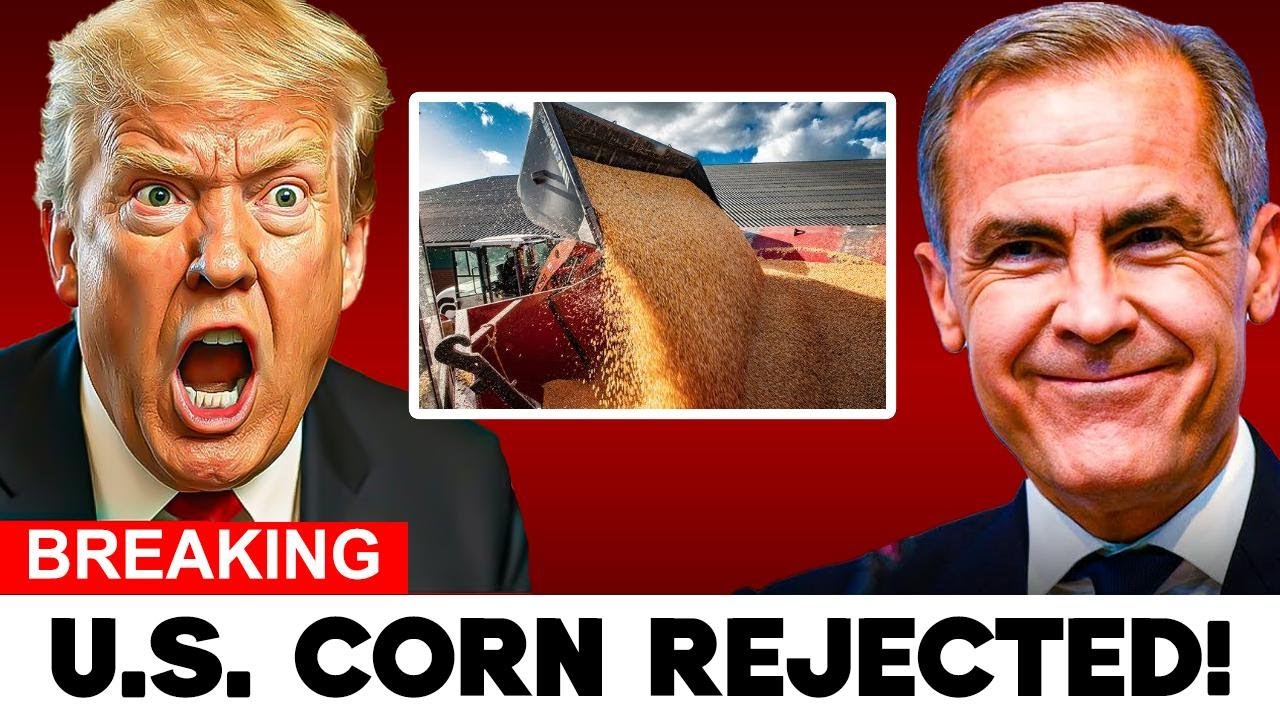
According to data from the United States Department of Agriculture, U.S. corn exports declined sharply over the past marketing year, with some estimates pointing to a drop of roughly 30 percent compared with earlier peaks. Analysts attribute the fall to a convergence of forces: retaliatory tariffs linked to broader trade disputes, currency fluctuations that have made American grain less competitive, and stricter phytosanitary standards in importing countries.
Several Asian and European buyers have delayed or declined cargoes over concerns about pesticide residues and documentation requirements, industry officials say. While such disputes are not unprecedented, exporters describe a more cautious global environment in which buyers are diversifying suppliers rather than relying heavily on a single country.
Canada has been among the beneficiaries.
Though better known for wheat and canola, Canada has expanded its corn exports in recent years, capitalizing on strong harvests, efficient port logistics and a reputation for regulatory consistency. Trade groups report new multiyear agreements with buyers in Japan and other parts of Asia, as well as increased shipments to Mexico — historically the largest foreign market for U.S. corn.
Canadian officials have emphasized quality assurance and traceability standards that align closely with evolving import rules abroad. In a market where margins are thin and disruptions costly, reliability can carry as much weight as price.
The repercussions for American farmers are significant. Corn is the nation’s largest crop by acreage, planted on roughly 90 million acres in a typical year. Exports account for a substantial share of demand, supporting farm incomes across Iowa, Illinois, Nebraska and other Midwestern states. When foreign purchases slow, domestic stockpiles can build quickly, pushing prices lower.
The pressure comes at a politically sensitive moment. Agriculture has long played an outsized role in electoral politics, and rural communities remain a key constituency for both parties. Trade tensions during the administration of Donald Trump reshaped long-standing relationships, particularly with China, once the largest buyer of American soybeans and an important customer for corn.
China’s purchases of U.S. corn surged in 2020 and 2021 but have since fluctuated sharply amid geopolitical strains and Beijing’s efforts to diversify supply. Brazil has expanded its role as a competitor in both soybeans and corn, investing heavily in port and rail infrastructure to speed shipments to Asia.
India has emerged as another flash point in the debate, though for different reasons. U.S. officials have criticized New Delhi for declining to import significant volumes of American corn. But India produces most of the grain it consumes and maintains tariff and biotechnology policies designed to shield its farmers and limit genetically modified imports. Nearly all corn grown in the United States is genetically engineered, while India prohibits commercial cultivation of GM corn and tightly restricts imports.
Trade experts say that framing India’s position solely as protectionism overlooks domestic political realities. Agriculture employs a large share of India’s workforce, and food policy remains closely tied to rural stability. Imports, when needed, often come from neighboring countries with lower freight costs.
The broader issue for the United States is not a single market but perception. For decades, global buyers viewed American agriculture as the benchmark — abundant, standardized and insulated from political risk. Recent tariff disputes and regulatory disagreements have introduced new uncertainty.
“Trust takes years to build and far less time to erode,” said one agricultural economist who advises grain traders. “When buyers see volatility — whether in pricing, policy or inspections — they hedge.”
That hedging is evident in procurement strategies that now spread risk across multiple suppliers. Canada, Brazil and Ukraine have all increased their presence in markets where U.S. grain once faced limited competition.
For consumers, the consequences are less immediate but still relevant. If American farmers respond to weaker exports by reducing acreage in coming seasons, domestic supplies could tighten, eventually affecting feed costs and food prices. Livestock producers, who rely heavily on corn for animal feed, are watching closely.
None of this signals a collapse of American agriculture. The United States remains one of the world’s largest and most technologically advanced grain producers, with deep infrastructure and longstanding trade relationships. But the current moment marks a transition from dominance to competition in a market that is increasingly multipolar.
In that environment, pricing, logistics and regulatory alignment matter as much as sheer output. Countries that once defaulted to American shipments are reassessing their options. Canada’s recent gains reflect not only its harvests but also its positioning as a predictable partner in a turbulent trade climate.
Whether the United States regains lost ground will depend on more than a single growing season. It will require rebuilding confidence in the stability of its trade commitments and adapting to a marketplace where buyers have choices — and are willing to use them.