🔥 BREAKING: CANADA’S $5.7B BRIDGE RESHAPES NORTH AMERICAN TRADE — POWER BALANCE SHIFTS AT THE BORDER 🌉
For more than 90 years, a single span across the Detroit River has carried an outsized share of trade between the United States and Canada. When the new Gordie Howe International Bridge opens in early 2026, that era of singular control will end — with economic and political consequences that reach far beyond Michigan and Ontario.
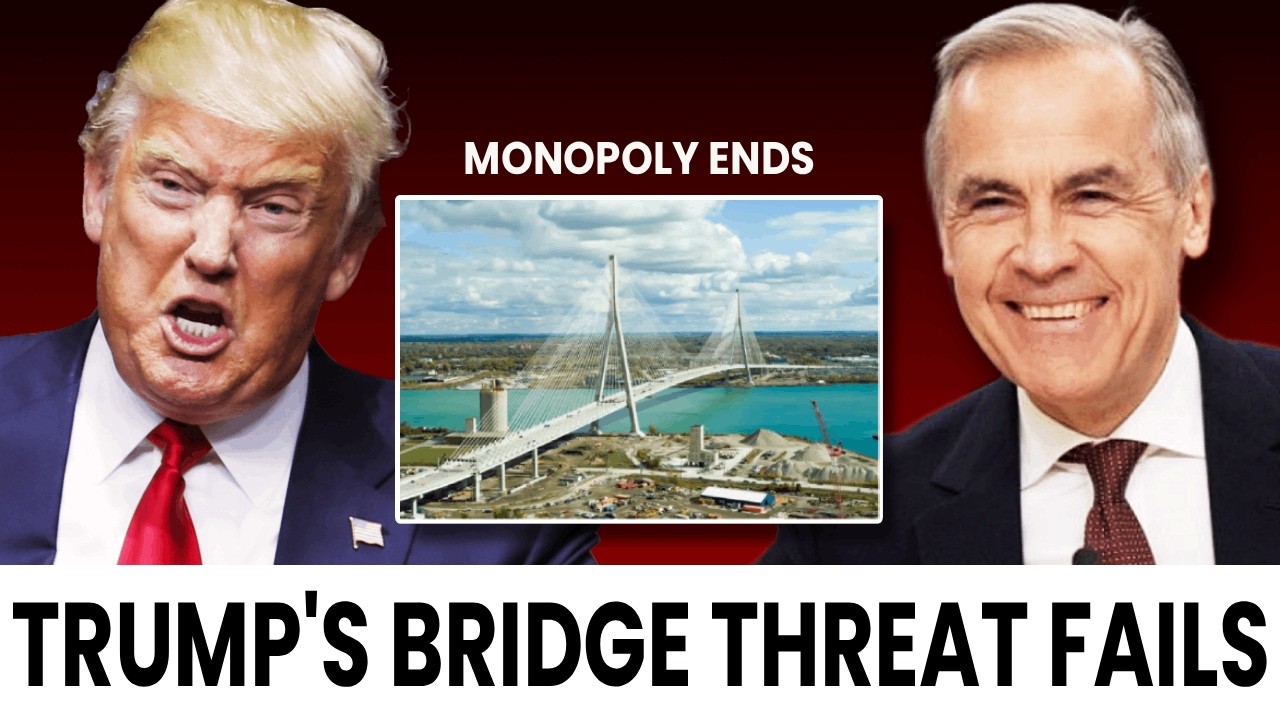
The nearly $5.7 billion bridge, financed entirely by Canada under a 2012 bilateral agreement, will connect Windsor, Ontario, directly to Interstate 75 in Detroit, creating a second major commercial crossing in the busiest trade corridor between the two countries. Roughly 25 percent of all U.S.-Canada merchandise trade — including an estimated $51 billion in automotive goods in 2023 alone — moves through the Detroit-Windsor gateway.
For decades, however, heavy truck traffic has relied primarily on one privately owned span: the Ambassador Bridge, opened in 1929 and controlled since 1979 by businessman Manuel “Matty” Moroun and his family. The bridge has long functioned as a critical artery for auto parts, steel, agricultural goods and advanced manufacturing components that crisscross the border multiple times before a finished vehicle rolls off an assembly line.
That concentration of control has worried policymakers for years. The vulnerability became unmistakable in 2022, when truckers protesting pandemic restrictions blocked the Ambassador Bridge for six days. Assembly plants in Michigan and Ontario quickly felt the strain. Automakers including Ford, General Motors and Stellantis curtailed operations as supply chains faltered.
The disruption underscored what Canadian officials had concluded long before: allowing a quarter of bilateral trade to hinge on a single, privately owned crossing posed an unacceptable risk. Ottawa’s response was structural rather than rhetorical. It committed to building a publicly overseen alternative designed to introduce redundancy, competition and more efficient highway connections.
The Gordie Howe bridge — named for the late hockey legend — will be the longest cable-stayed bridge in North America. Unlike the Ambassador Bridge, which funnels trucks into city streets on the Canadian side, the new crossing links directly to Highway 401 in Ontario and Interstate 75 in Michigan. Studies by the University of Windsor estimate that eliminating urban bottlenecks could save about 20 minutes per trip and generate billions of dollars in long-term efficiency gains.
The financial arrangement behind the project is unusual. Under the 2012 Canada-Michigan Crossing Agreement, Canada agreed to finance construction on both sides of the border, including U.S. customs facilities. Michigan receives 50 percent ownership without upfront cost; Canada will collect initial toll revenue to recoup expenses before sharing net proceeds with the state.
The agreement was negotiated under Michigan’s Republican governor at the time, Rick Snyder, and received necessary federal approvals, including a presidential permit issued by the U.S. State Department in 2013. In 2017, President Donald Trump publicly endorsed the project as an important economic link. A federal appropriation later supported American customs infrastructure at the site.
Construction is now about 98 percent complete, with technology testing underway. The U.S. Department of Homeland Security has designated the crossing as an official port of entry, clearing one of the final procedural hurdles before opening.
Yet the project has recently re-entered the political spotlight. Mr. Trump posted on social media that he would seek to block the bridge’s opening unless the United States was “fully compensated,” arguing that the structure lacked sufficient American ownership or benefit. Public records indicate that Michigan already holds a 50 percent stake under the binding 2012 agreement, and that American workers and materials have been extensively involved in construction.
Legal experts note that revoking a presidential permit more than a decade after issuance, or attempting to nullify an international agreement ratified by both governments, would invite significant legal challenges. Michigan officials from both parties have expressed support for the bridge, emphasizing its importance to the state’s manufacturing base.
Senator Debbie Stabenow and other lawmakers have warned that delaying the opening would harm Michigan workers and businesses. Governor Gretchen Whitmer has described the project as central to job growth and regional competitiveness. Even Mr. Snyder, the Republican who helped broker the original deal, has argued publicly that obstructing the bridge would damage American interests more than Canadian ones.
Beyond the political rhetoric lies a broader strategic shift. By financing and constructing its own publicly overseen crossing, Canada has reduced its dependence on infrastructure it does not control. For decades, exporters relied on a single privately owned bridge to access their largest trading partner. Once the new span opens, freight operators will have a choice, and toll rates will be subject to competitive pressure.
The change will not sever the deep economic ties between the two nations. About 8,000 trucks cross the Detroit River daily, supporting roughly 150,000 jobs on both sides of the border. Nearly 5,000 Canadians commute into Detroit for work. The auto sector, in particular, remains tightly integrated, with parts routinely crossing back and forth multiple times during production.
But the balance of leverage will subtly shift. Infrastructure shapes power. When alternatives exist, the ability of any single actor — public or private — to exert pressure diminishes. The Gordie Howe bridge represents not only a transportation upgrade but also a form of economic insurance against disruption, whether caused by protest, pricing disputes or political maneuvering.
When the first trucks roll across the new span in 2026, the immediate effect will be practical: shorter travel times, reduced congestion and, potentially, lower tolls. The longer-term impact may be quieter but more enduring — a reconfigured trade corridor in which redundancy replaces monopoly and cross-border commerce rests on two pillars rather than one.