CARNEY ERUPTS WITH MASSIVE TRADE SHIFT — $2.5 TRILLION NETWORK LOCKS OUT U.S. ACCESS — TRUMP’S TARIFF THREATS
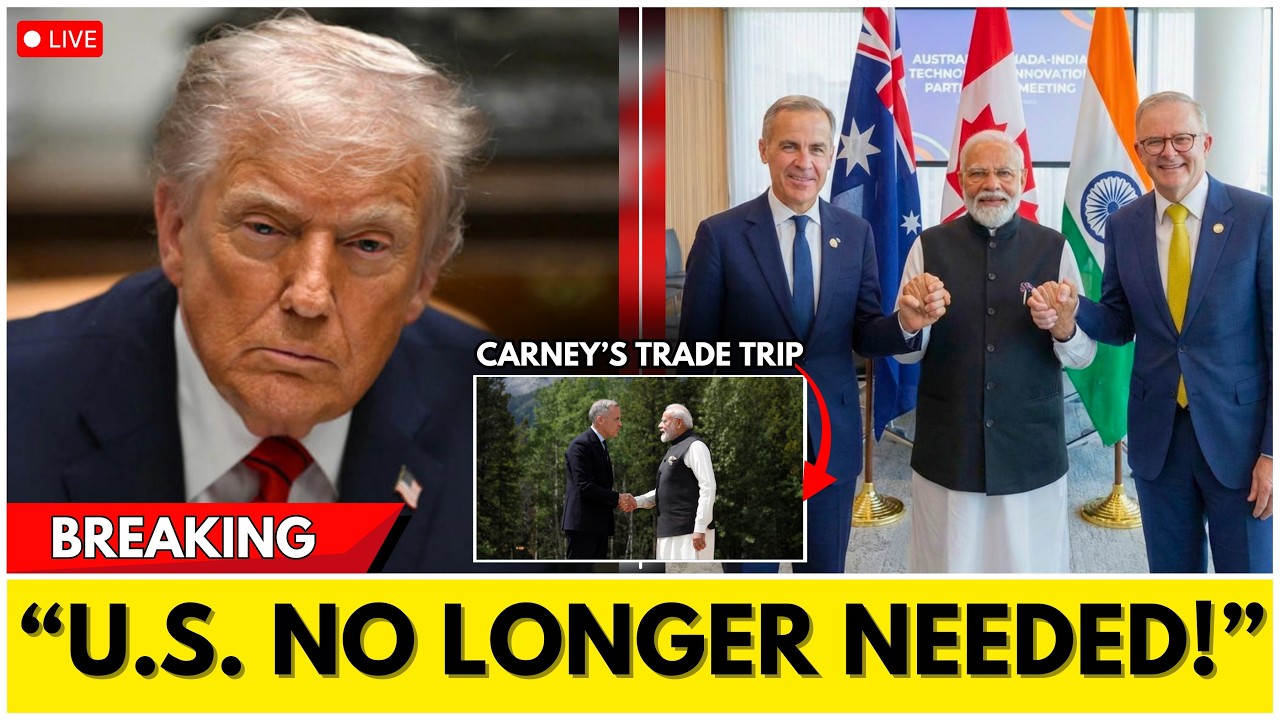
In the high-stakes world of international politics, Canadian Prime Minister Mark Carney is making waves with a bold economic maneuver. As tensions escalate between Canada and the United States over trade policies, Carney’s upcoming nine-day tour to India, Australia, and Japan signals a significant pivot. This strategic outreach aims to forge a $2.5 trillion trade network, diversifying Canada’s economic dependencies amid threats of 100% tariffs from former U.S. President Donald Trump. Drawing on recent announcements and financial data, this move underscores a shift in global alliances, highlighting how middle powers are navigating great power dynamics.
Carney’s Indo-Pacific Itinerary: A Diplomatic Power Play
Prime Minister Mark Carney boards a plane on February 26, 2026, embarking on a whirlwind tour that spans Mumbai, Delhi, Sydney, Canberra, and Tokyo. Over nine days, he will meet with three prime ministers to discuss trade, energy, technology, and defense. The official narrative frames this as “trade diversification,” but underlying data reveals a systematic effort to build alternative revenue streams independent of U.S. markets.
This itinerary comes hot on the heels of Trump’s January 2026 tariff threats, triggered by Canada’s preliminary trade deal with China. That agreement lowered tariffs on Chinese electric vehicles in exchange for reduced barriers on Canadian agricultural products. Trump labeled it as Canada becoming a “drop-off port” for Chinese goods, potentially exploiting USMCA rules for tariff arbitrage. Within 72 hours of the threat, Carney’s trip was announced, illustrating a rapid response to mitigate economic vulnerabilities.
Canada’s current trade landscape is heavily skewed: 75% of its exports flow to the U.S., creating a dependency trap. In 2023, merchandise trade under USMCA reached $1.9 trillion, a 30% growth since implementation. However, this concentration allows the U.S. to wield significant leverage, from tariff impositions to demands for policy concessions. Carney’s mission seeks to dilute this influence by expanding partnerships in the Indo-Pacific.
Building Ties with India: Doubling Trade Volumes by 2030
India stands as a cornerstone of this diversification strategy. Bilateral trade hit $30.8 billion in 2024, positioning India as Canada’s seventh-largest partner. Negotiations for a Comprehensive Economic Partnership Agreement (CEPA), launched at the November 2025 G20 Summit in Johannesburg, aim to boost this to $70 billion by 2030—more than doubling in four years.
During Carney’s visit, discussions will cover trade, clean energy, AI, talent mobility, culture, and defense. Canada eyes India’s booming consumer market and tech sector, while India seeks Canadian critical minerals, energy resources, and pension fund investments. With India growing at 9.4% annually from 2019-2023 as the world’s fastest-growing major economy, the partnership makes economic sense.
The proposed CEPA would eliminate tariffs on 99% of goods, opening doors for Canadian canola, wheat, pork, and beef exports. In return, India gains access to uranium, LNG, and minerals for batteries and renewables. Beyond commerce, the trilateral Australia-Canada-India (ACI) Partnership, launched at the same G20, focuses on critical technologies, green energy, and resilient supply chains—code for reducing reliance on China or U.S. policy shifts.
Canada contributes AI research and clean tech; India offers scale and engineering talent; Australia provides minerals and manufacturing. This creates a technology corridor across continents, accelerating AI adoption, net-zero goals, and joint ventures in solar, wind, and hydrogen.
Strengthening Bonds with Australia: Investments Over Trade Flows
Australia’s role emphasizes investment over mere trade. Bilateral merchandise trade was $6.1 billion in 2024, but Canadian direct investment there reached $58.8 billion—eighth globally and largest in the Indo-Pacific. Australian investments in Canada total $28.5 billion, fostering mutual dependence.
Carney’s address to both houses of Australian Parliament—the first by a Canadian PM in nearly 20 years—signals constitutional-level commitment. Talks will cover defense, maritime security, critical minerals, AI, and capital attraction. Both nations, as Pacific powers, share challenges from China proximity and U.S. trade reliance.
The Comprehensive and Progressive Agreement for Trans-Pacific Partnership (CPTPP), effective since 2018, has driven 6.9% annual trade growth. The Canada-Australia Economic Leadership Forum ensures institutional continuity, with meetings in Sydney (February 2025) and Vancouver (May 2026).
Deepening Relations with Japan: Energy and Agriculture Focus
Japan, Canada’s fifth-largest trading partner, saw $36.4 billion in bilateral trade in 2024. Canadian exports ($15 billion) include energy and minerals (41.8%) like coal, petroleum, copper, and agricultural products (26.8%) such as canola, wheat, pork, and beef. Japan, the world’s largest net food importer, relies on Canada as its second-largest supplier for wheat, canola, and pork.
Imports from Japan ($21.4 billion) are dominated by automotive parts (44.5%). Japanese FDI in Canada hit $29.1 billion by 2016, sixth globally and largest from Asia. CPTPP has eliminated tariffs on 99% of goods, boosting pork exports to over $1.2 billion in 2023.
Aggregated Impact: A $130 Billion Trade Boost by 2030
Combining these partnerships: current trade totals $73.3 billion ($30.8B India, $6.1B Australia, $36.4B Japan). Projections reach $130 billion by 2030 ($70B India, $15B Australia, $45B Japan). Investment stocks exceed $90 billion Canadian outbound and $50 billion inbound, creating $140 billion in mutual assets for policy stability.
This shifts Canada’s economic gravity, potentially raising Indo-Pacific exports to 15-20% of total, reducing U.S. leverage. If American markets close, the pain is severe but survivable, altering negotiation dynamics.
U.S.-Canada Tensions: Trump’s Tariffs and Broader Implications
Trump’s threats stem from fears of Chinese goods flooding U.S. via Canada, undermining American barriers. Daily cross-border flows of $3.6 billion could collapse under 100% tariffs, ending USMCA. Carney counters by accelerating diversification, not capitulation.
At Davos, Carney urged middle powers to unite against coercion, earning international praise. This reflects eroding U.S. institutional credibility, as executive workarounds bypass judicial limits on tariffs.
Probable outcomes include faster India negotiations, ACI implementation with funding and visas, and Carney’s parliamentary speech framing collective action. Trump may escalate, testing network resilience.
Ultimately, this $2.5 trillion network—aggregating projected trade and investments—rebuilds Canada’s economic security amid volatility. Allies learn that U.S. integration brings vulnerability, prompting redundancy over severance.