Trump’s Fertilizer Tariff Threat Exposes America’s Most Dangerous Agricultural Dependency
Donald Trump’s latest tariff threat against Canada isn’t just another trade skirmish — it’s a direct hit to the foundation of American food production.
This week, Trump warned of “severe fertilizer tariffs” on Canada, a move that left much of the agricultural industry scratching its head. The confusion is understandable: the U.S. president has spent months reducing fertilizer levies, not raising them. Reversing course now would immediately drive up costs for American farmers — and ultimately for American families.
And while the move could sting Canada’s fertilizer sector, the reality is far more uncomfortable for Washington.
Because buried beneath Canadian soil is a pinkish mineral that quietly keeps the world fed — and the United States is dangerously dependent on it.
That mineral is potash.
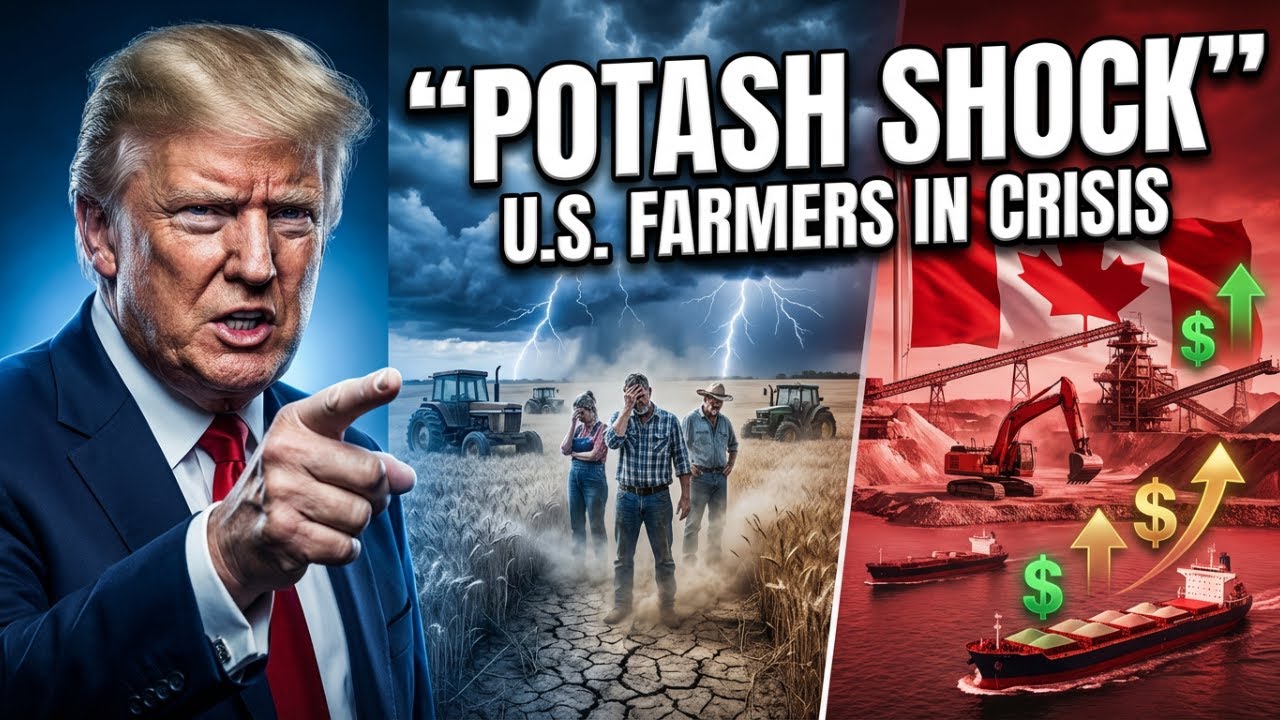
The Pink Rock That Keeps America Alive
Potash is an irreplaceable nutrient in modern agriculture. Without it, crops simply do not grow at scale. According to The Fertilizer Institute, roughly 85–87% of all U.S. potash imports come from Canada, a dependency so extreme that there are virtually no viable substitutes.
You cannot just decide to mine potash anywhere. These deposits are geographically rare, formed millions of years ago, and staggeringly expensive to develop.
Canada won that geological lottery.
-
Canada holds 1.1 billion tons of potash reserves — roughly five times more than the United States
-
In 2023, Canada accounted for 32% of global production and over 41% of global exports
-
Canada’s potash mining scale is 36 times larger than that of the U.S.
In short: Canada doesn’t just participate in the potash market — it dominates it.
America Has Demand, Not Supply
The United States does operate a handful of domestic potash mines in Utah, New Mexico, and Michigan. But industry experts consistently note that these facilities struggle with lower-grade rock and limited output.
America’s alternative suppliers?
Belarus and Russia — an option that, in today’s geopolitical climate, is about as reliable as a chocolate teapot.
This leaves U.S. agriculture with a brutal reality:
Canada has the supply.
America has the demand.
And tariffs don’t change geology.
Nutrien and Canada’s Strategic Advantage
At the center of this dependency sits Nutrien, the world’s largest producer and exporter of potash.
-
Nutrien sold 14.4 million metric tons in 2024
-
It owns 6 of Canada’s 11 active mines, all in Saskatchewan
-
Those mines produced 21.9 million tons in 2023 alone
Canada also has what many resource-rich countries lack: infrastructure. Rail, ports, and logistics are already in place to move massive volumes efficiently.
Then came the trade shock.
Tariffs That Hit Farmers First
In February 2025, Trump imposed tariffs on Canadian fertilizer imports, initially setting them at 25%, before scaling them back to 10% following fierce backlash from American farmers and industry groups.
But the damage was already done.
-
The U.S. import price index for chemical fertilizers jumped from 164.5 (Dec 2024) to 186.5 (Sept 2025)
-
Fertilizer now represents up to 45% of operating costs for corn farmers
-
Potash prices hover around $450 per ton
A full 25% tariff would add more than $100 per ton — a cost farmers cannot absorb.
As Josh Linville of StoneX explains, potash is different from other tariffed goods:
Canada doesn’t need to discount. It controls the market.
Those costs pass straight to farmers.
And farmers don’t set prices — global markets do.
A Universal Tax on Food
Agricultural economists warn this is effectively a tax on food production itself.
-
Nearly every major crop uses potash
-
Farm income is already declining
-
Corn producers face a third straight year of weak prices
-
Fertilizer costs remain near historic highs after COVID, the Ukraine war, and soaring energy prices
Professor Bill Knudson of Michigan State warns that tariffs push potash prices up and profits down — across the board.
And consumers don’t escape the fallout.
Food prices rise next.
Can the U.S. Mine Its Way Out?
There is a proposed potash mine in Michigan’s Osceola County that could eventually produce 800,000 tons per year, backed by a $1.1 billion federal loan that only received conditional approval in early 2025.
Even under ideal conditions, experts say it would take years — possibly a decade — to meet domestic demand.
Meanwhile, Canada is expanding.
BHP’s massive Jansen project in Saskatchewan is expected to come online by 2027, set to become one of the largest potash mines in the world.
Canada is preparing to flood global markets.
American farmers are trapped behind a tariff wall.
You Can’t Tariff Geology
By late 2025, Trump signaled he was considering even harsher fertilizer tariffs, claiming they would boost U.S. production.
Industry groups strongly disagree.
The Fertilizer Institute has begged for exemptions, calling Canadian potash a “vital lifeline” for U.S. agriculture.
The core problem remains unsolved.
You cannot legislate mineral deposits.
You cannot fast-track geology.
And you cannot threaten your way out of dependence.
Canada has the potash.
America needs it.
And the cost of ignoring that reality is already being felt — not in trade statistics, but in every aisle of the American grocery store.