Trump’s Open Acknowledgment of Impeachment Risk Reflects Rising Political and Legal Tensions
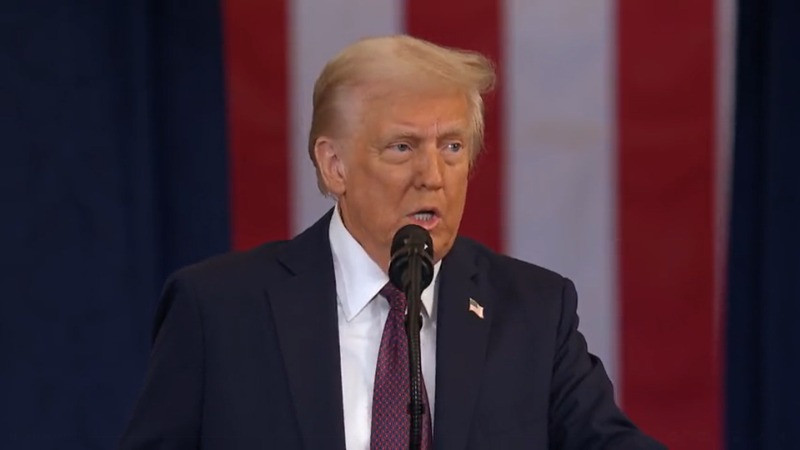
WASHINGTON — President Donald Trump surprised political observers this week by openly warning House Republicans that if they fail to retake the House majority in the 2026 midterm elections, Democrats would pursue impeachment. The remarks, delivered at a retreat of Republican lawmakers, drew immediate scrutiny from both sides of the aisle and crystallized a moment of deepening constitutional conflict as Trump’s presidency enters its second year. (AOL)
“I’ll get impeached,” Trump told Republican representatives, bluntly linking the party’s electoral prospects to his political survival. “You’ve got to win the midterms, because if we don’t… they’ll find a reason to impeach me.” (AOL)
The comments reflect a rare moment of candor from a president who has long dismissed impeachment as partisan theater. Trump’s warning came nearly a week after he ordered a controversial military operation in Venezuela that resulted in the capture of President Nicolás Maduro and his wife — an action that many constitutional scholars, lawmakers, and even some Republicans have labeled unauthorized and potentially unlawful. (Bloomberg.com)
A Foreign Policy Gambit Ignites Domestic Backlash
On January 3, U.S. forces carried out a pre‑dawn strike in Caracas that Trump administration officials described as a highly successful mission to apprehend Maduro on drug trafficking and corruption charges. “It was a brilliant operation,” Trump told reporters in subsequent days, defending the decision as necessary to disrupt criminal networks and protect American security. (Reddit)
But the operation — which Trump repeatedly claims gives the United States control over Venezuelan affairs and potentially its vast oil reserves — has triggered a cross‑aisle backlash in Congress. Many lawmakers argue that the president acted without the constitutionally required authorization from Congress. “A military operation to capture and overthrow a president — even an illegitimate one — is an act of war that must be authorized,” said Senator Chris Coons, the Democratic member of the Senate Appropriations Subcommittee on Defense. (Global Times)
As a result, the Senate advanced a bipartisan war powers resolution intended to curb further unilateral military actions by the White House. The measure — supported by five Republican senators along with all Democrats — sends a stark message that Trump’s most hawkish allies in Congress are not automatically united behind his strategy. (The Guardian)
At the same time, the Biden administration’s former allies abroad have voiced deep concern. United Nations officials warned that the operation, widely seen as a breach of international norms, “makes all states less safe,” and global powers such as China and Russia are actively exploiting the fallout to undermine U.S. credibility. (The Guardian)
Impeachment Talk Is No Longer Hypothetical

Trump’s invocation of impeachment has injected new urgency into what had been a cautious debate among Democrats about whether pursuing impeachment again is politically or strategically wise.
In the House, several Democrats — including Representatives Dan Goldman, Delia Ramirez, and Al Green — have publicly described Trump’s Venezuela operation and other actions as impeachable offenses, arguing that the Constitution’s separation of powers and congressional war‑making authority have been violated. (Reddit)
But leading Democrats have been more circumspect. Some argue that pushing for impeachment now could distract from the party’s broader objective of winning back control of the House in November — a necessary first step for any formal impeachment inquiry. “We don’t have the votes now,” said Senator Peter Welch, a former House member who previously voted to impeach Trump in his first term. “We’ve got to win at the ballot box.” (Reddit)
Others, including Senator Adam Schiff, are advocating for war powers legislation as a more immediately achievable check on executive authority, even as they acknowledge Trump’s actions may indeed meet the constitutional standard for impeachment. “This could force a real debate about the president’s use of military force,” Schiff told reporters. (PBS)
Political Calculus vs. Constitutional Duty
Legal experts and historians emphasize that impeachment — a political as well as constitutional tool — is meant to address “high crimes and misdemeanors,” but exactly what qualifies remains a matter of fierce debate. Even if the House were to impeach Trump, removal would require a two‑thirds vote in the Senate, a threshold that Democrats are unlikely to reach even if they also flip control of that chamber. Betting markets currently favor Republican control of the Senate after the midterms, making a conviction improbable. (Bloomberg.com)
“That’s always been my view: if the president did something worthy of impeachment, you should impeach,” said one constitutional scholar familiar with congressional deliberations. “But we are not likely to see enough Republican senators cross the aisle for conviction.”
Trump himself appears to understand this dynamic, and some political analysts believe his blunt remarks about impeachment are designed in part to rally Republican voters around the perceived threat. By framing the stakes of the midterms as a referendum on his presidency’s survival, Trump may be attempting to nationalize local races and boost turnout among his base.
Social Media and Public Discourse Escalate
Across social media platforms, reactions to Trump’s comments and the Venezuela episode run from outrage to bemusement.
On Reddit’s political forums, users have described the situation with a mix of humor, cynicism, and alarm. Some noted the irony of Trump openly acknowledging impeachment as a real possibility, reflecting a broader sense of disbelief that such a moment could arrive within weeks of a highly controversial foreign intervention. (Reddit)
Other users pointed out internal divisions among Democrats — with some arguing the impeachment chat is premature and potentially counterproductive, while others insist that Trump’s actions constitute a clear abuse of executive power. (Reddit)
Such exchanges illustrate how social media has become a parallel arena for political debate, shaping narratives and amplifying voices that sometimes diverge from official party positions.
Legacy, Polarization, and the Road Ahead
Trump’s public preoccupation with legacy — and particularly how history will judge his presidency — was evident in his remarks to lawmakers. Insiders say the president is intensely focused on how the midterms and a potential impeachment might define his political imprint. With legislative achievements limited and the Supreme Court already reshaped, Trump’s inclination toward bold — and often controversial — actions abroad may be a bid to cement his place in history.
For now, the nation remains deeply divided. Republicans overwhelmingly defend Trump’s Venezuela action as decisive leadership, while many Democrats and constitutional conservatives view it as an alarming overreach. The impeachment conversation, once peripheral to mainstream politics, has now moved squarely into the spotlight — not as a distant possibility but as an active element of the 2026 electoral calculus.
Whether Democrats will actually pursue articles of impeachment and how voters will respond to Trump’s strategy remains uncertain. But one thing is clear: in an era of intense polarization and heightened institutional conflict, the lines between domestic politics and foreign policy have never been more blurred.