For decades, the energy relationship between Canada and the United States followed a familiar, almost unquestioned pattern. Canadian oil and gas moved south. American pipelines, ports, regulators, and pricing hubs shaped how that energy traveled and how much influence it carried. The arrangement was rarely framed as dependency, but in practice it created one. Canada produced. The United States controlled the routes. And control over routes has always translated into geopolitical leverage.
That balance began to change quietly, without speeches or public declarations. While political attention remained fixed on tariffs, regulatory disputes, and trade rhetoric, infrastructure decisions were unfolding far from the spotlight. A new westward logic started replacing the traditional north–south flow. Energy that once had no practical alternative but to move through American systems began finding paths that bypassed them entirely. The shift was subtle at first, easy to miss unless one was watching shipping routes rather than press conferences.
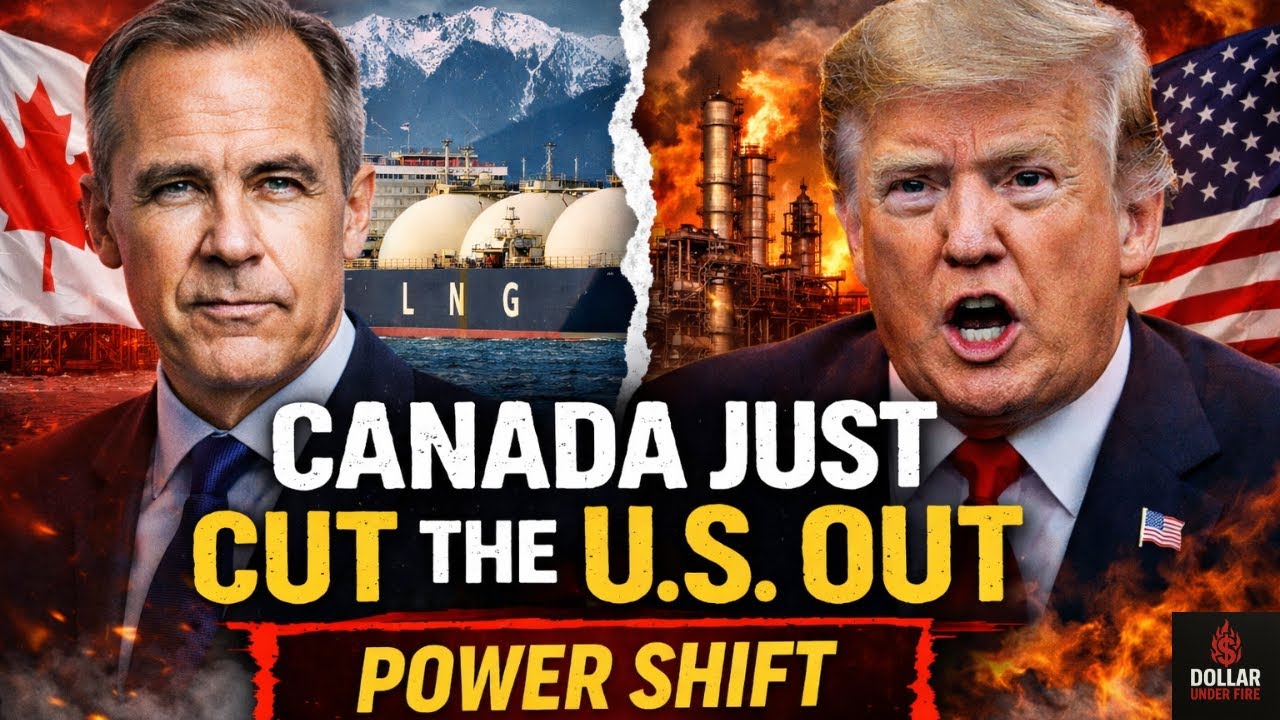
The symbolic moment came when liquefied natural gas shipments departed Canada’s Pacific coast bound directly for Asian markets. Unlike earlier exports, these cargoes did not rely on U.S. pipelines, ports, or transit approvals. They crossed the Pacific without touching American infrastructure, removing long-standing chokepoints from the equation. In logistical terms, the change reduced shipping time dramatically compared to U.S. exports that must navigate congested routes and canal delays. In political terms, it signaled something deeper: Canada no longer needed permission to reach global buyers.
What made the move significant was not volume alone, but permanence. These were not trial shipments or temporary diversions. They were the opening phase of long-term export systems backed by private capital, locked-in contracts, and expansion plans already approved. Once operational, such infrastructure is difficult to reverse. Steel in the ground changes behavior long before policy catches up. And by the time external pressure appeared, the routes were already functioning.
This reorientation did not stop with gas. Canadian oil, long assumed to be destined almost exclusively for American refineries, began to gain credible alternatives. New westbound routes opened the possibility of crude reaching Pacific terminals and onward to Asia or Latin America. Importantly, Canada did not restrict supply to the United States. Instead, it removed exclusivity. American buyers could still purchase Canadian crude, but they would increasingly do so in competition with global markets, subject to global pricing dynamics.
That distinction matters. Cutting supply would have sparked immediate backlash. Creating options, however, shifts leverage quietly. Refiners built on the assumption of guaranteed access suddenly faced uncertainty. Replacing Canadian crude is not simple; alternatives often come from farther away, cost more to transport, and require adjustments in processing. Even small price differences can ripple through margins, inventories, and downstream fuel costs. None of this happens overnight, but the pressure accumulates.
Against this backdrop, tariff threats lost much of their force. Tools that once triggered rapid market reactions now produced muted responses. Energy flows continued. Buyers adjusted. Domestic pricing absorbed shocks. The absence of panic was telling. Tariffs rely on dependency to be effective. When exits exist, threats become background noise rather than decisive weapons.
In Washington, the realization set in slowly. The issue was no longer a single policy dispute or trade negotiation. It was structural. Power rooted in geography and legacy infrastructure was being challenged by mobility, speed, and diversification. The ability to move energy efficiently, without reliance on a single corridor or regulator, began to matter more than sheer production volume.
Canada’s approach contrasted sharply with U.S. delays. While American energy projects often stalled in litigation and regulatory deadlock, Canadian authorities streamlined approvals by elevating certain infrastructure beyond routine political cycles. Negotiations with local and Indigenous communities occurred earlier, focusing on long-term participation rather than courtroom battles. The result was alignment instead of paralysis, and projects that advanced while others remained stuck.
The broader implication is not that the United States suddenly lost all influence, but that influence is no longer assumed. Energy dominance, once treated as a permanent condition, now appears contingent on adaptability. Routes can change. Markets can shift. Allies can become independent actors without becoming adversaries. The Pacific is no longer a barrier; it is a highway. Asia is no longer a secondary outlet; it is a primary destination.
What unfolded was not loud or theatrical. That is precisely why it worked. By changing infrastructure rather than rhetoric, Canada altered the underlying mechanics of power. Energy kept flowing, but in different directions. Pricing centers adjusted. Diplomatic calculations evolved. The story is less about confrontation than about repositioning — a reminder that in the modern economy, leverage follows movement, not volume, and control fades fastest when it is assumed to be permanent.