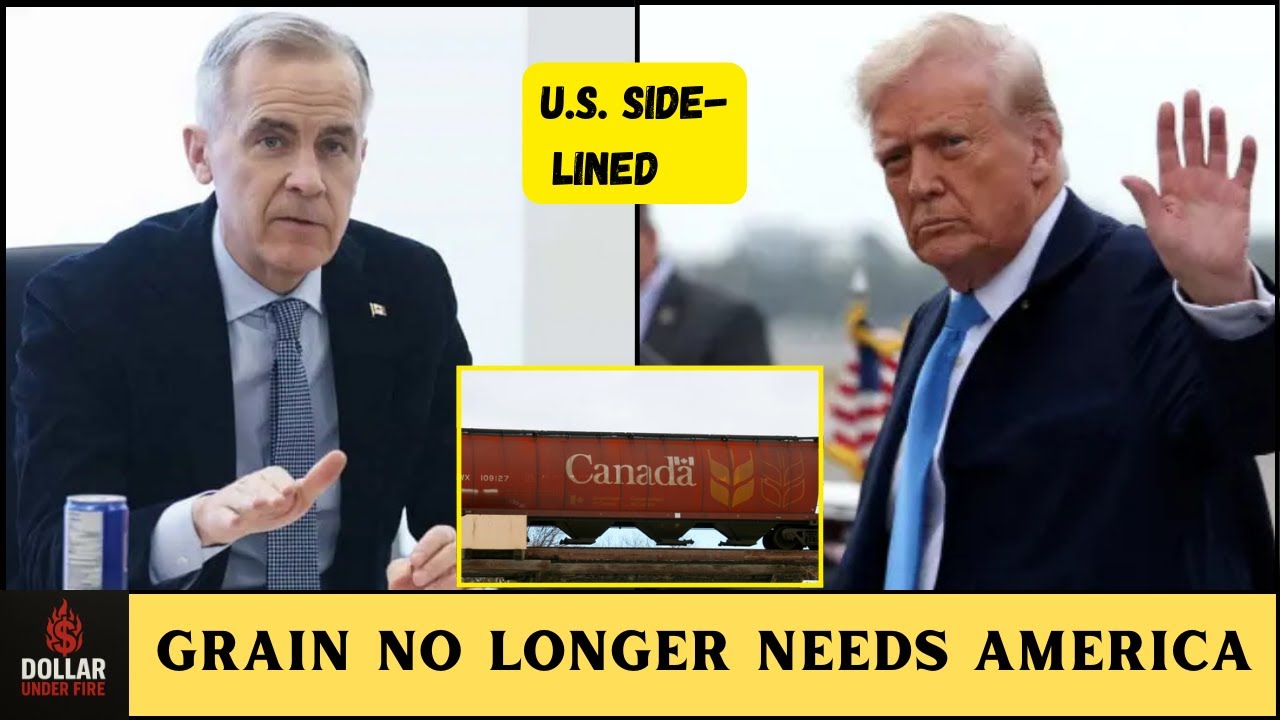
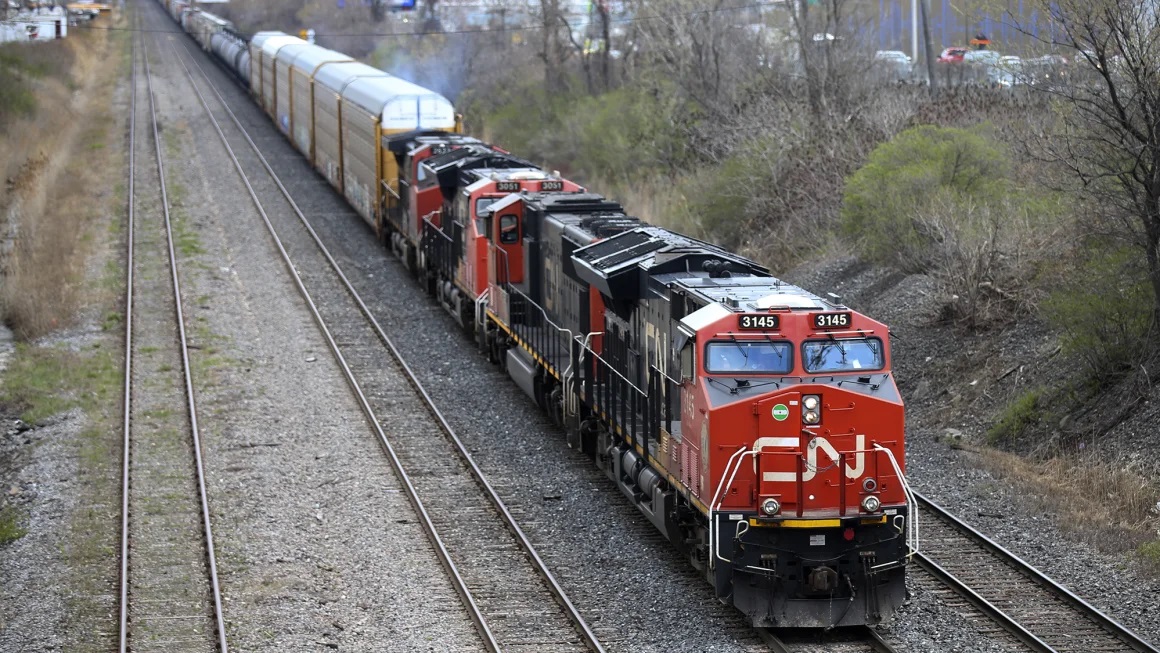
Winnipeg — The train did not announce itself. It did not stop for ceremonies or speeches. It crossed borders without fanfare, rolling south for more than 3,000 miles, carrying Canadian grain from the Prairies through the United States and into Mexico City. For most Americans, it passed unnoticed. For trade officials and agricultural economists, it marked something more consequential: a reordering of how influence works in North American food trade.
The shipment — wheat and other grains bound directly for Mexican buyers — was the first of its kind to travel uninterrupted from Canada to Mexico using a single rail corridor. It did not pass through U.S. export terminals. It did not rely on American ports or American exporters. It simply moved, end to end, from producer to buyer.
In practical terms, it was a proof of concept. In strategic terms, it was a signal.
For decades, the United States has occupied a central position in North American agricultural trade. Geography and infrastructure made American ports, terminals and logistics firms the default gateways for Canadian grain headed to global markets. That arrangement generated revenue, scale efficiencies and quiet leverage. It also fostered an assumption: that if Canada wanted to sell to the world, it would have to pass through American hands.
That assumption no longer holds.
The train’s journey was made possible by the integration of continental rail networks following the merger that created Canadian Pacific Kansas City. For the first time, a single operator controls a continuous rail line linking Canada, the United States and Mexico. What had once been fragmented national systems became a seamless corridor.
Ironically, much of the route runs through American territory, using American track, crews and maintenance yards. But the value capture has shifted. The fees that once accrued to U.S. export terminals, inspection services and port operators are no longer part of the chain. The infrastructure remains; the leverage does not.
“This is not about bypassing the United States physically,” said one agricultural economist who studies North American logistics. “It’s about bypassing the points where the United States extracted economic and strategic value.”
For American ports, the implications are subtle but serious. Pacific Northwest terminals long handled Canadian grain destined for Asia. Gulf Coast ports moved volumes south. Great Lakes facilities fed the St. Lawrence system. Each shipment generated jobs and revenue. Each reinforced scale advantages that kept U.S. exporters competitive globally.
Those volumes are now eroding. Canada has expanded its own port capacity in Vancouver and Prince Rupert. Eastern ports in Montreal and Quebec have absorbed traffic that once passed through American facilities. And now, direct rail shipments to Mexico eliminate the need for U.S. terminals altogether.
The effects are cumulative. Lower volumes mean higher per-unit costs. Higher costs compress margins. Compressed margins weaken competitiveness. Over time, American exporters lose pricing power — not because of retaliation, but because alternatives exist.
Mexico sits at the center of that shift. Once treated as a secondary destination, it has become a strategic market. Feed demand is rising. Food processing capacity is expanding. Mexican buyers, wary of policy volatility, have sought predictability. Direct Canadian access offers exactly that: fewer intermediaries, fewer choke points, less exposure to sudden regulatory or political shifts.
“From a buyer’s perspective, this is about risk,” said a logistics consultant who works with food processors in Mexico. “If you can lock in a multi-year supply with fewer variables, you do it.”
Once those contracts are signed, behavior changes. Supply chains settle. Habits form. And habits, in trade, are hard to reverse.
What makes the shift durable is the preparation behind it. Canada did not improvise. It invested quietly over years in rail capacity, rolling stock and port throughput. High-capacity hopper cars were added. Longer, heavier trains became standard. Scheduling systems were redesigned to prioritize reliability over speed.
Equally important were less visible changes. Export certification was digitized, reducing paperwork delays. Inspection processes were streamlined. Each incremental improvement removed a reason to rely on U.S. intermediaries.
Infrastructure, economists note, does not argue. Once built, it is used.
The result is a structural realignment rather than a tactical diversion. Even if political tensions ease, the routes will not automatically revert. Capital has been committed. Systems have been proven. Companies optimize around what works.
This is why the consequences are quieter than tariffs but potentially more lasting. American exporters are not being punished; they are being out-competed on efficiency. That distinction matters because it leaves little room for policy response. You cannot negotiate away a lower cost structure.
The shift also exposes a vulnerability in long-standing assumptions about geography. For years, proximity to U.S. ports was treated as destiny. Influence followed infrastructure. But infrastructure is not static. When alternatives are built, influence disperses.
Canada’s approach offers a case study in how leverage erodes in modern trade. There were no dramatic threats, no retaliatory measures. Instead, Canada reduced dependence. It built exits. It diversified routes. And by the time the consequences became visible, the grain was already gone.
For American agriculture, the risk is not collapse but gradual marginalization. Smaller volumes mean less blending flexibility, higher shipping costs and weaker negotiating positions with carriers. Over time, that can translate into lost contracts — not because U.S. grain is inferior, but because it arrives with more friction.
The story has drawn little public attention in the United States, in part because nothing broke. Trains still run. Ports still operate. But the economics underneath are shifting.
Trade historians note that such moments rarely announce themselves. Power in logistics fades through design choices rather than declarations. By the time headlines catch up, behavior has already changed.
For Canada, the gain is not merely economic. It is strategic autonomy. With multiple viable routes to market, the country is less exposed to external pressure. Independence, once built into infrastructure, does not require rhetoric to defend it.
For the United States, the lesson is uncomfortable. Influence derived from being indispensable lasts only as long as no one builds an alternative. Once they do, relevance must be earned anew.
The grain train will not be the last. Each successful run strengthens the corridor, encourages additional contracts and reinforces the logic of bypass. What began as an unnoticed shipment is becoming a pattern.
In modern trade, leverage does not disappear in a single moment. It thins, quietly, as options multiply elsewhere. Canada did not announce independence. It engineered it.
And as more grain rolls south without stopping, the message will become harder to ignore: in a system built on efficiency, those who are no longer needed rarely get asked again.