New York — A newly surfaced tranche of records from the Jeffrey Epstein investigation — identified as “Data Set 8” — has reignited scrutiny over how federal authorities have handled one of the most politically sensitive document releases in recent memory, while raising fresh questions about past associations involving T.r.u.m.p that prosecutors themselves once flagged as more extensive than publicly known.
The documents, briefly appearing online before being reposted with altered indexing, include internal communications, correspondence, and flight records that had not previously been accessible to the public. Their emergence followed public comments by Democratic Representative Ro Khanna, who said he expected the Department of Justice to release an additional batch of Epstein-related files. When no release appeared, journalists and researchers independently located a portal hosting the material, downloaded tens of thousands of pages, and began reviewing them before the department formally reposted the dataset later that night.
That sequence — an apparent early availability, followed by document renumbering and reorganization — has become a central source of concern for transparency advocates. Legal experts note that changing Bates numbers within hours complicates independent verification and comparison, making it more difficult to track what was altered, moved, or possibly withheld.

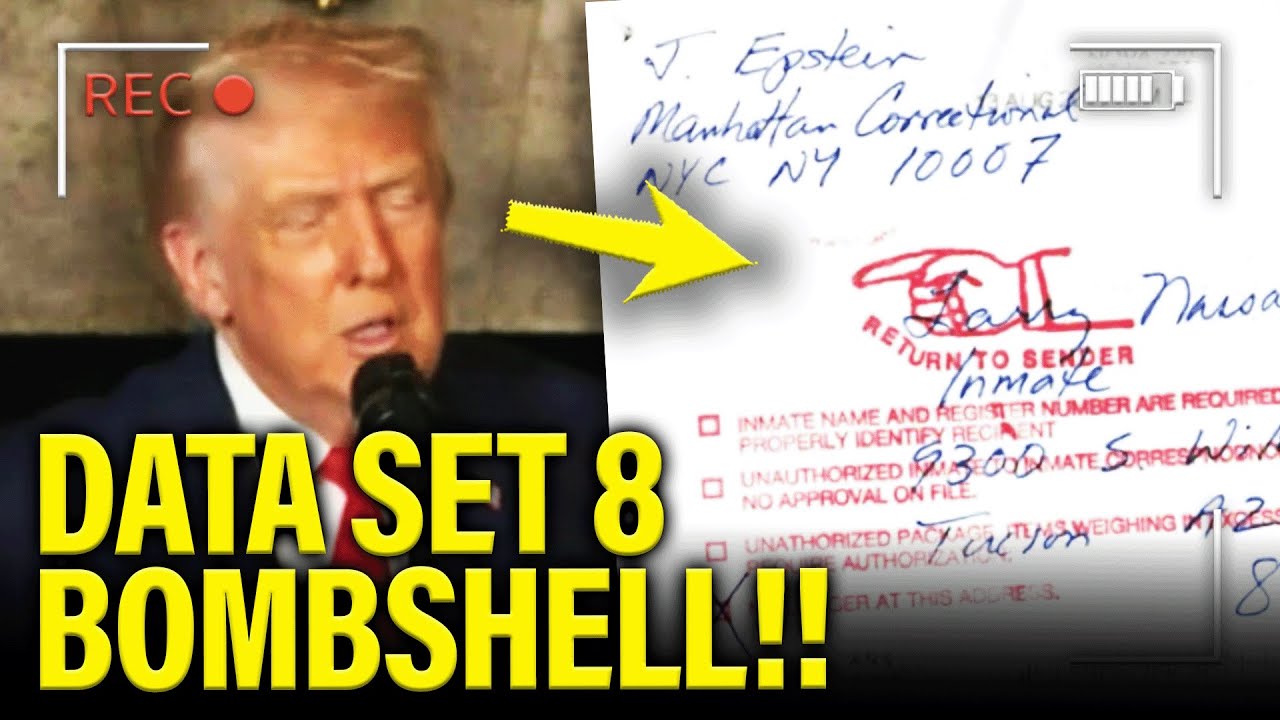
Among the most disturbing items is a letter attributed to Jeffrey Epstein and addressed to Larry Nassar, the former USA Gymnastics doctor now serving a lengthy sentence for s.e.x.u.a.l a.b.u.s.e. of minors. The letter, postmarked days after Epstein’s death, contains language so explicit that investigators previously flagged it for forensic handwriting analysis. Records within Data Set 8 show the FBI sent the letter for examination, though no conclusion has been publicly released confirming authorship.
The existence of such a letter was previously referenced in Bureau of Prisons emails obtained through Freedom of Information Act requests and reported by the Associated Press in 2023. Until now, however, the actual text had not surfaced in public-facing files. Prison officials at the time debated whether the correspondence — discovered in a jail mailroom weeks after Epstein’s death — should be opened or turned over to investigators.
Another document drawing particular attention is an internal email from assistant U.S. attorneys in the Southern District of New York discussing Epstein’s flight logs. The email states that records showed T.r.u.m.p traveled aboard Epstein’s private aircraft “many more times than previously reported,” including during periods prosecutors believed were relevant to the criminal case against Ghislaine Maxwell. According to the memo, T.r.u.m.p was listed on at least eight flights between 1993 and 1996, several of them alongside Maxwell, and on one flight as Epstein’s only fellow passenger.

The prosecutors’ message, marked for “situational awareness,” emphasized that the review covered more than 100 pages of tightly written flight data and warned colleagues not to be surprised by the scope of what the records showed. Some flights, the email noted, included individuals whose names were redacted — a practice often used to protect potential victims or witnesses.
While T.r.u.m.p has long denied wrongdoing and previously acknowledged only limited social contact with Epstein, the prosecutors’ own assessment suggests a deeper level of interaction than the public narrative has reflected. No criminal charges were brought against T.r.u.m.p in connection with Epstein, and the documents do not allege specific criminal acts. Still, their contents underscore why lawmakers and survivors’ advocates continue to press for the release of investigative interviews.
Representative Khanna, who introduced the bipartisan Epstein Transparency Act alongside Republican Representative Thomas Massie, argues that the Justice Department has failed to comply with the law’s core requirement: disclosure of internal communications and FBI interview memoranda, with redactions limited strictly to protecting victim identities. According to Khanna, survivors and their attorneys have repeatedly said those interviews name other powerful figures — financiers, politicians, and business leaders — whose identities remain shielded.
“The problem,” Khanna said in a recent interview, “is that the department is exposing survivors while protecting reputations.” He and Massie have threatened to pursue “inherent contempt” proceedings, a rarely used congressional enforcement mechanism that could include daily fines against officials who refuse to comply.
Legal scholars observing the dispute note that the law explicitly rejects claims of reputational harm or work-product privilege as reasons for withholding documents. Draft charging decisions, internal deliberations, and prosecution memoranda were deliberately included, supporters say, to prevent selective transparency.
The Justice Department has defended its approach by citing ongoing legal constraints and judicial oversight, though critics counter that federal judges have already ruled the materials should be released under the statute. Some advocates are now urging courts to appoint a special master to review the files and determine appropriate redactions — a move that could bypass the political standoff altogether.
What emerges from Data Set 8 is less a complete picture than a reminder of how much remains unseen. The documents hint at broader evidentiary files — witness statements, victim interviews, internal analyses — that have yet to be made public. For survivors, lawmakers, and journalists alike, the newly revealed records sharpen a single question: what else is still being held back, and why?
As pressure builds on federal agencies and political leaders to answer that question, the partial release has only intensified public scrutiny — and with every new page examined and shared, the online reaction continues to surge, leaving the internet, once again, exploding.