What unfolded in Ottawa was not a loud confrontation or a theatrical threat, but a calculated shift that sent shockwaves through Washington. Canada signaled a fundamental change in how it will manage its economic, industrial, and strategic relationship with the United States. At the center of this moment stood Prime Minister Mark Carney and Ontario Premier Doug Ford, presenting a rare, unified front that reframed Canada not as a reactive partner, but as a decisive economic power willing to set its own terms.
For decades, North American supply chains have functioned on an assumption of U.S. dominance and Canadian compliance. Energy, aluminum, steel, automotive manufacturing, critical minerals, and cross-border logistics were deeply integrated, with Canada often absorbing pressure in the name of stability. That balance has now shifted. Carney made it clear that Canada remains committed to cooperation, but only under conditions of predictability, respect, and genuine partnership. The message was unmistakable: Canada will no longer underwrite American economic chaos created by tariff threats, unilateral demands, and political intimidation.
The scale of what is at stake is enormous. The integrated North American supply chain is valued at approximately $1.7 trillion annually. Canadian energy keeps U.S. cities running. Canadian aluminum production saves the United States the equivalent energy output of multiple Hoover Dams. Canadian manufacturing supports millions of American jobs across border states. Yet these realities have been increasingly taken for granted, even weaponized, as trade pressure became a recurring political tactic in Washington. Carney’s remarks reframed this dependency as leverage Canada is finally prepared to use.
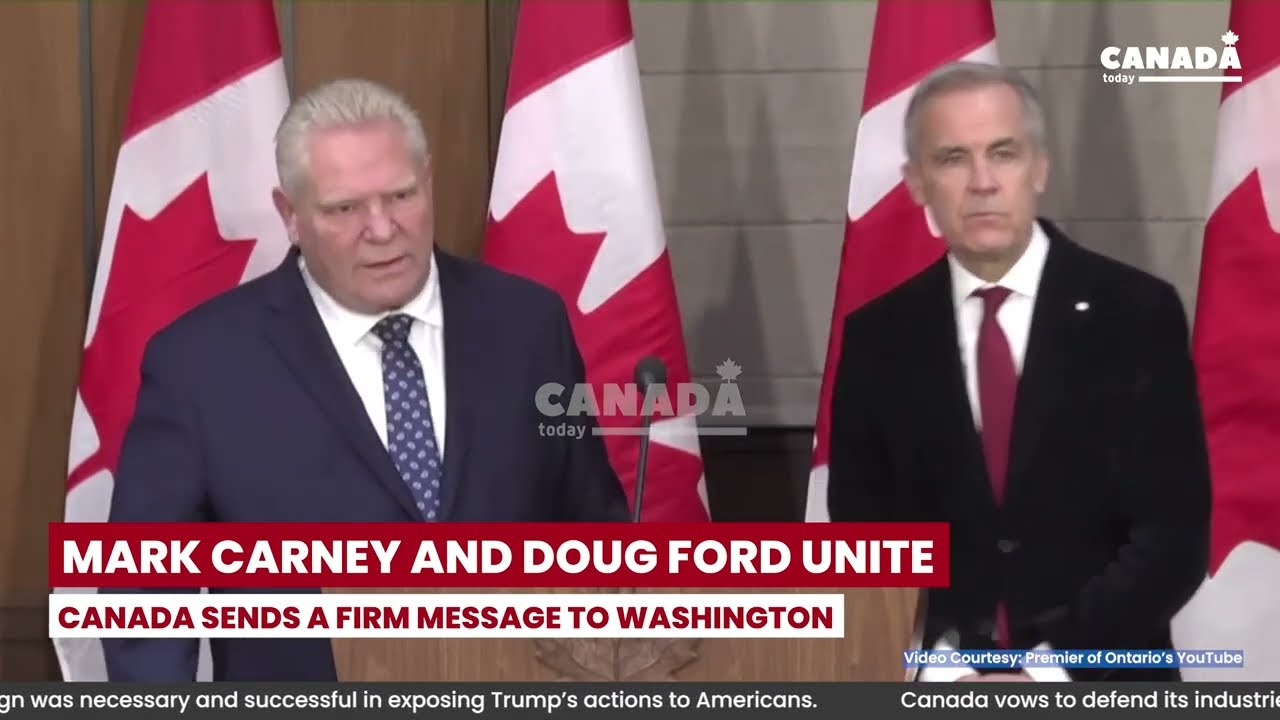
Doug Ford’s role in this shift was equally significant. Where Carney delivered measured, strategic diplomacy, Ford applied political force. He openly defended aggressive messaging campaigns that exposed contradictions in U.S. trade policy, arguing that silence and restraint had failed to protect Canadian workers. Ontario, home to Canada’s manufacturing heartland, has borne the brunt of tariffs targeting steel, aluminum, autos, pharmaceuticals, and advanced manufacturing. Ford’s stance was blunt: Canada will not “roll over” while its core industries are targeted for political gain.
What makes this moment different from past disputes is coordination. This was not a fragmented response between federal and provincial leadership. It was a synchronized strategy. Carney focused on stabilizing long-term frameworks, securing market access, and protecting supply management. Ford focused on immediate economic defense, public pressure, and rapid bilateral engagement with U.S. governors, senators, and industry leaders who are already feeling the domestic fallout of disrupted trade. Together, they closed the gap that Washington once exploited.
This coordinated approach has immediate implications. Canada is accelerating internal trade agreements to reduce dependence on any single external market. Billions of dollars in interprovincial barriers are being dismantled to unlock domestic growth. At the same time, Canada is fast-tracking development in strategic sectors such as critical minerals, rare earths, clean energy, and advanced manufacturing. These are resources and capabilities the United States wants, but no longer automatically controls access to.
The geopolitical implications are equally profound. By signaling that access to Canadian supply chains is conditional, not guaranteed, Canada has altered the power dynamic. American industries reliant on Canadian inputs now face uncertainty not because of Canadian instability, but because of U.S. unpredictability. That distinction matters. It shifts responsibility for disruption back onto Washington, weakening the effectiveness of pressure tactics that rely on asymmetric dependence.
This strategy also resonates beyond the United States. International partners are watching Canada demonstrate that middle powers can assert economic sovereignty without abandoning alliances. By emphasizing diversification, internal resilience, and selective leverage, Canada is positioning itself as a model for navigating a more volatile global economy. Cooperation remains the goal, but submission is no longer the price.

The reaction in Washington has been one of visible surprise. U.S. officials accustomed to quiet Canadian accommodation now face a government that is calm, unified, and immovable. T.r.u.m.p, who has long relied on speed, intimidation, and disruption to force concessions, is confronting an opponent that refuses to be rushed or rattled. This is not retaliation. It is restructuring.
At its core, this moment represents a maturation of Canadian economic policy. Canada is no longer merely reacting to external shocks. It is anticipating them, insulating itself, and reshaping incentives across the border. The implosion referenced in the supply chain is not the collapse of cooperation, but the collapse of assumptions that Canada will always absorb the cost of American instability.
Ford and Carney have made one thing clear: Canada will continue to build North American prosperity, but only on terms that protect Canadian workers, industries, and sovereignty. The era of one-sided leverage is ending, and the consequences of that shift are only beginning to unfold.