The collapse of Canada’s planned $19 billion F-35 fighter jet acquisition marks one of the most consequential defense and industrial policy shifts in modern Canadian history. What had long been treated as a near-automatic alignment with U.S. military procurement has instead evolved into a strategic rupture, exposing deeper tensions over sovereignty, trade leverage, and national decision-making. Ottawa’s move to reassess the deal and pivot toward European alternatives did not emerge suddenly, but the speed at which it unfolded stunned Washington and reshaped the strategic conversation almost overnight.

At the core of the issue is Canada’s growing discomfort with the political and economic strings attached to U.S.-dominated defense systems. While the F-35 offers advanced stealth and interoperability, Canadian officials and defense analysts have increasingly questioned the long-term implications of reliance on U.S.-controlled software updates, maintenance pipelines, and operational permissions. These concerns intensified as broader U.S.–Canada relations became strained by tariff threats, trade disputes, and public political pressure that extended well beyond defense policy.
According to multiple industry and government sources, Ottawa’s reassessment accelerated after U.S. pressure tactics were perceived as crossing into coercion. Rather than reinforcing alliance unity, the approach triggered a backlash inside Canada’s defense, manufacturing, and political communities. The result was a rapid expansion of talks with European aerospace firms offering alternatives that emphasized domestic assembly, technology transfer, and greater operational autonomy. For Canada, these offers aligned closely with long-standing goals of strengthening domestic industry while reducing external dependence.

Economically, the implications are significant. The F-35 program promised participation in a global supply chain, but critics argued that Canada’s role remained limited and vulnerable to political decisions made in Washington. European competitors countered with proposals that included thousands of high-skilled jobs, long-term manufacturing commitments, and deeper integration into Canada’s industrial base. For a government under pressure to deliver tangible economic benefits at home, the contrast proved difficult to ignore.
The defense dimension is equally critical. Canada faces evolving security demands across the Arctic, Atlantic, and Pacific, requiring flexibility rather than rigid alignment. European aircraft platforms, while different in design philosophy, offer proven capabilities tailored to regional defense, sovereignty patrols, and interoperability with NATO partners beyond the United States. Ottawa’s willingness to entertain these options reflects a broader strategic recalibration, one that prioritizes independence of action alongside alliance commitments.
From Washington’s perspective, the fallout has been sobering. The assumption that Canada would remain locked into U.S. defense procurement regardless of political climate has been sharply challenged. The episode revealed that economic pressure and public political leverage can erode trust even among the closest allies. Rather than securing compliance, the approach accelerated diversification and weakened U.S. influence over a critical partner’s defense posture.
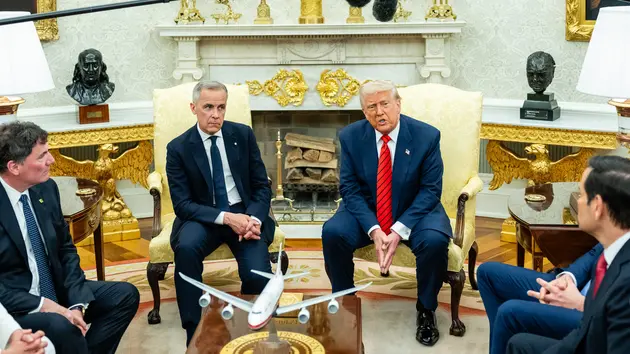
For Canada, the moment represents more than a procurement dispute. It signals a shift toward assertive middle-power strategy, where trade, defense, and industrial policy are treated as interconnected tools rather than isolated decisions. The government’s move underscores a willingness to absorb short-term uncertainty in exchange for long-term strategic flexibility. Markets, defense planners, and allied governments are now recalibrating expectations around Canada’s role in transatlantic and Indo-Pacific security frameworks.
Domestically, the debate has reignited long-standing questions about sovereignty and national interest. Supporters of the pivot argue that true alliance strength requires mutual respect, not unilateral pressure. Critics warn of interoperability risks and potential cost overruns. Yet even skeptics acknowledge that the previous assumption of inevitability surrounding the F-35 deal no longer holds. The discussion has shifted from whether Canada can choose a different path to how far it is willing to go in redefining its defense identity.
Ultimately, the implosion of the F-35 deal as originally envisioned highlights a changing global order in which middle powers are less willing to accept asymmetric dependencies. Canada’s turn toward Europe reflects a calculated response to political pressure that backfired, transforming what was meant to be leverage into a catalyst for strategic diversification. The outcome will shape not only Canada’s air force for decades, but also its broader approach to alliance management, industrial sovereignty, and economic resilience in an increasingly contested geopolitical landscape.