Markets React Sharply as U.S.–Canada Trade Tensions Resurface

New York — Financial markets recoiled this week as renewed tension between the United States and Canada unsettled investors already on edge over slowing growth and political uncertainty, highlighting how quickly trade rhetoric can spill into broader economic anxiety.
The volatility followed a series of statements by former President Donald J. Trump suggesting a tougher posture toward Canada on trade, remarks that revived memories of earlier disputes over tariffs, supply chains and cross-border integration. While no formal measures were announced, the rhetoric alone was enough to rattle markets accustomed to the deep interdependence of the two economies.
Canadian officials responded with restraint but clarity. Prime Minister Mark Carney said Canada would defend its economic interests and adhere to rules-based trade, signaling that Ottawa was prepared to resist pressure while avoiding escalation.
“Our approach is stability, not confrontation,” Mr. Carney said in brief remarks. “Canada will act calmly and decisively to protect its economy.”
Wall Street’s Unease
U.S. equity markets fell sharply in the immediate aftermath, with industrial and financial stocks leading the decline. Analysts said the sell-off reflected fears that renewed trade friction with a close ally could exacerbate existing headwinds, including high interest rates and slowing global demand.
“Markets are hypersensitive to anything that looks like trade disruption,” said Megan Greene, chief economist at the Kroll Institute. “When it involves Canada, the concern is amplified because of how integrated the supply chains are.”
Treasury yields dipped as investors sought safety, while the dollar weakened slightly against a basket of major currencies, signaling a broader risk-off mood.
Why Canada Matters
Canada is the United States’ largest trading partner, with more than $900 billion in goods and services crossing the border annually. Key sectors — including energy, autos, agriculture and manufacturing — depend on predictable cross-border flows.
Even the suggestion of punitive measures can force companies to reassess investment and hiring plans.
“You don’t need tariffs to do damage,” said Chad Bown, a trade economist at the Peterson Institute for International Economics. “Uncertainty alone can freeze decision-making.”
Ottawa’s Calculated Response
Mr. Carney avoided inflammatory language, emphasizing continuity in Canada’s trade strategy while making clear that Ottawa would not accept unilateral pressure. Canadian officials underscored that existing agreements, including the U.S.–Mexico–Canada Agreement, provide mechanisms for resolving disputes.
Privately, Canadian diplomats said the government was working to reassure markets and allies that Canada remained committed to open, predictable trade.
“This is about demonstrating credibility,” said a senior Canadian official, speaking on the condition of anonymity. “Overreacting would undermine that.”
Allies Watch Closely
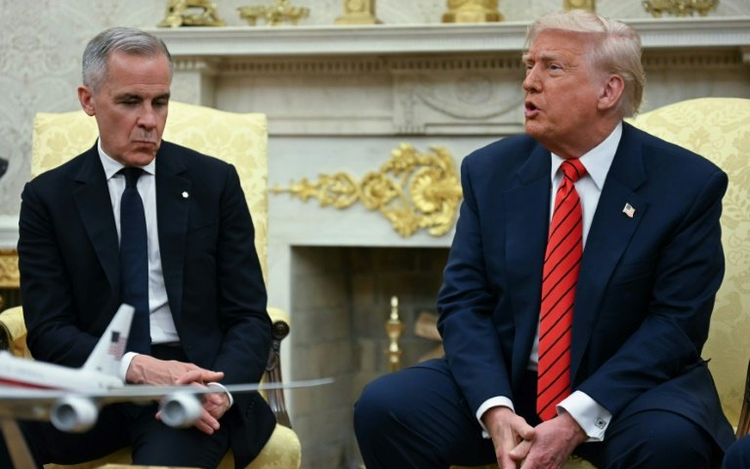
The episode drew quiet concern among U.S. allies, particularly in Europe and Asia, where governments have been recalibrating trade and security strategies amid uncertainty about U.S. policy direction.
Several diplomats said the renewed tension reinforced the importance of diversification — not as a rejection of the United States, but as insurance against volatility.
“There is a sense that no relationship, however close, is immune from sudden stress,” said one European trade official.
Political Overtones
Mr. Trump has long argued that aggressive trade tactics strengthen U.S. leverage. Supporters say such rhetoric plays well with voters frustrated by globalization. Critics counter that it risks alienating allies and destabilizing markets without delivering clear gains.
The White House declined to comment on the former president’s remarks, emphasizing that current U.S. policy remains unchanged.
Economists cautioned against conflating campaign rhetoric with policy action, but acknowledged that markets often respond to signals, not just decisions.
A Fragile Moment for the Economy
The timing of the tension has heightened its impact. Recent economic data has pointed to slowing job growth and cooling consumer demand, leaving markets less tolerant of additional uncertainty.
“When growth is strong, markets can absorb shocks,” Greene said. “When it’s slowing, everything feels bigger.”
What Comes Next
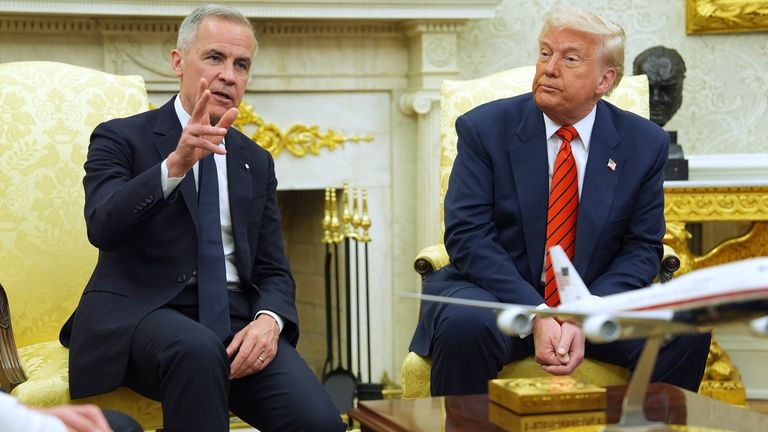
Whether the episode fades or escalates will depend on how rhetoric translates — or does not translate — into policy. Analysts said clear communication from both governments could help calm markets, while ambiguity could prolong volatility.
For now, investors appear to be betting that cooler heads will prevail, even as they hedge against the risk that trade disputes with allies could reemerge as a defining feature of U.S. economic politics.
As one portfolio manager put it, “The fundamentals between the U.S. and Canada haven’t changed. But confidence is fragile — and right now, that’s what markets are reacting to.”
In an interconnected economy, even the hint of strain between close partners can echo far beyond the border, reminding policymakers how closely diplomacy and financial stability are entwined.