For decades, Ford Motor Company stood as more than just an automaker. It symbolized the backbone of American manufacturing — industrial strength, union labor, and global dominance built from Detroit outward. That is why Ford’s decision to halt production across multiple U.S. assembly plants sent shockwaves far beyond the auto sector. What initially appeared as a routine production adjustment quickly revealed itself as a symptom of a much deeper structural crisis unfolding inside America’s industrial core.
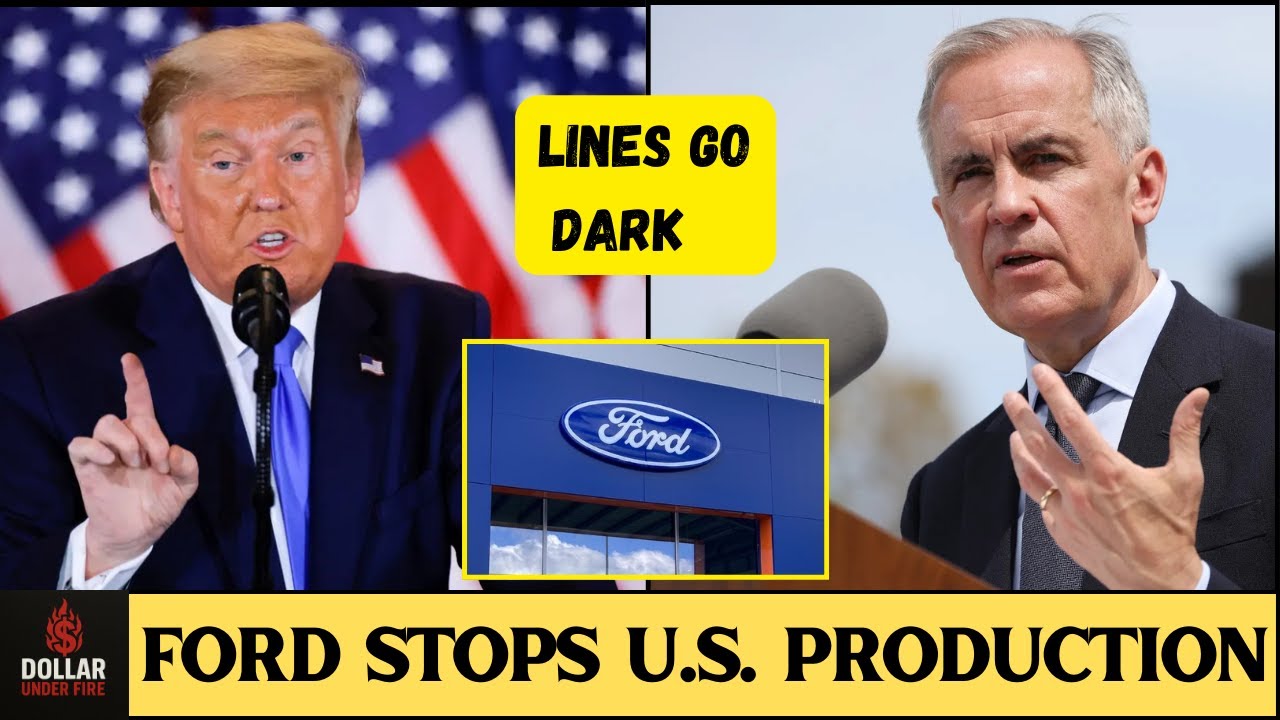
The shutdowns were not driven by falling demand or an economic recession. In fact, consumer interest remained relatively stable. Instead, the disruption was triggered by a policy shock: sweeping tariffs imposed on imported auto parts as part of an escalating U.S. trade war. These measures were designed to pressure foreign suppliers and encourage domestic manufacturing. Instead, they destabilized a supply chain that had been carefully optimized over decades to span borders, minimize costs, and ensure just-in-time delivery.
Although Ford assembles nearly 80% of its vehicles sold in the United States domestically, “built in America” no longer means “sourced entirely in America.” Modern vehicles depend on thousands of components sourced globally — from electronic modules and aluminum wiring to brake systems and critical electric vehicle battery materials. When tariffs hit these inputs, costs surged immediately. Some parts became scarce, others prohibitively expensive, and production schedules that once ran with precision began to unravel.
Industry analysts estimate that tariffs added nearly $4,900 in cost to each U.S.-built vehicle. That figure alone explains why Ford was forced to freeze assembly lines. Profit margins evaporated, suppliers struggled to absorb cost increases, and Ford’s balance sheet took a severe hit. In a single quarter, the company absorbed losses exceeding $1.5 billion. While public statements framed the situation as manageable, internal assessments painted a far more urgent picture of systemic risk.
The consequences quickly spread beyond factory gates. In the Midwest, production pauses translated into reduced shifts, temporary layoffs, and the loss of overtime hours. Communities built around auto plants felt the impact almost immediately. Restaurants lost regular customers, small businesses saw declining sales, and local economies dependent on steady manufacturing wages entered a state of uncertainty. Unlike previous downturns driven by collapsing demand, this crisis emerged from disrupted logistics and policy-driven cost inflation.

Ford was not alone. Other automakers felt the strain as well. Nissan canceled U.S. SUV orders from Mexico, Toyota slowed shipments, and Honda quietly raised prices. Even America’s most iconic vehicle, the Ford F-150, saw costs climb as aluminum tariffs added hundreds of dollars per unit. Across the industry, analysts estimate the total financial burden exceeded $41 billion, with the majority passed directly to consumers.
The trade conflict soon escalated beyond U.S. borders. Retaliatory tariffs from China sharply reduced demand for U.S.-built vehicles, cutting off one of Ford’s most important export markets. Buyers pivoted quickly to European and Korean brands, erasing market share Ford had spent decades building. Attempts to reroute production through alternative trade pathways offered little relief, as additional logistics costs erased potential savings.

Meanwhile, Wall Street responded with caution. Automakers withdrew earnings guidance, paused share buybacks, and delayed long-term investments. Supplier stocks dropped, signaling broader concern across the industrial ecosystem. Ford’s internal strategy shifted toward cost containment, renegotiating supplier contracts and delaying nonessential projects. One bright spot emerged in Ford Pro, the company’s commercial vehicle and software division, which provided much-needed cash flow amid declining consumer margins.
Yet even that stability could not fully offset the uncertainty ahead. Electric vehicle plans faced delays as battery material costs remained exposed to global politics. CEO Jim Farley acknowledged the core challenge plainly: unpredictability. Without stable trade rules, long-term planning becomes impossible. Tariffs, rather than strengthening domestic industry, exposed how deeply interconnected modern manufacturing truly is.

Ford’s experience underscores a broader reality facing American industry. Rebuilding domestic supply chains requires years of investment, regulatory consistency, and international cooperation. Disrupting them, however, can happen in months. The production freeze was not a failure of innovation or labor, but the collision of domestic policy with global economic reality.
Detroit’s shockwave serves as a warning. Industrial strength is not sustained through isolation alone, but through stability, coordination, and trust across borders. As Ford navigates this transition, the outcome will shape not only the company’s future, but the direction of American manufacturing itself.