It began with a single social media post and a handful of short video clips, the kind that often flash across political timelines and then disappear. This time, they did not. Within hours, the posts had fused into a sweeping claim: that former President Donald Trump was signaling a renewed deportation clampdown linked to an alleged $1 million fraud case in Minnesota, and that Representative Ilhan Omar was at the center of the storm.
The claims, amplified by cable commentary and partisan influencers, suggested that a rollback of Temporary Protected Status (TPS) tied to Somalia was being framed as an “accountability” measure, with Minnesota portrayed as a focal point. Supporters cast the moment as long-overdue enforcement. Critics warned it was a dangerous conflation of isolated allegations with an entire community’s legal status.
What was striking was not the substance — which remained vague — but the speed with which the narrative hardened. Trump’s post did not announce a policy, name a specific action, or cite documentation. Yet the suggestion that he had “found” something major proved enough to ignite a debate that leapt from social media to Capitol Hill within a single news cycle.
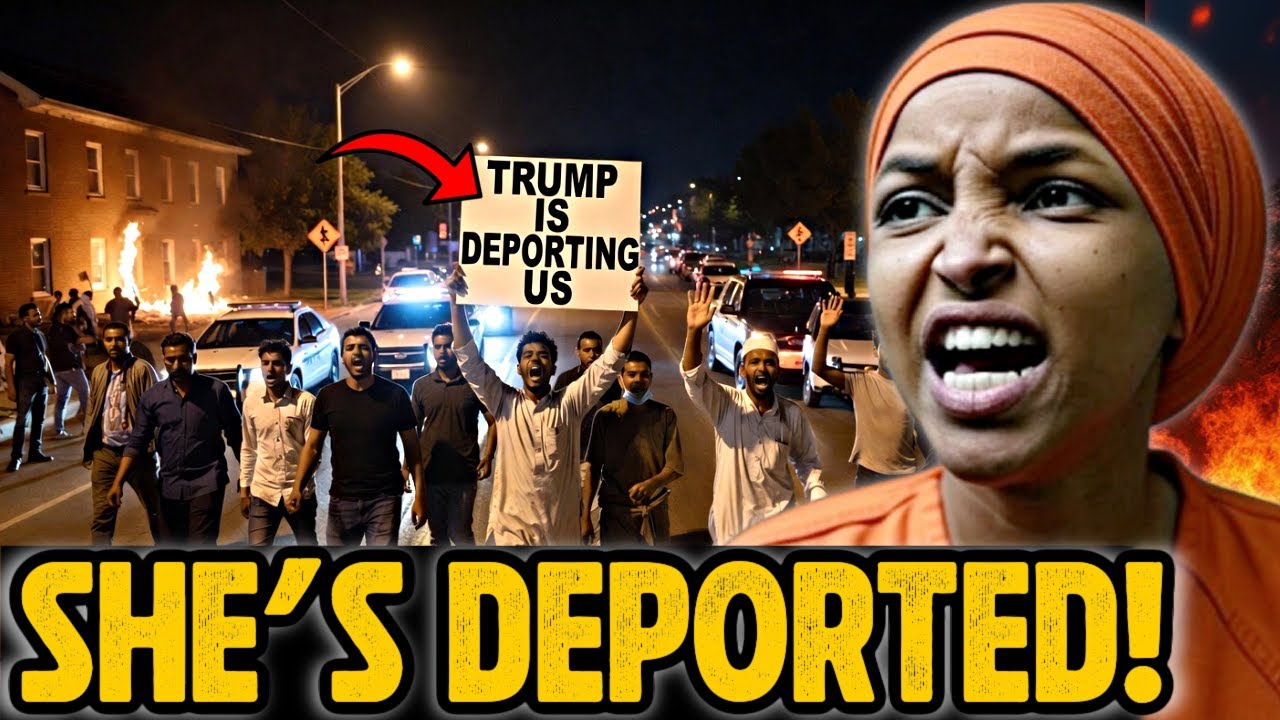
Omar, who represents a district with one of the largest Somali American populations in the country, responded cautiously, warning that rhetoric linking fraud allegations to immigration protections risked endangering communities already under scrutiny. Her allies emphasized that TPS is a federal humanitarian designation, not a discretionary benefit that can be revoked by implication or online commentary. Any change, they noted, would require formal review, agency action, and likely litigation.
The fraud allegation itself — frequently described online as “missing money” — refers to a real but narrow set of cases that have circulated in conservative media for years. Federal and state authorities have pursued prosecutions where evidence warranted, but legal experts say those cases do not establish grounds for broad immigration penalties. “There is a difference between prosecuting fraud and using fraud rhetoric to justify collective action,” said one former Department of Homeland Security official. “The law draws that line very clearly.”
Nevertheless, the framing took hold. On television panels, the story was debated less as a legal question than as a moral one. Was this accountability, as supporters argued, or collective punishment, as critics charged? The lack of concrete detail allowed each side to project its own interpretation, turning uncertainty into a catalyst rather than a constraint.

Behind the scenes, according to people familiar with internal discussions who spoke on the condition of anonymity, the real activity was far more procedural than the online drama suggested. Lawyers were reviewing timelines associated with TPS designations. Political advisers were tracking court calendars, not drafting deportation orders. Both parties, those sources said, were acutely aware of how easily immigration rhetoric can escalate — and how difficult it is to rein it back once it does.
Trump’s role in the episode followed a familiar pattern. By signaling significance without specificity, he dominated the conversation while avoiding commitment to a particular course of action. Supporters interpreted the post as a warning shot. Opponents saw it as a provocation designed to shift attention and energize a base. In either case, the effect was the same: the spotlight moved.
For Minnesota’s Somali American community, the episode stirred unease. Community leaders said the online narrative blurred the distinction between individuals accused of wrongdoing and the broader population living under legal protections. Past surges in rhetoric, they noted, have coincided with increases in harassment and misinformation. “When people argue about ‘TPS fraud’ as if it’s a thing, it creates fear even when nothing has legally changed,” said one local advocate.
Fact-checkers and immigration scholars attempted to slow the momentum, pointing out that no TPS rollback had been announced and no filing connected Omar to the alleged fraud. Their posts circulated, but far less widely than the original claims. In the current media environment, correction often trails accusation.

What remains is a story suspended between implication and reality. There is, as of now, no formal action, no official proposal, and no evidence tying a $1 million fraud allegation to a sweeping deportation plan. Yet the viral framing has already shaped public perception, transforming a speculative claim into a perceived showdown.
The episode underscores how political narratives are increasingly built not on policy moves but on signals — hints, phrases, and fragments that invite interpretation. In that space, fear and certainty can coexist, even when neither is fully justified.
As observers wait to see whether any concrete filing or statement follows, the larger question lingers: in an era when a single post can trigger national panic, how much power does suggestion hold over substance? For now, the answer seems clear. The rhetoric has already done its work, long before the law has had any chance to speak.