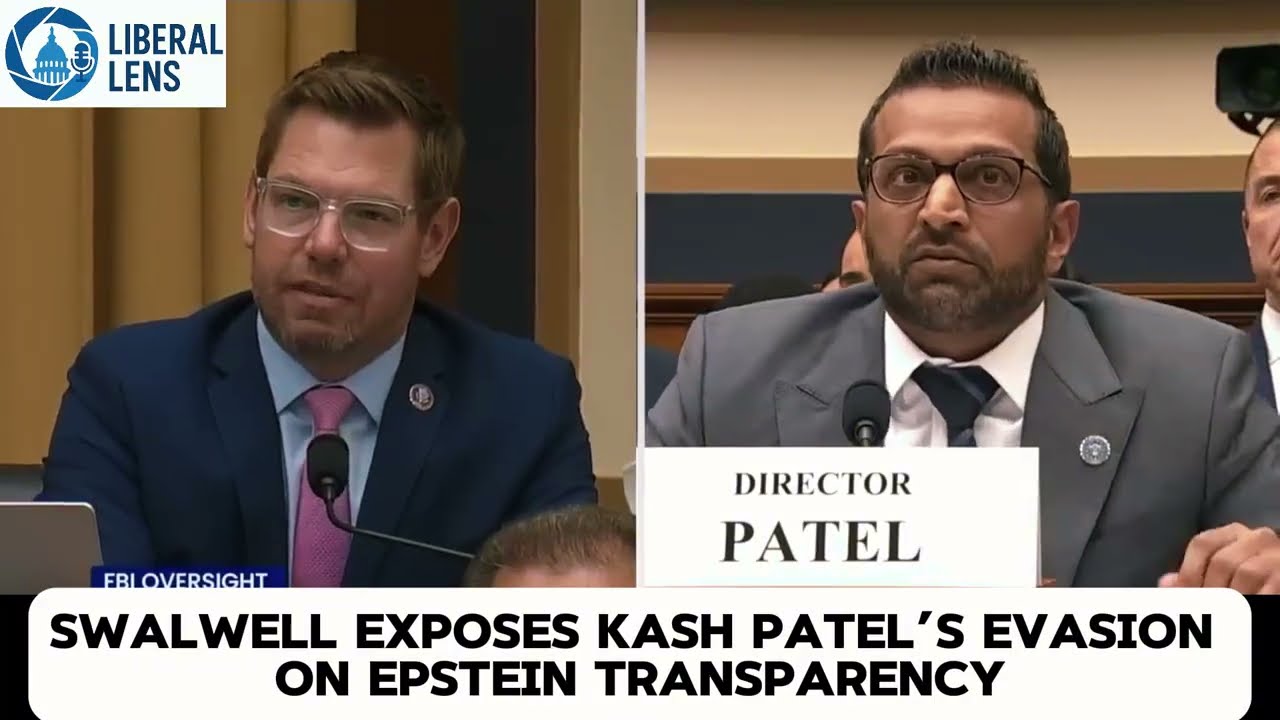
WASHINGTON — A tense exchange on Capitol Hill this week underscored a growing frustration among lawmakers over the federal government’s handling of records related to Jeffrey Epstein, as Representative Eric Swalwell confronted FBI leadership, including Kash Patel, over continued secrecy surrounding the case. The moment was not driven by speculation or political theatrics, but by a pointed demand for clarity about who is making decisions, under what authority, and why Congress itself appears unable to get straight answers.
At issue are the Epstein-related files that remain sealed or undisclosed years after the financier’s death and long after public officials promised transparency. Swalwell, a Democrat from California and a former prosecutor, focused his questioning on process rather than personalities. He asked who specifically decided which records would remain hidden, what legal standards were being applied, and why those standards could not be articulated clearly to elected officials charged with oversight.
Again and again, the answers circled back to vague references to “ongoing reviews,” “legal constraints,” and “established procedures.” For Swalwell, that was precisely the problem.
“This isn’t about gossip or internet theories,” he said during the exchange. “This is about whether Congress can understand — and trust — how decisions are being made inside the FBI.”
A Case That Never Lost the Public’s Attention
Few criminal cases in recent history have generated the level of sustained public scrutiny as the Epstein investigation. The financier’s connections to wealthy and powerful figures, combined with the lenient plea deal he received in Florida in 2008 and his death in federal custody in 2019, created a deep well of mistrust that has never fully dissipated.
Successive administrations have pledged openness, releasing limited batches of documents while insisting that other materials must remain sealed to protect victims, ongoing investigative equities, or sensitive law enforcement methods. Those explanations, while legally plausible, have done little to satisfy lawmakers who argue that the lack of specificity has become an accountability problem in its own right.
Swalwell’s questioning reflected that concern. Rather than demanding immediate disclosure of all files, he pressed for a clear explanation of the decision-making framework. Who signs off on continued secrecy? Is it prosecutors, FBI leadership, career attorneys, or political appointees? And what distinguishes documents that can be released from those that cannot?
According to multiple members present at the hearing, the answers did not provide the clarity Swalwell was seeking.
Oversight Versus Institutional Caution
From the FBI’s perspective, caution is not optional. Law enforcement agencies routinely argue — often correctly — that premature disclosure can compromise investigations, expose sources, or retraumatize victims. In cases involving sexual abuse, those concerns are especially acute.
But Swalwell and other lawmakers counter that institutional caution becomes problematic when it is paired with broad, nonspecific explanations that cannot be independently evaluated. Oversight, they argue, is impossible if Congress cannot tell whether decisions are being driven by law, policy, or internal risk aversion.
Legal analysts note that this tension is not unique to the Epstein case. It reflects a broader pattern in which agencies rely on procedural language that is internally coherent but externally opaque. Over time, that opacity can erode trust — not only among lawmakers, but among the public.
“When officials can’t explain their reasoning in plain terms, people assume the worst,” said one former Justice Department official who reviewed the exchange. “Even if the decisions are defensible, the communication failure becomes the story.”
The Cost of Vague Answers
What made the Swalwell–Patel exchange notable was not its volume, but its focus. Swalwell did not accuse the FBI of misconduct, nor did he endorse any particular narrative about Epstein’s associates. Instead, he framed the issue as a test of institutional credibility.
Trust in law enforcement, he suggested, depends on three things: transparency, consistency, and accountability. When agencies promise openness but deliver only generalized process language, those pillars weaken.
That concern resonates beyond this single case. Polls already show declining confidence in major institutions, including the federal government and the justice system. High-profile cases involving powerful figures only magnify that skepticism.
Inside the hearing room, the gap between what the public has been promised and what Congress is being told was unmistakable. While FBI representatives emphasized legal obligations and internal safeguards, lawmakers left with the impression that the system remains largely self-policing — a reality that sits uneasily with democratic oversight.
An Unfinished Conversation
As the session concluded, Swalwell made clear that the issue is far from settled. He and other members are expected to seek further briefings, document production, and potentially legislative remedies aimed at clarifying disclosure standards in high-profile cases.
Whether those efforts lead to additional transparency remains uncertain. What is clear is that the Epstein files have become more than a question of records management. They are now a proxy for a larger debate about how much trust institutions can expect when they ask the public — and Congress — to accept assurances without explanation.
For now, the answers remain incomplete. And as long as that is the case, the pressure on federal law enforcement to explain itself more clearly is unlikely to ease.