How a Threat Against Canada’s Potash Exposed Washington’s Hidden Economic Vulnerability
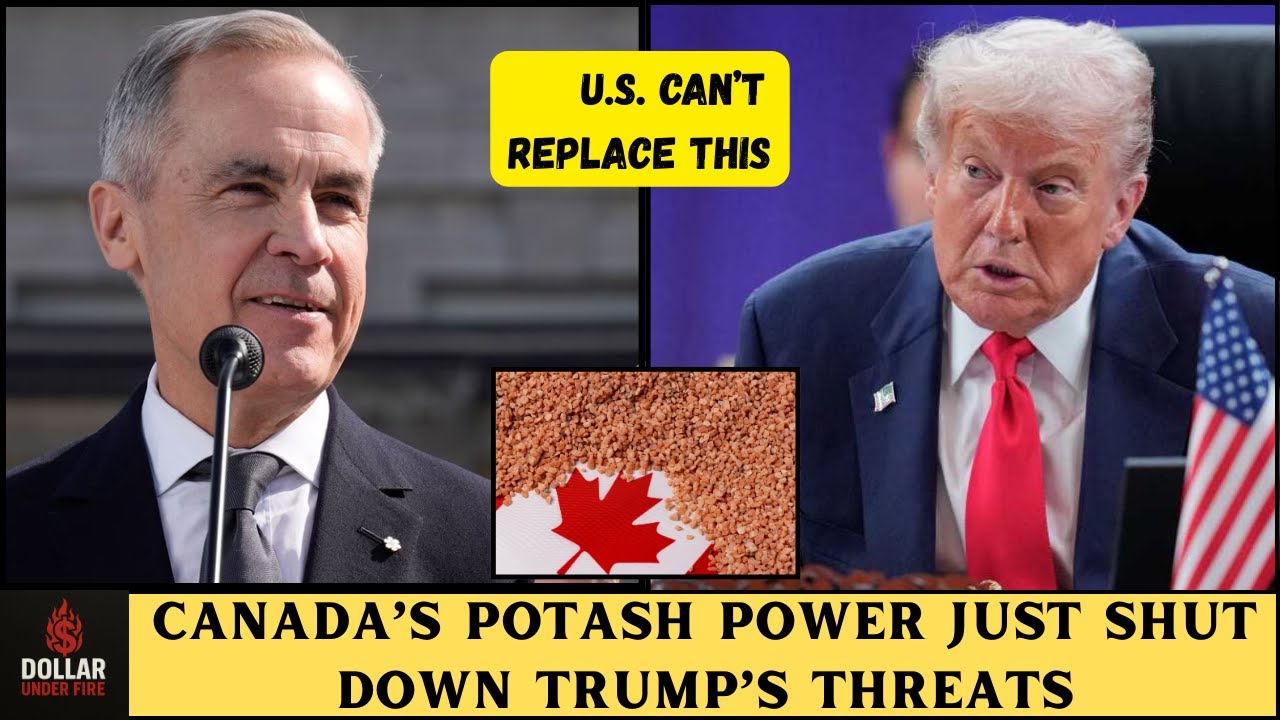
When former President Donald Trump issued a threat to impose harsh tariffs on Canada’s potash industry, few expected the immediate shockwaves that followed. There were no policy papers, no regulatory filings, and no formal actions—just a public threat. Yet within hours, the ripples of that moment began spreading through North America’s food supply chain, exposing a fragile dependency few Americans ever consider.
Across supermarket aisles, farm fields, and commodity markets, an unusual pattern emerged. Prices shifted before any law changed. Fertilizer markets reacted before any negotiation began. And the first signs of economic pressure appeared not in Canada—the target of the threat—but in the United States.
Potash, a potassium-rich mineral essential for modern agriculture, rarely receives public attention. But it sits at the center of global food production. The United States relies on potash to grow corn, wheat, soybeans, and countless crops that feed both households and livestock. And nearly 90 percent of that potash comes from one source: Canada.
Canada is not only America’s largest supplier; it is the world’s most stable producer. Beneath Saskatchewan lies one of the planet’s most significant geological formations: an estimated 1.1 billion tons of recoverable, high-quality potash. It is a resource shaped not by politics, but by prehistoric geology—meaning no policy shift in Washington can create a replacement.
So when Trump signaled his intent to impose tariffs of up to 25 percent on Canadian potash, global markets took the threat seriously. Prices climbed almost instantly, rising from about $330 per ton to nearly $350 per ton in a matter of days. The increase was not symbolic. For farmers, fertilizer ranks among the top input costs, accounting for roughly 22 percent of corn production expenses. Even small movements in the potash market can determine whether a season ends in profit or loss.
The immediate result of the tariff threat was clear: American farmers felt the impact first. Higher fertilizer prices tightened margins, forcing growers to reassess planting strategies. And for consumers, the consequence was predictable—food inflation. Bread, vegetables, cereal, and meat all rely on the crops most sensitive to fertilizer costs.
Canada, in contrast, responded with unusual calm. There were no heated press conferences, no public threats, and no rapid-fire countermeasures. Ottawa waited. And in that silence lay its strategy.
Canadian policymakers understood a central fact of the trade relationship: the United States cannot quickly replace Canadian potash. Alternative producers such as Russia and Belarus have become less viable due to sanctions, geopolitical strain, and market instability. Building new American supply would take years of permitting, billions in investment, and the construction of specialized mining infrastructure.
While Washington amplified its rhetoric, Canada strengthened quiet economic defenses. It expanded partnerships with Europe, reinforced domestic credit supports, and coordinated closely with provinces, especially Saskatchewan, the heart of potash production. The goal was stability, not escalation.
When Canada finally responded, it did so with precision. Ottawa unveiled $30 billion in counter-tariffs aimed at key U.S. political battleground industries. These were not broad measures—they were targeted actions designed to apply maximum pressure with minimal noise. Canada also signaled it was prepared to escalate to an additional $125 billion in tariffs if necessary, building on a separate $60 billion package already drafted.
For the United States, the consequences of the initial threat grew increasingly complex. The government quietly assembled a $12 billion bailout fund to cushion farmers from rising input costs, adding to nearly $40 billion in previous agricultural aid. In effect, taxpayers would subsidize the fallout of a tariff that had not yet materialized.
This sequence created an unusual economic loop: a political statement triggered market fears, those fears raised costs for farmers, and the government prepared to compensate them—all while Canada continued exporting uninterrupted.

The broader implications of the episode stretch beyond North America. As climate instability and global conflict reshape trade patterns, essential commodities like potash are gaining strategic value. Nations dependent on agricultural imports or heavily integrated supply chains are watching closely. The case illustrates a reality that geopolitical scholars increasingly note: essential resources can outweigh political leverage.
In the end, the confrontation revealed a structural truth long overlooked. The United States wields global economic influence, but in a world where food security is tied to geology, Canada holds a unique form of power. Potash cannot be manufactured or relocated. It exists where it exists, and for North America, that place is overwhelmingly northern Saskatchewan.
What began as a political maneuver ultimately underscored a deeper dependency. While Washington debated the merits of tariffs, markets delivered their verdict: potash is not a conventional bargaining chip. It is the foundation of a continental food system.
For policymakers, the episode serves as a reminder that supply chains—especially those tied to food—are not easily weaponized. And for North America’s farmers and consumers, it was a vivid demonstration of how a single remark can echo across an interconnected economy, producing consequences far beyond the podium where it was first spoken.