Mark Carney Did Not Cry Today. Justin Trudeau Did — Again.
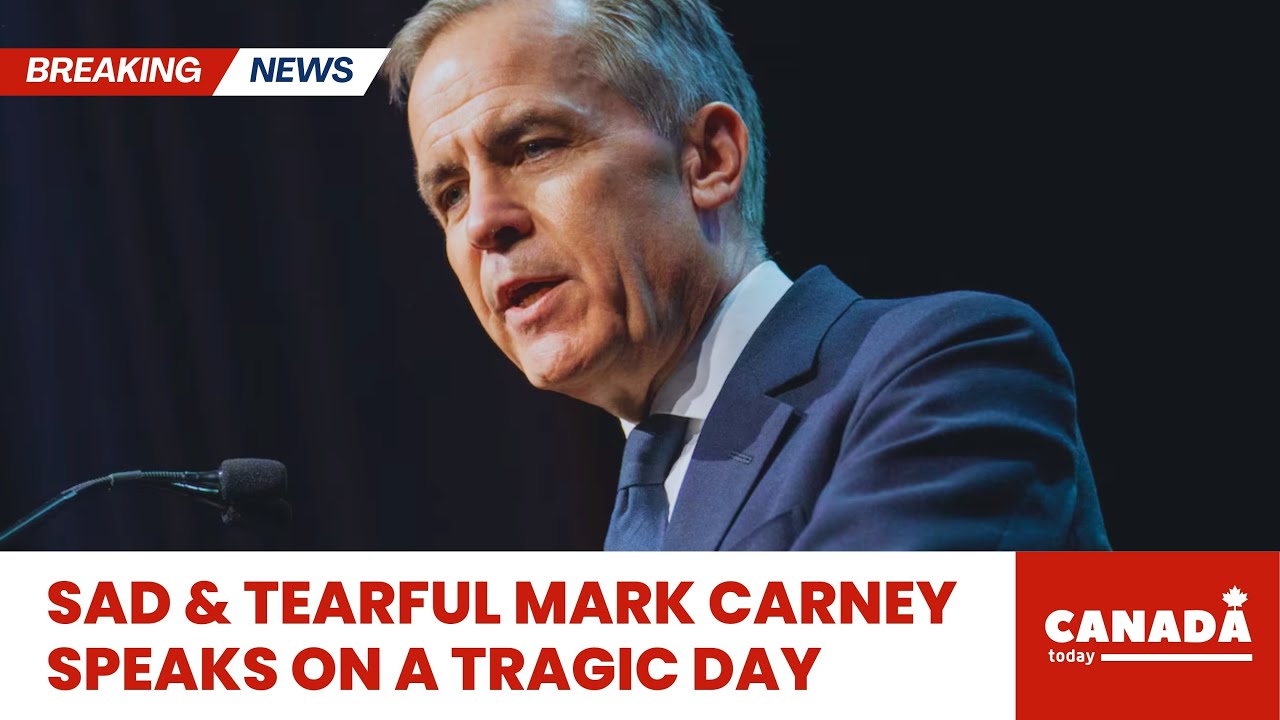
MONTREAL — On a gray December morning outside the engineering building of École Polytechnique, the Prime Minister of Canada stood before a small memorial of white roses and fourteen beams of light. His voice cracked almost immediately.
“It’s um… it’s always a difficult day,” he began, then paused so long that the microphones caught only the wind. “I was in England at the time. I didn’t know until the next morning…”
It was the 36th anniversary of the day a gunman separated female students from their male classmates and murdered fourteen of them because, in his words, “feminists have always ruined my life.” The same sentences — the same halting cadence, the same memory of waking up in Oxford to the news — have been spoken by Justin Trudeau at this ceremony almost every year since 2015. Yet the emotion is never rehearsed; it arrives raw, unfiltered, and unmistakably real.
What was new this year was the caption that traveled around the world within minutes: “Mark Carney breaks down at Polytechnique memorial.” Within hours, the clip — voice trembling, eyes red — had been viewed millions of times under headlines claiming Canada’s former central banker and would-be Liberal leader had finally shown his human side.
He had not.

Mark Carney was not in Montreal. He was not in Canada. He was, by all reliable accounts, in London, preparing for a week of climate-finance meetings. The man who choked back tears while promising tougher gun laws and action against coercive control was the same one who has stood in that exact spot, year after year: Justin Trudeau.
The confusion appears to have originated with a YouTube channel calling itself “Canada Today,” which overlaid Trudeau’s 2024 remarks with a breathless, AI-sounding narration insisting that “today we saw a side of Mark Carney Canadians rarely get to see.” The video, posted in the last 48 hours, has already amassed 1.8 million views and spawned dozens of copycat clips across TikTok, Instagram, and X. None of them correct the error. Some double down, adding dramatic piano and slow-motion close-ups of Trudeau’s face while continuing to label him “Carney.”
The misidentification is more than a viral glitch; it is a symptom of a political moment in which reality and speculation have become nearly indistinguishable. Mr. Carney, the former governor of the Bank of Canada and the Bank of England, has indeed been widely discussed as a potential successor to Mr. Trudeau, whose approval ratings hover in the low thirties. Liberal insiders speak openly of a leadership contest that could begin as early as next spring. In that context, the doctored clip serves as a kind of political fan fiction: what it might look like if the cerebral, unflappable financier were suddenly thrust into the most emotionally charged annual ritual on the Canadian calendar.
But the real story is simpler, and more poignant. Justin Trudeau — often criticized for performative emotion, for the theatrical sigh, for tears that arrive too conveniently — has never needed to act on December 6. The Polytechnique massacre happened when he was 17, three weeks before his 18th birthday. His father, Pierre Trudeau, was no longer prime minister, but the family still lived under protective watch. The news from Montreal arrived like a private earthquake. For a teenager who had grown up believing Canada was a gentle exception, the realization that fourteen young women could be executed simply for studying engineering was a permanent fracture

Every year since he entered office, he has returned to the same spot, stood beneath the same plaque that reads “Nef pour elles” — “Place for them” — and allowed the grief to surface again. The pauses grow longer as he ages. The sentences fragment more. There is no podium-thumping, no rhetorical flourish. Only the quiet admission that progress on gun control and violence against women has been real but “not nearly enough.”
That vulnerability is precisely what some Canadians say they can no longer abide in their leader after ten turbulent years. And yet, on this one morning, it is also what makes the impersonation so revealing. In an era of deepfakes and synthetic voices, a moment of genuine feeling can be detached from its owner and grafted onto someone else entirely — someone cooler, more technocratic, more palatable to a public exhausted by sentiment.
The fourteen women — Geneviève Bergeron, Hélène Colgan, Nathalie Croteau, Barbara Daigneault, Anne-Marie Edward, Maud Haviernick, Maryse Laganière, Maryse Leclair, Anne-Marie Lemay, Sonia Pelletier, Michèle Richard, Annie St-Arneault, Annie Turcotte, and Barbara Klucznik-Widajewicz — do not belong to any one politician. Their memory is not a prop for leadership contests that have not yet begun.
Today, as every December 6, the only man who wept in front of their memorial was the one who has always wept there.
And for one viral moment, the internet decided he was someone else entirely.