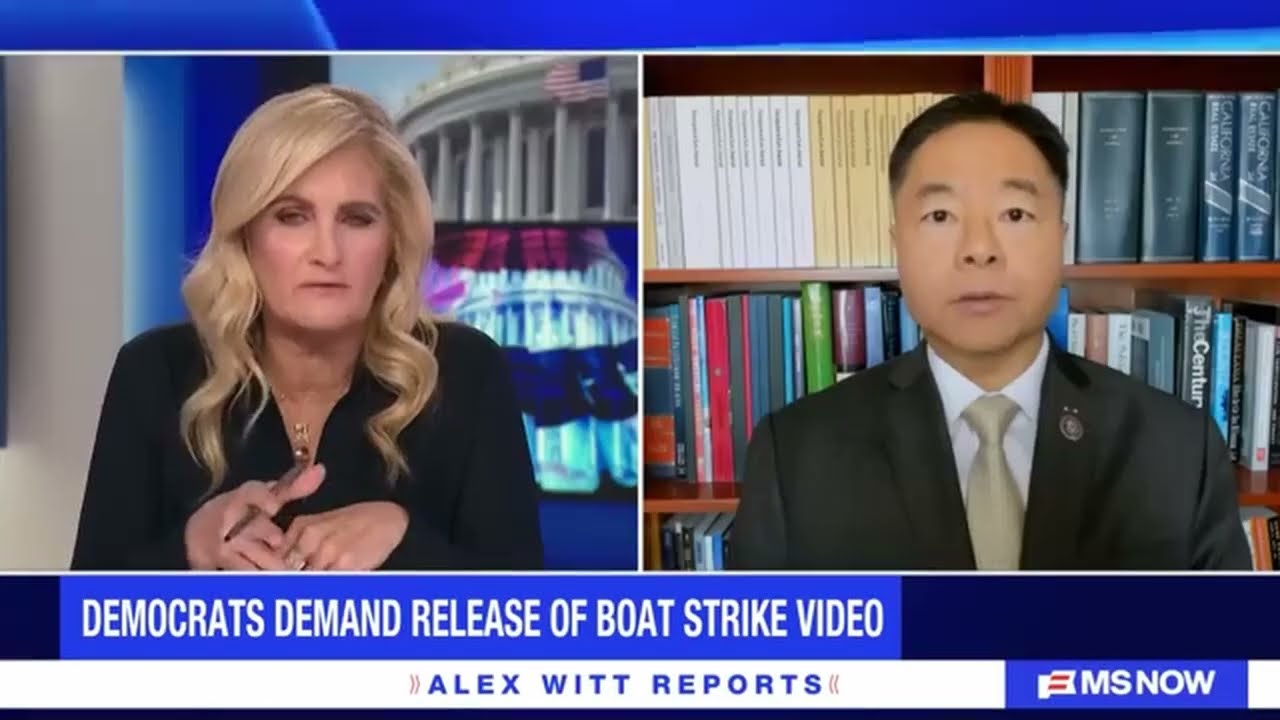
In a sweeping and unusually direct exchange that has quickly escalated into one of Washington’s most contentious national-security debates, Representative Ted Lieu of California — a longtime member of Congress with years of experience as a Judge Advocate General (JAG) officer in the U.S. Air Force — asserted that a second airstrike on survivors clinging to a destroyed vessel may qualify as a “war crime” under international law. His remarks, grounded in legal precision and delivered with measured intensity, have placed significant pressure on the Trump administration and its national-security leadership, who now face growing scrutiny over the events of September 2.
The controversy centers on two American airstrikes against a small vessel in international waters, a boat that U.S. officials initially described as posing an imminent threat. But according to Lieu — and a mounting collection of independent reports — the boat was not moving toward the United States, nor toward any U.S. vessel or installation, raising profound questions about whether the strikes had any legal foundation under the principles of self-defense or proportional use of force. The lack of clarity surrounding the incident, combined with inconsistencies from the Department of Defense, has further intensified calls for transparency.
A Former Military Lawyer Raises Alarm
Lieu’s intervention carried unusual weight. Few members of Congress possess his combination of legislative standing and firsthand experience with the legal frameworks governing war. As a former JAG attorney, Lieu has prosecuted and advised on cases involving the Law of Armed Conflict (LOAC) — the very rules that define when and how military force may be used.
During the televised panel discussion that sparked the uproar, Lieu stated plainly that “the second strike on survivors is a war crime.” The statement was not delivered as political rhetoric but as a legal conclusion: under international humanitarian law, targeting individuals hors de combat — those incapacitated, defenseless, or already rendered safe — is prohibited.
His concern extended beyond the second strike alone. Lieu questioned the legitimacy of both September 2 strikes, indicating that the U.S. may have lacked the necessary legal justification from the outset. If the vessel was unarmed, not approaching U.S. assets, and not demonstrating hostile intent, he argued, the threshold for a lawful preemptive attack was not met.
Calls for Transparency Amid Signs of Contradiction
The California Democrat urged the administration to authorize a full investigation, including the release of surveillance footage, internal communications, and the rules of engagement used by commanders that day. Lieu noted that discrepancies between Pentagon statements and independent reporting suggest “a pattern of concealment,” and possibly an effort to obscure the chain of command behind the second strike.
Several military analysts echoed Lieu’s concerns, pointing out that the Pentagon’s shifting explanations — from initial assertions of an imminent threat to more ambiguous phrasing about “perceived danger” — have eroded confidence in the official narrative. One former defense official described the briefings as “painfully incomplete,” adding that the lack of video evidence is “increasingly untenable.”
Hegseth’s Defense Raises More Questions Than Answers
In contrast, Secretary of War Pete Hegseth offered a lengthy but largely non-specific defense of the administration’s decision-making process. Hegseth emphasized the “fog of war,” the difficulty of differentiating hostile actors from noncombatants, and the pressures faced by commanders who must make rapid judgments in uncertain environments.
Yet conspicuously absent from his remarks was any detailed explanation of the second strike — the moment now at the heart of the controversy. When pressed on allegations that a directive resembling “kill them all” may have influenced the attack, Hegseth deflected, insisting that such characterizations were politically motivated and “deeply misleading.” But his refusal to articulate who authorized the second strike, and under what criteria, only fueled speculation that senior officials may have attempted to obscure the incident’s most troubling elements.

Political Fallout and a Familiar Pattern
As the segment concluded, several analysts drew attention to what they described as a familiar pattern within the Trump administration: publicly celebrating the decisiveness of military actions, only to distance itself when questions of legality and accountability emerge.
According to these commentators, senior officials initially boasted of the September 2 strikes, framing them as evidence of strong leadership and swift action against suspected threats. But as legal concerns surfaced — and as reports contradicted early public accounts — the administration shifted toward placing responsibility on military commanders, suggesting miscommunication or misjudgment in the field.
Critics argue that this late pivot is unlikely to contain the political damage. “The problem,” one analyst noted, “is that the celebratory narrative was already established. When the administration tries to walk it back, it looks less like clarification and more like an attempt to avoid liability.”
A Growing Demand for Answers
The mounting pressure has now transformed what might have been a fleeting controversy into a broad, bipartisan call for clarity. Lawmakers from both parties have requested briefings, while international observers and human-rights organizations have urged the United States to conduct a transparent inquiry.
For Lieu, the stakes are clear: the United States must not only uphold the laws of war but also demonstrate a commitment to truth. “If the evidence shows wrongdoing,” he said, “the American people deserve honesty — not evasion.”
Whether the administration will voluntarily release the requested footage and documents, or whether Congress will have to compel disclosure, remains to be seen. But what is already evident is that the September 2 strikes have opened a deeper debate about accountability, wartime conduct, and the boundaries of presidential authority.