Obama’s Calm Rebuke to Trump’s Harvard Mockery Reverberates Through Washington
When President Trump publicly questioned Barack Obama’s Harvard Law credentials during an impromptu exchange with reporters last week, the remark initially landed like one more rhetorical jab in a long and tangled political feud. But the former president’s measured, almost understated response — delivered during a televised forum the following evening — quickly overshadowed the initial insult, sending ripples across Washington, the press corps, and even inside the White House itself.

The exchange, now circulating widely online, began with one of the president’s familiar riffs. Standing outside the West Wing, he dismissed Obama’s academic pedigree with a wave of the hand, declaring that “nobody really knows how he got into Harvard” and suggesting that Obama’s record “was never as impressive as people say.” It was a line crafted less like policy critique and more like performance — a return to the insinuations that once fueled Trump’s political ascent.
Obama, who had spent much of the past year avoiding direct confrontation with Trump, chose this moment to respond. Appearing at a moderated conversation in Chicago, he was asked about the president’s remarks. His answer was concise, delivered with a polite smile but laced with unmistakable firmness. “I don’t spend much time worrying about people questioning my education,” Obama said. “Especially not from someone who has tried very hard, for many years, to prove expertise in areas where he has shown very little.”
The room broke into surprised laughter. The comment, delivered without theatrics, struck a nerve precisely because it did not attempt to rise to the president’s level of provocation. It was not a roast or a rally-line; it was a calibration — a reminder of the differences in temperament, political style, and intellectual discipline that have long defined the divide between the two men.
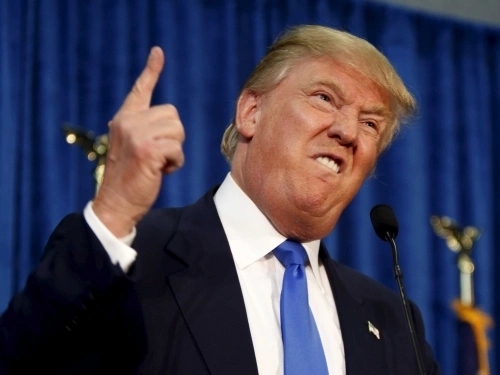
Within hours, clips of Obama’s response dominated political coverage. What began as a seemingly minor exchange between two public figures evolved into a broader referendum on presidential conduct, credibility, and the boundaries of political discourse in an election climate already fraught with tension.
Inside the West Wing, according to two aides who spoke on background, the president was “visibly irritated” as coverage of Obama’s remark intensified. One aide described him as pacing, demanding to know why networks “kept replaying that line” and insisting that surrogates “hit back immediately.” As the night progressed, the president reportedly called several allies, complaining that the media had turned a “throwaway comment” into a national story.
But while the White House moved to downplay the moment, several Republican strategists privately questioned the wisdom of attacking Obama’s academic record — a topic easily verifiable and largely uncontroversial. “It’s not a political winner,” one longtime GOP adviser said. “It’s the kind of thing that only distracts from the larger message they’re trying to push.”
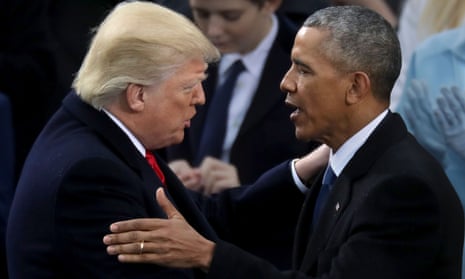
Democrats, meanwhile, seized on the exchange as yet another illustration of what they view as the president’s obsession with delegitimizing his predecessor. “It’s the same playbook: question his origins, question his achievements, question his intellect,” said Representative Jamie Raskin of Maryland. “It’s a pattern that the country knows all too well.”
Yet what made Obama’s response resonate was not the partisan framing but the tone. His remark was not a tactical attack but a philosophical one, delivered in a way that felt more like civic commentary than political jousting. He did not merely defend his credentials; he defended a broader idea — that expertise, preparation, and intellectual rigor matter in public life.
Political analysts noted that the moment captured a growing tension between two very different visions of leadership. Trump’s instinct for confrontation, improvisation, and spectacle has always contrasted sharply with Obama’s emphasis on deliberation and institutional respect. Their exchanges, even indirectly, often reflect the nation’s own divide: a clash between improvisational populism and procedural liberalism.

In that sense, the brief exchange between the two men became symbolic of more than personal rivalry. It pointed to the ongoing struggle over the meaning of credibility in American politics — who gets to define it, who gets to claim it, and why it still matters.
By week’s end, what lingered was not the president’s initial insult but Obama’s response: a single line, lightly delivered, that nevertheless reframed the entire conversation. It suggested that calmness can be a form of strength, that precision can cut deeper than volume, and that in a political era defined by turbulence, an understated rebuke can generate aftershocks that even the most forceful insult cannot match.
In a city accustomed to constant noise, Obama’s quiet comeback proved unusually loud.