A Viral Narrative Reimagines the Swedish King’s Visit to Canada as a Covert Push for Saab’s Gripen, Colliding With F-35 Politics and Sparking National Debate
A speculative narrative spreading rapidly across social platforms this week transforms what was, in reality, a routine ceremonial visit by Sweden’s King Carl XVI Gustaf into a geopolitical drama involving fighter jets, industrial promises, and a reimagined tug-of-war inside Canada’s defence establishment. Although the claims circulating online have no verified connection to official policy discussions, the scenario has captured public imagination by weaving together the symbolism of a royal visit with longstanding tensions around Canada’s fighter procurement strategy.
The viral posts begin by reframing the King’s arrival in Ottawa as something far more consequential than a diplomatic courtesy call. In the narrative, the King’s appearance on the tarmac is portrayed as the opening move in a targeted Swedish campaign to persuade Canada to consider Saab’s Gripen E fighter over the Lockheed Martin F-35 — despite Ottawa already having committed to the latter in real-world planning. Analysts who track online political discourse note that the storyline taps into a persistent undercurrent of public dissatisfaction with major defence purchases and concerns about cost, sovereignty, and technological dependence.
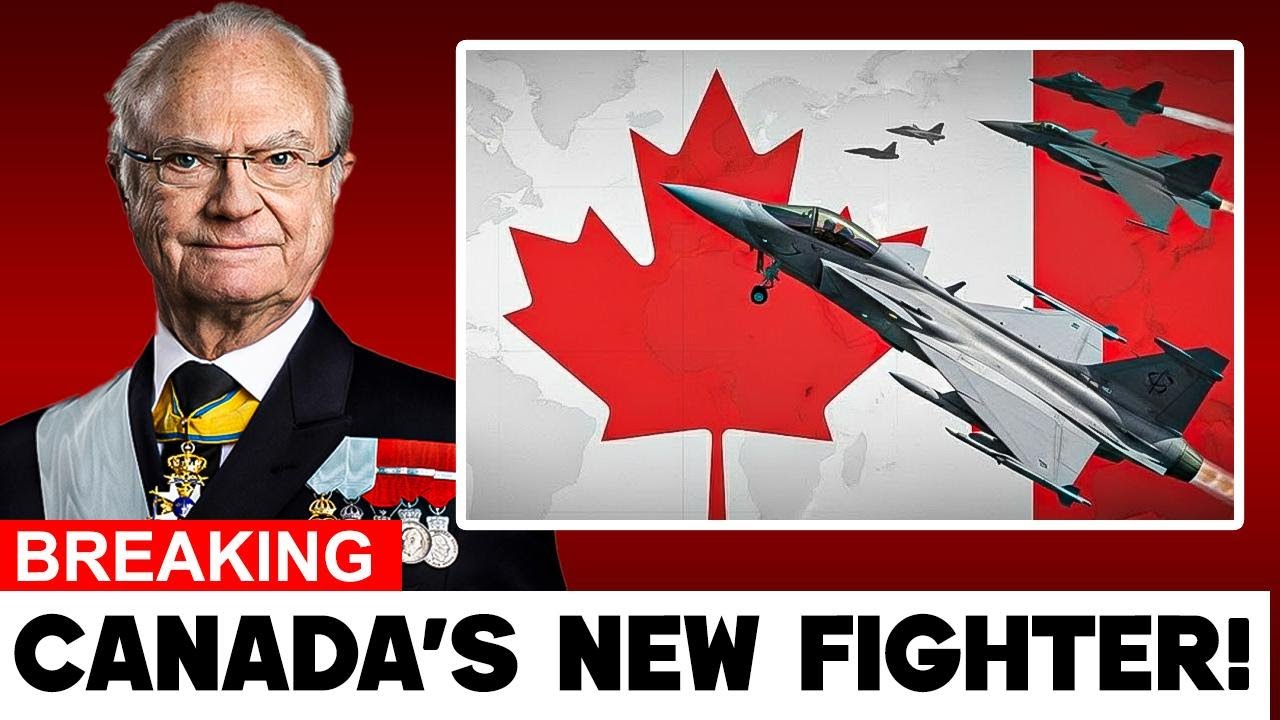
Social media users have amplified this framing with edited video clips showing the King greeting Canadian officials, often accompanied by captions suggesting covert negotiations or strategic intent. The posts frequently reference unnamed insiders who claim that the royal delegation’s schedule included private engagements with defence thinkers and aerospace executives. While no evidence supports such assertions, experts say the narrative succeeds because it resonates with a broader distrust of opaque procurement processes that periodically stir debate in Canada.
In this imagined version of events, Saab’s pitch to Canada — a combination of technology transfer, domestic manufacturing opportunities, and operational autonomy — is depicted as a central subplot. The fictional narrative suggests that Swedish officials, emboldened by the King’s presence, offered Canada unprecedented industrial cooperation, including joint development rights. Defence economists observing the scenario point out that these themes echo real-world discussions in other countries where the Gripen has been marketed as a flexible, locally integrated alternative to more expensive platforms.
By contrast, the F-35 program is cast in the narrative as representing entrenched interests and bureaucratic inertia. Users circulating the story describe an imagined “F-35 lobby” within Canadian defence circles that is caught off guard by Sweden’s symbolic overture. Political scientists note that this portrayal aligns with a familiar storytelling trope: the underdog challenger confronting an established power structure. In reality, Canada’s procurement pathway is determined through multiyear planning involving numerous agencies and regulatory oversight, but the narrative compresses that complexity into an emotionally compelling power struggle.
:max_bytes(150000):strip_icc():focal(749x239:751x241)/Sweden-King-Carl-XVI-Gustaf-010423-3-63020226378644a982e29ea39d24d33e.jpg)
As the hypothetical drama unfolds, the scenario depicts MPs and defence staffers exchanging urgent messages, attempting to gauge whether the royal visit signals a shift in Canadian strategic thinking. Some posts imagine internal divisions deepening as proponents of industrial sovereignty clash with advocates of interoperability within NATO. These fictional tensions have been particularly compelling for Canadian audiences who recall past debates about aerospace jobs, domestic manufacturing, and the country’s role within multilateral defence frameworks.
Observers of digital misinformation note that a key driver of the narrative’s popularity is its blending of ceremonial imagery with policy speculation. Royal visits are typically covered with an air of formality and cultural diplomacy, offering visually striking footage with minimal political controversy. By infusing those visuals with imagined strategic intent, the online narrative transforms familiar ceremonial moments into suspenseful geopolitical signals. “It allows audiences to project high-stakes meaning onto something intentionally designed to be apolitical,” one media researcher explained.
The scenario has also ignited broader discussion about Canada’s long-term defence posture, including its industrial capacity, procurement transparency, and commitment to NATO modernization. Some commentators have used the viral storyline as a springboard to revisit real concerns: delays in aircraft deliveries, the impact of global supply chain constraints, and cost overruns in defence programs. Others have framed the fictional account as a symbolic reminder of Canada’s complex position between U.S. defence integration and opportunities for diversification.

Meanwhile, the narrative has found enthusiastic engagement among military aviation enthusiasts who contrast the technical characteristics of the F-35 and Gripen platforms. These discussions — while grounded in real performance data — often become entangled with the broader fictional arc, blurring the lines between technical debate and imagined political intrigue.
Ultimately, the popularity of the viral scenario reflects a broader trend in how audiences interpret defence and foreign-policy events. In an age of rapid information circulation, ceremonial state visits can become raw material for political storytelling, especially when existing debates about procurement and sovereignty provide fertile ground. While no evidence supports the narrative’s suggestion of covert diplomatic maneuvering, its spread underscores the public’s appetite for stories that dramatize otherwise opaque policy processes.
As the posts continue to circulate, analysts warn that such narratives — even when openly speculative — can shape public perception of defence policy. Whether viewed as satire, political commentary, or digital folklore, the fictional account of a Swedish royal power play speaks to genuine uncertainties about Canada’s strategic direction in a rapidly shifting geopolitical environment.