Late-Night Collision: Jimmy Kimmel and Rosie O’Donnell Take Aim at President Trump in a Televised Takedown
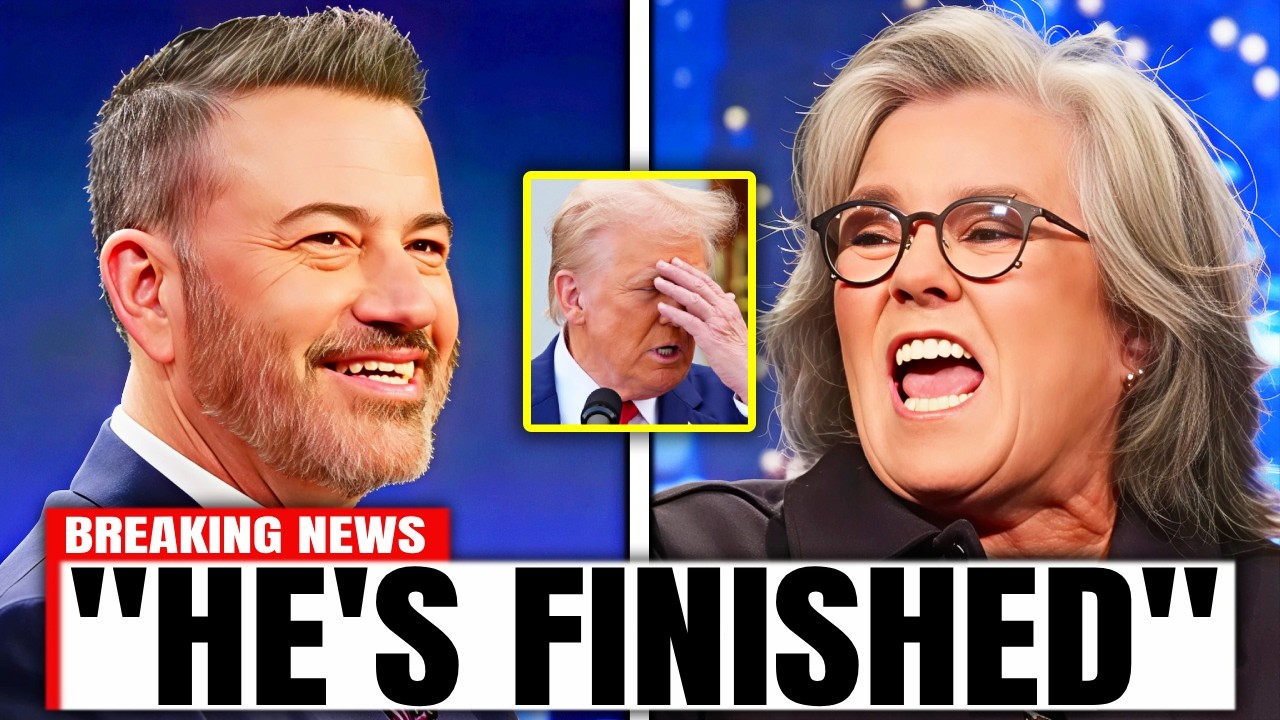
In an unusually charged moment for late-night television, Jimmy Kimmel and Rosie O’Donnell delivered a coordinated on-air critique of President Donald J. Trump this week, blending political commentary, satire, and long-standing personal history in a segment that quickly reverberated far beyond the studio. What began as a routine monologue on Jimmy Kimmel Live evolved into a pointed, sustained examination of the president’s public persona — a confrontation shaped as much by comedy as by the country’s increasingly polarized media environment.

The moment gained momentum almost instantly online. Clips of the exchange circulated across social media platforms overnight, aided by celebrity engagement, partisan reactions, and a sense — familiar throughout both of Mr. Trump’s presidencies — that entertainment and politics now operate on the same cultural wavelength. Observers of late-night programming noted that political humor has long been a staple, but the Kimmel–O’Donnell pairing introduced a distinctly personal dimension.
Mr. Kimmel opened the segment with the measured, teasing tone that has characterized much of his commentary on the White House. But the monologue sharpened as he described what he called the “cycles” of Mr. Trump’s public messaging: repeated grievances, revived disputes, and triumphs declared anew. Delivered with Kimmel’s signature dry smile, the lines drew laughter from the studio audience while signaling a shift toward more pointed criticism.
Ms. O’Donnell, joining Kimmel midway through, brought a markedly different energy. Her appearance carried symbolic weight: her highly public, two-decade feud with Mr. Trump remains one of the most enduring celebrity–politician clashes in American pop culture. On Kimmel’s stage, she referenced that history directly, describing herself as having “unwanted expertise” in recognizing the president’s rhetorical patterns. Her remarks — quick, sharp, and laced with exasperated humor — blended personal grievance with broader political critique.
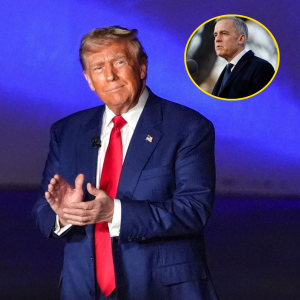
As a piece of entertainment, the segment was brisk, theatrical, and openly confrontational. As political commentary, it was blunt and unfiltered. And as a media event, it reflected the increasingly prominent role entertainers occupy in shaping national political narratives, especially during a presidency defined by its constant interplay with popular culture.
According to two individuals familiar with the president’s reaction — who requested anonymity because they were not authorized to speak publicly — Mr. Trump became aware of the segment shortly after it aired. One person described him as “irritated but unsurprised,” noting that late-night criticism has long been a source of frustration for him. Another, however, suggested the presence of Ms. O’Donnell lent the moment a personal edge, given their contentious history. Their rivalry, originating in the mid-2000s, has rarely remained dormant for long.
The White House did not respond to requests for comment.
Media scholars say the rapid spread of the exchange highlights an ongoing shift in how Americans consume political content: through late-night shows, podcasts, and digital clips rather than traditional news broadcasts. “Satirical spaces have become political spaces,” said a professor of media studies at the University of California, Los Angeles. “These segments blur the line between humor and political argument — and audiences often treat them as both.”
For Mr. Kimmel, the episode fits within a broader evolution. Although once focused largely on celebrity culture, his show has increasingly embraced political commentary in recent years, drawing audiences who expect a mix of humor and critique. His willingness to address the president directly — sometimes humorously, sometimes earnestly — has become a hallmark of his approach.
Ms. O’Donnell’s reemergence on a national broadcast stage — particularly alongside Mr. Kimmel — added intensity to the moment. While she no longer hosts a daily program, she remains an active online political voice, and her critiques of Mr. Trump have sustained a devoted following. Her appearance reignited that spark, prompting reactions across the political spectrum: supporters praised her candor, while critics accused the pair of veering into personal hostility.
Within hours, outlets across the ideological landscape reframed the exchange according to their preferred narratives, emphasizing either its comedic sharpness or its perceived antagonism. The speed and fervor of this response underscore a defining feature of the Trump era: political debate can be triggered not by press conferences or policy announcements, but by satirical segments delivered from a late-night stage.
Whether the Kimmel–O’Donnell exchange will meaningfully influence public sentiment remains unknown. But its rapid rise in the national conversation reflects a broader reality: in a fragmented media environment, late-night television remains one of the few cultural forums where political critique can still become a mainstream event.
On this occasion, two entertainers — united by history, sharpened by years of public sparring, and propelled by a polarized nation — delivered a critique that many viewers saw as unusually direct. It served as a reminder that in contemporary American politics, the boundaries between governing, media, and satire are not merely blurred. They are, increasingly, indistinguishable.