Trump Renews Calls for Jimmy Kimmel’s Firing as a Quiet On-Air Retort Escalates Their Long-Running Feud
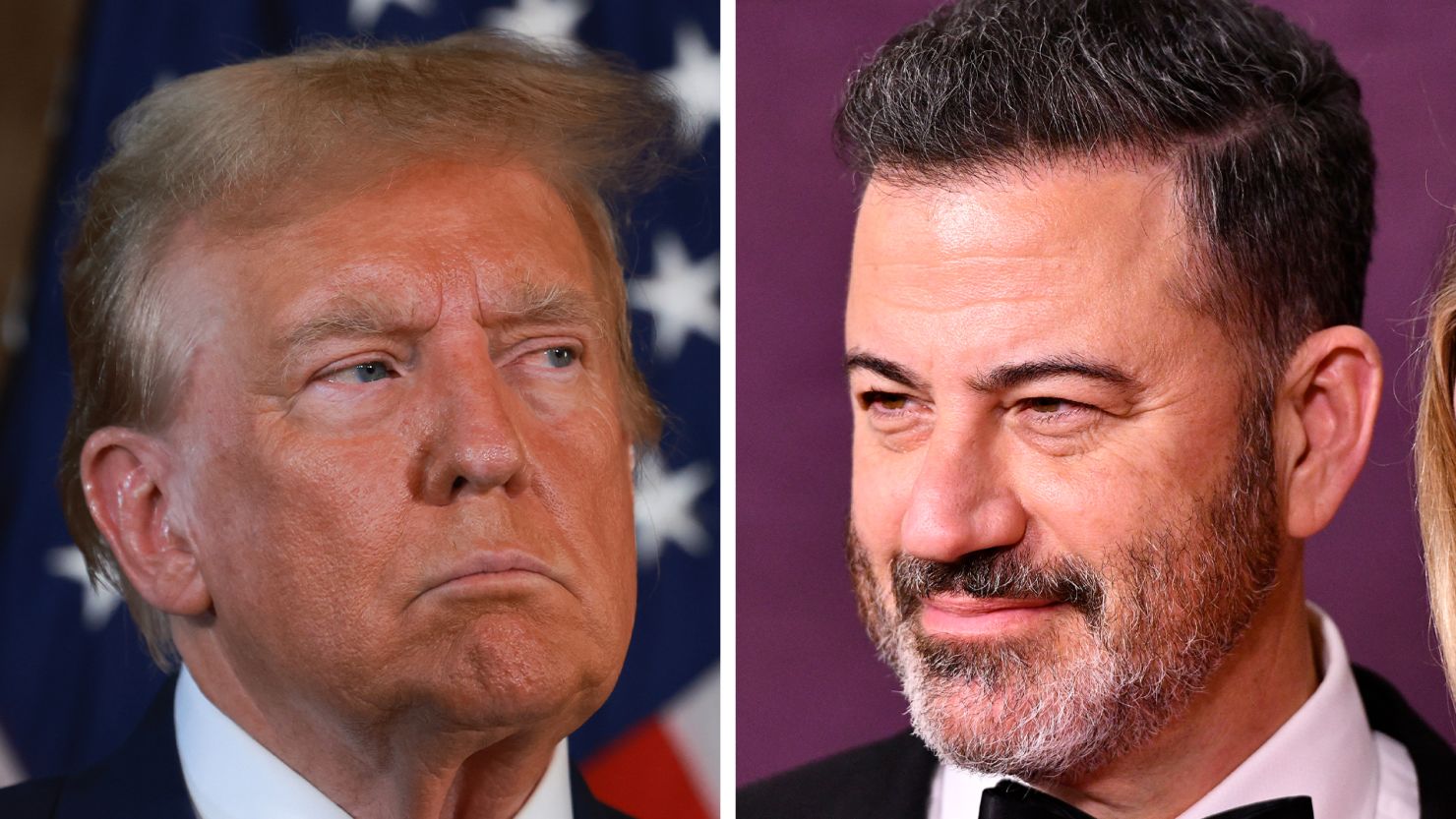
In another episode of a political–entertainment clash that has stretched across nearly a decade, former President Donald J. Trump once again called for ABC to dismiss late-night host Jimmy Kimmel — a demand that triggered a new wave of attention after Kimmel delivered what viewers described as a “quiet but devastating” response during his broadcast on Tuesday night.
The exchange marked the latest chapter in an increasingly personal rivalry between the former president and the comedian, whose monologues have frequently scrutinized Trump’s public statements, legal troubles and political ambitions. But this particular confrontation unfolded with a level of restraint unusual for late-night television, producing a moment that rapidly spread across social media and reignited a discussion about political power, media accountability and the boundaries of televised satire.
A Renewed Call, Familiar Rhetoric
Earlier in the day, Mr. Trump had posted a series of sharply worded criticisms targeting Mr. Kimmel, calling him “a disgrace to ABC,” “a failing late-night host,” and “a clown who should have been fired long ago.” The language, pointed yet familiar, reflected Trump’s long-practiced strategy of attacking media critics directly and publicly.

But the tone of this latest demand carried an additional edge. According to aides who spoke on the condition of anonymity to describe private conversations, Mr. Trump expressed frustration that his earlier criticisms of Mr. Kimmel had failed to generate the network response he expected. He reportedly urged advisers to “apply pressure” and explored ways to publicly escalate the dispute.
Within hours, the statements had already ricocheted through conservative media outlets, sparking commentary about the role of political bias in late-night programming. But it was Mr. Kimmel’s televised response — brief, understated, and unusually subdued — that transformed the moment from a predictable rhetorical flare-up into a national talking point.
A Quiet Line With Loud Impact
Mr. Kimmel addressed the controversy less than ten minutes into his opening monologue. After a short pause, delivered with the intentional patience of someone choosing each word carefully, he remarked:
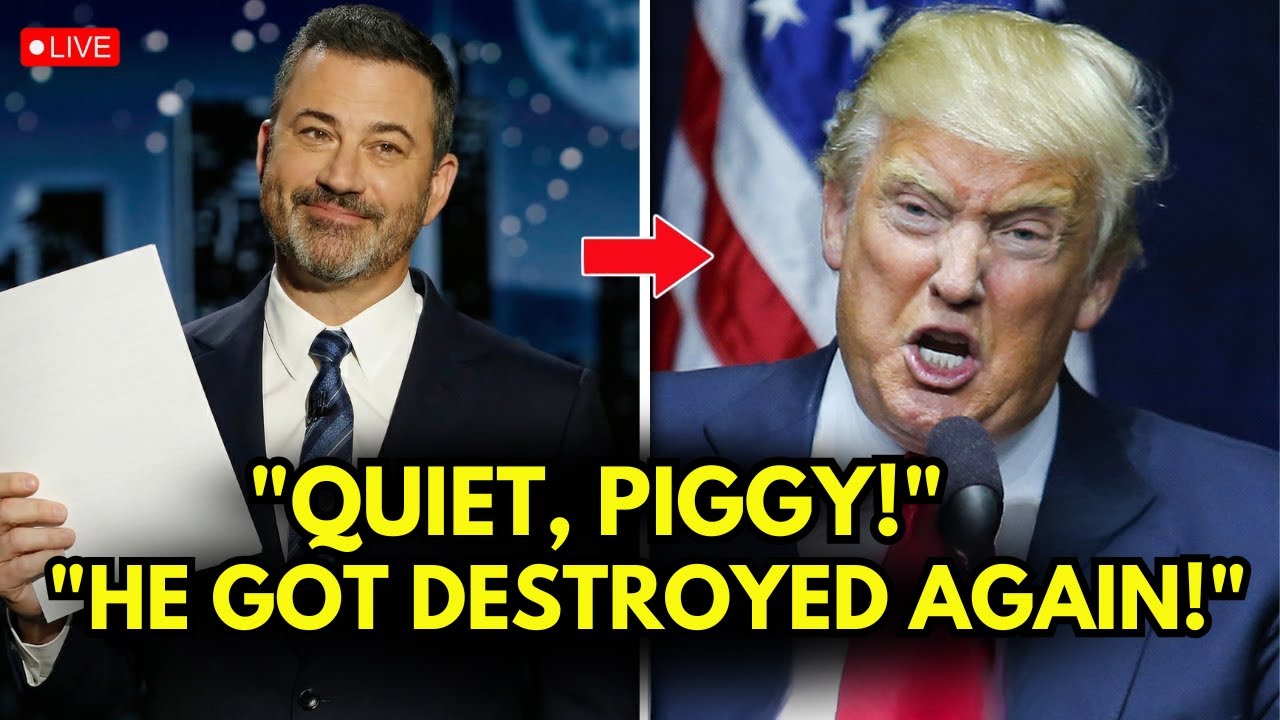
“If I’m a piggy, then someone’s been rolling in the mud far longer than I have.”
The audience broke into surprised laughter, but the host did not raise his voice, lean into a punchline, or extend the joke. Instead, he moved on to the next segment with calm precision, leaving the remark hanging in the air. It was the restraint — not the insult — that gave the moment its staying power.
Within minutes, clips of the remark circulated widely online. Political commentators across the spectrum noted that Mr. Kimmel had, in effect, inverted Mr. Trump’s rhetorical style by refusing to match his volume. “It was the kind of response that cuts deeper because it isn’t trying to,” one media scholar observed in a late-night panel discussion.
Fallout in Trump’s Orbit
Inside Mar-a-Lago, the reaction was reportedly immediate and intense. According to an adviser familiar with the former president’s mood, Mr. Trump was watching the broadcast live and “became visibly agitated.” He complained about the perceived disrespect, questioned why ABC had not imposed disciplinary action, and at one point instructed aides to draft a stronger public rebuttal.
“It wasn’t the joke,” the adviser said. “It was the fact that Kimmel sounded like he had already won.”
Though the account could not be independently verified, it aligns with a long pattern: Mr. Trump has historically shown sensitivity to televised criticism, particularly when it involves comedians whom he considers politically motivated adversaries.
A Clash Bigger Than Its Protagonists
The latest confrontation comes at a moment when the boundaries between political speech and entertainment commentary have blurred to an unprecedented degree. Mr. Kimmel, like many late-night hosts, has increasingly incorporated political material into his show, while Mr. Trump has continued to frame media criticism as evidence of systemic bias.
The tension, while often dramatic, reflects broader dynamics in American culture. Social media has amplified every slight, every retort, every satirical line, transforming relatively small on-air moments into national debates. And at a time when public trust in institutions remains fragile, confrontations between political leaders and entertainers carry symbolic weight far beyond the individuals involved.
The Viral Aftermath
By Wednesday morning, the clip of Mr. Kimmel’s remark had become the most-shared late-night segment of the week, drawing millions of views on platforms such as X, TikTok and Instagram. Supporters praised the comedian’s composure; critics accused him of hiding behind humor to deliver partisan commentary.
ABC did not issue a statement in response to Mr. Trump’s renewed call for Mr. Kimmel’s firing. Nor did Mr. Kimmel return to the subject on subsequent broadcasts, leaving the line — soft, brief, but unmistakably pointed — as his only public reaction.
For now, the conflict remains a familiar one: a former president seeking to exert influence over a cultural arena that has, for years, refused to align with him, and a comedian who appears increasingly determined to answer political volume with carefully measured quiet.