Amid a Firestorm of Backlash: Mike Johnson’s Fiery Condemnation of Bad Bunny’s Yankee Stadium Snub
In the charged atmosphere of American cultural politics, few moments capture the nation’s deepening divides like a celebrity’s quiet act of defiance. On October 8, 2025, during the seventh-inning stretch of a high-stakes New York Yankees playoff game against the Toronto Blue Jays, global superstar Bad Bunny—born Benito Antonio Martínez Ocasio—remained seated as the Yankee Stadium crowd rose in unison to sing “God Bless America.” The Puerto Rican reggaeton icon, clad in a green hat and surrounded by friends in the VIP section, became an instant lightning rod. Video footage showed the 31-year-old artist unmoving amid the patriotic swell, his posture a silent counterpoint to the thousands belting out Irving Berlin’s post-9/11 staple. What might have been dismissed as a personal choice erupted into a national firestorm, drawing direct fire from none other than House Speaker Mike Johnson.
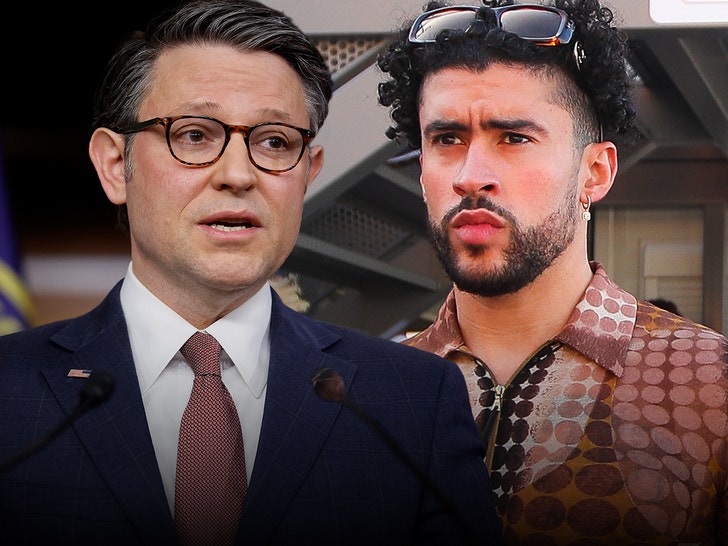
Johnson, the Louisiana Republican steering a fractious Congress through shutdown threats and midterm maneuvering, wasted no time linking Bad Bunny’s seating to broader grievances. In a blistering statement released via his official X account and amplified on Fox News that evening, the Speaker condemned the musician’s actions as “a blatant disrespect to the values that unite us as Americans.” “In a stadium filled with patriots honoring our nation’s sacrifices, Bad Bunny chose division over unity,” Johnson declared. “This isn’t just about a song—it’s about allegiance to the country that gave him a platform. Actions like these demand consequences, not celebration.” The Speaker went further, urging the NFL to “reconsider” Bad Bunny’s headlining slot for the Super Bowl LX halftime show in February 2026, suggesting “immediate punitive measures” such as barring the artist from future U.S. events or even reviewing his visa status through Immigration and Customs Enforcement (ICE). Johnson’s rhetoric echoed earlier conservative critiques of the NFL’s booking, which he had already labeled a “terrible decision” just days prior, proposing country singer Lee Greenwood—whose anthem “God Bless the U.S.A.” is a MAGA rally staple—as a more fitting replacement.
The backlash cascaded swiftly. Conservative pundits on platforms like Newsmax and OutKick piled on, framing Bad Bunny’s refusal to stand as a calculated protest akin to Colin Kaepernick’s NFL kneel-ins, but laced with “anti-American” undertones. “If he can’t stand for ‘God Bless America,’ he shouldn’t perform at the Super Bowl,” tweeted former NFL player Eric Dickerson, garnering over 50,000 likes. DHS Secretary Kristi Noem, already vocal about deploying ICE to the Super Bowl, amplified Johnson’s call: “We’ll be there to ensure real patriots prevail—no more coddling those who spit on our flag.” President Donald Trump, never one to miss a cultural fray, weighed in during a Mar-a-Lago press gaggle: “Bad Bunny? Sounds like a cartoon. If he hates America so much, stay in Puerto Rico. Mike’s right—punish the ingrates.” Hashtags like #BoycottBadBunny and #StandForAmerica trended nationwide, with streams of the artist’s music paradoxically spiking 20% on Spotify amid the outrage.

Yet, Johnson’s intervention wasn’t mere opportunism; it tapped into a simmering vein of resentment toward Bad Bunny’s unapologetic Latinx pride. The Super Bowl announcement on October 1 had already ignited fury: Bad Bunny pledged an all-Spanish performance, a historic nod to Latino influence in a league historically dominated by English-language acts. Critics decried it as “divisive,” ignoring the artist’s U.S. citizenship via Puerto Rico and his record-breaking feats—80 million monthly Spotify listeners, the most-streamed album ever with Un Verano Sin Ti. Johnson’s Yankees rebuke escalated this, portraying the seating as emblematic of “woke elitism” infiltrating sports. “We can’t let celebrities erode our traditions,” he thundered in a Capitol Hill briefing, linking it to broader fights over immigration and cultural assimilation ahead of the 2026 midterms.
Defenders, however, saw Johnson’s salvo as the real affront. Latino advocacy groups like UnidosUS blasted it as “xenophobic fearmongering,” arguing that “God Bless America”—not the official national anthem—carries no legal mandate to stand, protected by First Amendment freedoms. Fellow Puerto Rican artist Residente tweeted solidarity: “Bad Bunny stands for us—Puerto Rico, immigrants, the marginalized. Johnson’s the one dividing, not Benito.” On SNL’s October 4 episode, where Bad Bunny hosted, he skewered the controversy in his monologue: “Fox News loves me now? Great—tell Mike Johnson I’ll teach him Spanish for the Super Bowl. Or does ‘God Bless America’ come with subtitles?” The quip drew roars from the Studio 8H crowd and boosted his X followers by 100,000 overnight.

This clash underscores America’s cultural fault lines: patriotism versus pluralism, tradition versus transformation. Bad Bunny, whose lyrics often champion queer rights and anti-colonialism, embodies a borderless youth culture that terrifies Johnson’s base. By invoking “punishment,” the Speaker risks alienating Latino voters—now 19% of the electorate—potentially costing Republicans in swing states like Florida and Arizona. Polls from Pew Research show 62% of Hispanics view such rhetoric as discriminatory, fueling turnout for Democrats.
As the playoffs rage on and Super Bowl hype builds, Bad Bunny’s silence speaks volumes. No direct response to Johnson yet, but his actions—from seating to SNL jabs—signal resilience. In a nation grappling with identity, this “firestorm” isn’t cooling; it’s forging a new battleground where music meets might. Will the NFL buckle under pressure, or will Bad Bunny’s halftime become a defiant symphony of Spanish swagger? One thing’s clear: Mike Johnson’s call-out has turned a stadium seat into a seat of power, reminding us that in 2025 America, even sitting still can shake the foundations.